

Rebuilding Afghanistan: A Field Trip
“Think of Afghanistan and a plethora of images whiz past the mind’s eye .
- Poonam Mann
- July 2005
South Asia is one of the main areas of research focus at MP-IDSA. The region has been going through a period of turmoil over the last few years. Definitive steps have been taken in the recent past towards the establishment of democratic governments in the region. Given the importance of developments in the region for Indian security, experts at MP-IDSA keenly watch and analyse unfolding developments in each South Asian country.
Two projects that are currently under progress are ‘Developments in Pakistan’ and ‘Pakistan Occupied Kashmir’. In addition, individual scholars are engaged in researching various security-related aspects pertaining to South Asian countries. The Centre has established bilateral institutional relations with leading think tanks in the region and proposes to undertake joint studies.






No posts of Books and Monograph.
“Think of Afghanistan and a plethora of images whiz past the mind’s eye .
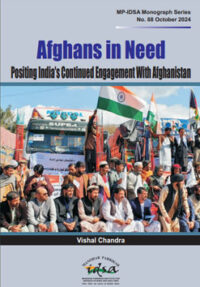
The Afghan war is far from over. With the political process that began in December 2001 having completed three years, it is pertinent to revisit and examine the course of the post-Taliban Afghan politics. Afghanistan’s attempt to move towards peace and democracy has been perilous and remains so. The ouster of the Taliban and subsequent signing of the Bonn Agreement at the end of 2001 marked yet another turning point in the long-drawn Afghan conundrum.
Four times since Pakistan’s creation, the Baloch, who never wanted to be part of Pakistan, have rebelled, demanding autonomy or an independent state. After three decades, Balochistan is in turmoil again; the Baloch rebels have been targeting the government institutions with impunity. The insurgents appear well versed in military craft as well as appear to be flush with arms and ammunition. An insurgency of this magnitude cannot be sustained without any external assistance. This paper attempts to analyse the foreign hand in Balochistan.
The paper seeks to study the challenges faced by the Pakistani state from the perspective of its vast ethno-cultural diversity which problematises the process of-nation building attempted by the Pakistani leadership since its very inception. The paper starts with a rudimentary definitional view of the concept of ethnicity and nationalism, and isolates the areas of friction in the way the Pakistani nation has been conceptualised and the way diverse ethno-cultural groups have evolved their identity through history
Pakistan seems to have realised that with the silting of Tarbela Dam (it has lost more than 30 per cent of its storage capacity), it needs to build at least one, if not two, mega dams on the Indus at the earliest. President Musharraf has made an impassioned plea for the construction of new reservoirs and canals to ensure sustainable agricultural development
On March 1, 2005, Afghan President Hamid Karzai appointed Uzbek militia commander Abdul Rashid Dostum as Chief-of-Staff to the Commander-in-Chief of the Afghan armed forces – a post which he holds.1
Iran-Pakistan relations have had a distinct characteristic over the past five decades and Islamabad’s clandestine transfer of nuclear technology and materials to Iran underlines its significance. Political and strategic imperatives have formed the basis of their close relationship despite divergence of interests and political outlook on regional and global issues. Both the countries have tried to reconcile the differences and consolidate their ties.
Afghanistan once represented a fragmented and failed socio-economic and political entity. Operation Enduring Freedom, while targeting the Taliban and Al Qaida as part of the global war on terrorism helped create the structure of a new Afghan State. This article analyses the challenges faced by Afghanistan and how the new Afghan elite and its foreign supporters seek to address them through constitutional means. The New Constitution provides the framework of how Afghanistan wishes to reconstruct the new State.
Disruption of terrorist networks - intra-regional, inter-regional and trans-national - should be supplementary to the overall counterterrorism strategy. Larger issues including socio-economic and cultural can only be addressed in the long-term. The immediate goal, however, has to be an effective localised response. Otherwise, efforts like Bhutan’s counter-terrorism operations against ULFA, NDFB and KLO - popularly called ‘Operation All Clear’- may only have a partial impact.
The uncertainties regarding regular SAARC meetings have clouded the prospect of regional cooperation. Though India has been accused as the main culprit, other member-countries are no less responsible for the organisation’s lack of progress.
If the Pakistan Army fails to conclusively eliminate the scourge in the north-west, it will soon reach Punjab, which has been relatively free of major incidents of violence.
The Peshawar school massacre does not appear to be a simple tit-for-tat game; it has an intricate link to the Afghan endgame in which Pakistan wants to be the victor.
It will be in India`s interest to adopt a neutral posture vis-à-vis the contestants in the January 2015 Sri Lankan Presidential elections.
If the Sinhala opposition parties, the Tamil TNA, and the Muslim parties support the common candidate, there is a possibility that they may be able to defeat Mahinda Rajapaksa. But will these political forces come together?
The time has perhaps come to restructure, even partition, SAARC to make it more effective. This is something that might also be required to be done in the likely event that Pakistan fosters the Taliban in Afghanistan.
The Wagah incident is not going to wake-up Pakistan to the existential threat posed by jihadist terror groups. There is neither going to be any change in its attitude towards using terrorism as an instrument of state policy, nor its inimical attitude towards India.
The recent heavy firing by the Pakistani army is to gain public sympathy and providing it greater flexibility in the flawed civil-military relations. It is an orchestrated plan to provoke India believing that it can take such a risk of escalation in the back drop of its effective nuclear capability.
Given that the onus for settling the border disputes with Nepal and Bangladesh is on India, the Indian government has to demonstrate political wisdom in evolving political framework that would satisfy the national interests of both India and Nepal as well as win over the domestic opposition to the LBA.
If Nawaz Sharif now plays his cards well - improves governance, makes his politics more responsive and inclusive, reaches out to opposition and his constituency, doesn’t remain aloof and keeps the parliament and political parties as his back – he could well change the power equations for good.
In the short-term India needs to let the internal situation within Pakistan play itself out and see what emerges from the standoff. There is no doubt that Pakistan will have to be engaged but terms and manner will be dictated by the prevailing political and economic scenario in India, Afghanistan and the region including India-China relations.





