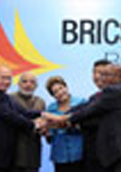
Modi would find the Eurasian dynamics at odds with his vision of containing China along with the United States. He will have to display pragmatism for building greater convergence with China and Russia.
The Declaration pushes for a more equitable norm and the New Development Bank is an interesting outcome. The initial subscribed capital of $50 billion dollars and the responsibilities of the functioning are to be shared equally among the founding members of the bank. While China will host the headquarters, the regional centre will be located in South Africa; similarly the first President of the Bank will be from India, the First Board of Governors from Russia and the first chair of Board of Directors from Brazil.
Brazil will hold the 6th BRICS Summit of Heads of State and the Governments of BRICS from 15 July 2014 to 16 July 2014. It is a coalition of emerging economies providing alternative ideas of global governance.
It would not be a cliche to describe the strategic contours of Asia as being at the crossroads of history. A number of significant events are influencing the likely course that the collective destiny of the region could possibly take in the future. Some of the key issues and trends have been analysed in this year’s Asian Strategic Review
With the successful holding of the fifth summit of Brazil, Russia, India, China and South Africa (BRICS) in Durban during March 26–27, 2013, this influential group of emerging economies completed its first important phase of genesis and evolution. The idea was floated in 2001 as an ‘acronym’ created by an investment banker of Goldman Sachs, Jim O'Neil who believed that the fast-growing economies of Brazil, Russia, China and India would be the single greatest game changers in coming times.
BRICS is not challenging the existing world order. It is seeking a place in the sun for developing countries. It is looking at alternative approaches but there is no desire to seek confrontation with the West.
Now that NAM is defunct and very little wealth is left in the Commonwealth, and given that the G-20 has a set parameter and doesn’t encompass the aggregate of the hopes and aspirations of the developing world, India should use the BRICS forum to project its global profile.
If the BRICS Development Bank comes up, it will not only be a big moment for BRICS itself, but also for the global financial structure where the role, stake and space of the developing world will grow massively.
With economic growth and the political centre of gravity continuing to shift, BRICS already have a major role in dealing with transnational challenges, with power sharing institutionalised in the international architecture through the G20.