India–Australia Relations on the Upswing
India and Australia need to take a leadership role in maritime security affairs in the two oceans and have deeper engagements with the Pacific and Indian Ocean island countries.
- R.P. Singh
- April 26, 2022
India and Australia need to take a leadership role in maritime security affairs in the two oceans and have deeper engagements with the Pacific and Indian Ocean island countries.
Ensuring maritime security and freedom of navigation in the Indian Ocean and the wider Indo-Pacific region is key security imperative and one of the key objectives of India’s engagement with the US and other partners.
Colombo Security Conclave, a maritime security oriented sub-regional grouping, is emerging as a promising platform through which India can demonstrate its commitment and credibility for becoming the ‘Preferred Security Partner’ for the smaller nations in the Indian Ocean Region.
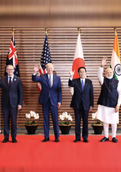
The recent Joint Statement issued after the Quad Foreign Ministers’ meeting in Melbourne indicates the grouping’s drive towards institutionalisation and coming close to achieving a concrete mandate for its existence.
The Indo-Pacific construct has significantly enhanced the strategic salience of both India and Australia in a multipolar region. While the two nations have considerably deepened their strategic partnership, there is scope for much more improvement in several sectors.
The recent visit of the Chief of US Naval Operations, Admiral Michael Gilday to India is not only significant to the national security narrative of India and the US but it is also bound to have a profound impact on the geopolitics of the Indo-Pacific region.
The future of the Quadrilateral Security Dialogue (Quad) will depend on the choices that China makes.
The Indian Ocean Region (IOR) is a prominent arena in international politics, in terms of trade, tourism, population, among other aspects. Several countries, some unconnected geographically, have shown interest in these waters. These entities offer financial, technical, infrastructural and capacity-building support, and security services to several IOR countries. India, the prominent resident power of this ocean, and others, consider this development unnecessary, uncalled for and unacceptable.
It would have been difficult to visualise the current scenario in Sino-Indian relations just before COVID-19 overtook the world narrative. This was considering the immense political capital poured into the relationship by the Indian government, first at Wuhan in 2017 and then in Mamallapuram in 2019. It might be argued by some that the Doklam incident of 2017 should have been enough for India to wake up and smell the coffee.
Considering the wide expanse to be covered on both sides of the Indian Peninsula, and the possibility of concurrent operations on either side, it is imperative that India maintains an operational carrier battle group on both sides, and at all times.