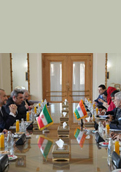
Jaishankar’s visit is a timely reminder that India’s partnership stands on its own, and Indian interests demand more rather than less engagement with Tehran.
The Indian Navy can be expected to continue to use its significant deterrent and punitive capabilities to protect the sea lanes of communications in the Western Indian Ocean.
The India-Russia partnership is longstanding and time-tested, one of steadiest of the major relationships in the world. Although the relations between the two countries have remained exceptionally warm and cordial,...
Publisher: Shipra The growing interest of nations in the ocean-realm has become discernable in recent years, leading to an increased significance of maritime security. This is particularly relevant to India,...
Publisher: Magnum Books Pvt Ltd Maritime security has increasingly been studied from the standpoint of the complexities of the ocean—where the ‘game’ has been played since ancient days. In recent...
Publisher: Norwegian Institute for Defence Studies International Order at Sea is a workshop series chaired by the Norwegian Institute for Defence Studies (IFS) in partnership with the Institute for Defence...
Publisher: Pentagon Press This book offers wide ranging divergent perspectives on India's role in managing and shaping Asian Security. The book offers important ideas on how Asian security will shape...
The ADMM-Plus offers India and ASEAN opportunities to develop practical collaboration on security issues ranging from terrorism, maritime threats and other non-traditional threats.
The impending removal of the piracy High Risk Area off the coast of Somalia presents an ideal opportunity for India, in partnership with the wider Indo-Pacific maritime community, to delegitimise...