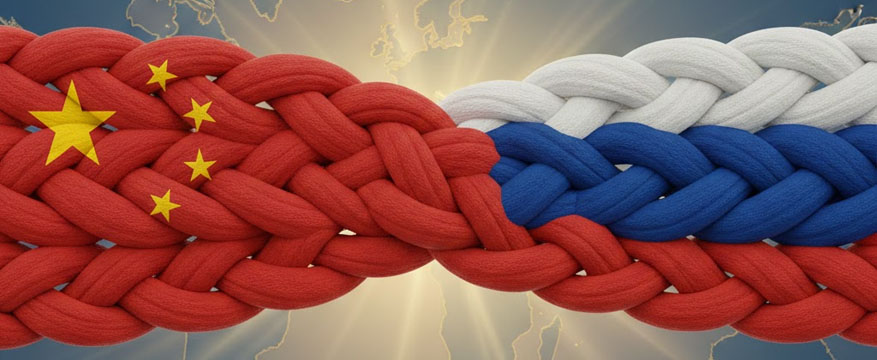
While China’s growing strategic cooperation with Russia is increasingly evident, historical and geopolitical issues still pose challenges to more coordinated collaboration.
The Ukraine crisis, shifting geopolitical alliances in the Indo-Pacific and Western-imposed economic sanctions on Russia have strengthened China–Russia cooperation in the Arctic.
The Central Asian region with its five post-Soviet republics is geopolitically important for its proximity to Afghanistan, West Asia, China, Russia and the Caucasus. These republics have been wooed by...
Even as China has emerged as one of Russia’s pillars to tackle the perceived Western threat, it is unlikely that their ongoing entente will morph into a military alliance.
The article discusses if China will be inspired by its strategic partner Russia to use force as an instrument of its foreign policy. After a pro et con discussion the...
This article discusses the type of partnership Russia pursues towards China in the Arctic. Through evidence, the author finds that while Russia may be aiming for an overall strategic partnership,...
The reasons for abstention go far beyond the immediate issue at hand and are enveloped in deep Chinese strategic interests. The Chinese leadership is adamant that there can be no...
This issue brief looks at the growing China-Russia relationship in the backdrop of a volatile North East Asia and the US ‘rebalancing’ to Asia –Pacific. While China-Russia relations have not...
In addition to their alternative vision on political issues, the RIC Foreign Ministers’ meet is gradually expanding trilateral cooperation in several sectors, including disaster relief, agriculture and public health.
Overthrowing Bashar is likely to result in an Islamist regime, which might turn out to be far worse for the country’s Kurdish, Christian, Druze and Armenian minorities.