In the wake of the resolution of several contentious issues, India and Bangladesh must cooperate to create a border that not only enhances trade efficiency but is also secure.
India shares 4095 kilometres of land and river boundaries with Bangladesh. The border is porous, criss-crossed by rivers and hilly and mountainous terrain which has made the guarding of this border extremely difficult. Border is a political construction. People living in the villages adjacent to the border do not subscribe to any concept of nationality or recognise the boundaries of the nation state. For the people living in the ‘borderlands’, a non-existent line bars them from leading the natural existence they have led for centuries.
Migration, a worldwide phenomenon, has often been seen as beneficial for both the sending and receiving countries. However, post-9/11, the phenomenon is seen as a mixed blessing. It is also being realised that it is impossible to check illegal migration unless the sending country cooperates. In South Asia, India has been at the receiving end of the problem of illegal immigration from Bangladesh. This paper argues that such illegal migration is posing a threat to internal security because the issue has not been properly securitised.
Security has been a major driving force of India's neighbourhood policy. India's sympathies with democratic forces and its aversion to extra-regional presence are all geared to optimise its security interest, which is ensconced in its principal belief of a stable neighbourhood while engaging in a mutually beneficial relationship. Within this broad framework, this paper attempts to study Bangladesh's reaction to these parameters of India's neighbourhood policy.
With a friendly dispensation in Dhaka, it is an opportune moment for India to deliver on its promise to exchange the enclaves and surrender adverse possessions.
The Bay of Bengal is the largest bay off the coast of Bangladesh, India, Myanmar and Sri Lanka. With the exception of Bangladesh all the littoral states have reached agreements over their bilateral maritime boundaries. As signatories to the UN Convention on the Law of the Sea, India and Myanmar had to file their claims by June 29, 2009 and by May 21, 2009 respectively, and Bangladesh has to file its claim by July 27, 2011 to the Commission on the limits of the continental shelf.
After a hiatus, relations between India and Bangladesh are back on track again. This period was ushered in with the Awami League government assuming power in Dhaka after the culmination of the much delayed ninth Jatiya Sangsad elections. The bilateral relations received a further boost with Bangladeshi Prime Minister Sheikh Hasina's four-day visit to India on January 10, 2010. It was breakthrough visit for a number of reasons.
If the growth of Islamic extremism and terrorism in Bangladesh is a threat to Indian security, then the presence of China with which India’s interests have the potential to clash is also of security concern.
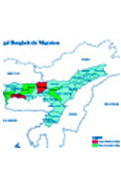
The issue of Bangladeshi illegal migration has troubled the state of Assam for decades now. Assamese political and social discourses fear that this unchecked migration from across the border will subvert their way of life and change the demographic profile of the state in the near future.
Bangladeshi Prime Minister Sheikh Hasina is visiting India on January 10, 2009. Both India and Bangladesh are looking foward to resolving some of the key bilateral issues. In the light of the new political climate in Bangladesh ever since Sheikh Hasina returned to power, what are the options for India?