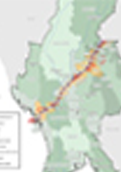
Tamanthi Hydel Project: India’s Eastern Foothold
Building dams like the Tamanthi represent India’s attempt to enhance strategic ties with Myanmar, which is seen as India’s gateway to the ASEAN.
- Shivananda H
- 2025 |
- IDSA Comments
- |
Building dams like the Tamanthi represent India’s attempt to enhance strategic ties with Myanmar, which is seen as India’s gateway to the ASEAN.
The increasing debate after the Fukushima crisis has undermined the recent renaissance of nuclear power and is likely to usher in greater regulation and stringent safety measures, making alternative sources of energy cheaper and therefore more appealing.
The Summit was part of Russia’s ongoing initiatives to play a greater role in stabilising the region before the expected withdrawal of American troops from Afghanistan.
Because an FTA would raise issues like market access, elimination of tariffs, quantitative restrictions etc., negotiations are likely to drag on for several rounds
Given lack of training, combat exposure and expertise in use of weapons, SPOs are unlikely to be effective even in the defensive line of action.
China’s response to the killing of Osama bin Laden has been cautious and marked by a degree of nuance given potential changes in US ties with Pakistan and India.
While energy interests and the promotion of One-China Policy are the main drivers of Chinese aid, the white paper can also be read as a projection of China’s new position in the international order.
If the TAPI pipeline does see the light of day, it will be due to US support and its larger political and strategic considerations.
This article deals with two questions: first, what is the security framework in which an Indian decision-maker must operate? Secondly, what are the specific policy restraints which affect Indian decision-making? Both these questions are cast in terms of Indian nuclear policy and it is assumed that the actual existence of a conventional Indian military deterrent against China and Pakistan is a ‘given’ in the present military and political equation in South Asian politics. The argument of this paper centres on the problem of defining ‘security’.
The responses to the arguments that I forwarded in my initial essay, ‘China in SAARC? To What Effect?’, have introduced interesting dimensions to this debate. While most of the respondents have agreed with my proposition that it is premature to think about China's entry into the South Asian regionalist project and that it would introduce complex challenges that would be difficult to manage, they disagree with some of the reasons that I have cited.