The Centre focuses on issues that challenge India’s internal security. Secessionist movements based on ethnic identities in the Northeast and Jammu & Kashmir have been contesting the Indian state through violent means for decades. The Left Wing Extremism movement based on Marxist-Leninist ideology is engaged in a struggle to overthrow the democratic structure of the Indian state. Intermittent terrorist attacks perpetrated by foreign and home grown terrorist groups have been disrupting peace and political order in the country. Infiltration, illegal migration, and trafficking of arms and narcotics are not only breaching the country’s international borders but are also aggravating its security situation. The research efforts of the Centre are focused on analysing the trends, patterns, causes, and implications of these threats and challenges, and suggesting policy alternatives. The Centre’s research agenda includes: left wing extremism, insurgencies in the Northeast India, cross border terrorism and militancy in Jammu and Kashmir, global and national trends in terrorism, management of India’s international borders and security of its coasts.
The Centre also undertakes various projects entrusted by the Ministry of Home Affairs and the National Security Council Secretariat on matters internal security. The Centre has a mix of civilian scholars and officers deputed from the armed forces and central armed police forces.
The Centre has a bilateral agreement to collaborate with the Border Security Forces’ Institute for Border Management and Strategic Studies.
The raging controversy on social media regulation post the violence in Assam has left the government in a losing perception battle. It is time to engage with the new media and exploit its potential to communicate strategically and not shoot the messenger
The need of the hour is to activate a clean and transparent record keeping of land by the state so that violence based on the fear of outsiders forcibly taking away the most precious commodity, land, can be effectively averted.
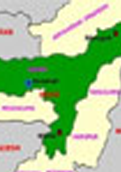
The ongoing violence between the Bodos and the minority Muslim community is a result of increasing tensions over issues of land grab and illegal migration
Without rooting out the parallel structures of an illegitimate economy and violence existing in Nagaland, efforts undertaken by Naga civil society to bring about peaceful reconciliation would only deliver sub-optimal results.
There is much scope for imaginative thinking on the desirability, compatibility of goals and feasibility of the political, cultural and socio-economic components of the new compact as suggested by the Interlocutors.
It is important that the ULFA talks do not get enmeshed on issues that create divisions, counter-claims and result in lack of consensus leading to a locked positional dialogue with no resolution in sight.
There are fears that the NSCN (Khaplang) and NSCN (Khole and Kitovi) will clash violently in big towns like Dimapur and districts like Mon for turf control since both outfits inhabit the same territorial space.
Given the urgent need to build strategic roads along the India-China border, the Ministry of Home has sanctioned Rs.1,934 crore for strategic road projects of about 804 kms.
Repeated acts of targeting infrastructure speak of Maoist intentions: paralyse normal life, sabotage economic activity, dictate terms and allow life and economic activity only on their “terms and conditions.”
All Indian Missions abroad need to closely monitor international communist groups to counter the propaganda campaign that they unleash from time to time and refute their false claims.