Foreign Policy

Difficulties of Regional Cooperation for Afghanistan: An Alternative Interpretation

This article addresses the question of why regional cooperation among Afghanistan’s neighbours has been so difficult despite these countries’ common concerns. To answer this question, Afghanistan is conceptualised as placed at the core of overlapping regions: South Asia, the Middle East, Central Asia and, through China’s influence, East Asia. Over the past decade, interactions among different regions ‘through’ Afghanistan have increased, and overlap has intensified.

India’s ‘Strategic Autonomy’ and the Club Model of Global Governance: Why the Indian BRICS Engagement Warrants a Less Ambiguous Foreign Policy Doctrine

India’s global policy strategy is on the verge of major changes. Non-alignment as a cornerstone of foreign policy has become outdated given the power shifts in a multipolar world, especially through the emergence of BRICS (Brazil, Russia, India, China, South Africa), which has put India in the position of being perceived as a potential new global player.

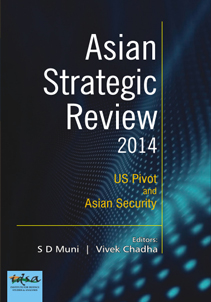
Asian Strategic Review 2014: US Pivot and Asian Security

  • Publisher: Pentagon Press

The “Pivot to Asia” strategy qualifies to be called Obama Doctrine: a part of Obama’s “grand strategy”. This policy may radically redefine not only the US engagement with Asia but also the Asian strategic dynamics. This book looks at various facets of the pivot strategy, to include US, Chinese, regional and country specific perspectives with an aim of providing greater clarity and understanding.

  • ISBN 978-81-8274-769-2,
  • Price: ₹ 995/-
  • E-copy available