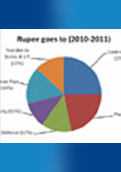
While India’s latest defence budget has no doubt catered for a sizeable capital component, it may be prudent to reduce costs by switching to more affordable programmes.
India's raised its defence budget for 2010-11 by 3.98 per cent to Rs. 1,47,377 crore. This allocation represents 2.12 per cent of gross domestic product (GDP), which is below the global average of 2.5 per cent. Considering the void in defence preparedness and the rising military expenditure and capability in neighbourhood, India needs to increase its defence spending to around 2.5-3.0 per cent of GDP. However, the increase in allocation has to go with reforms in capital acquisition system, which in present form is unable to spend the allocated resources.
The Indian armed forces appear to be driving defence budgets rather than a cold calculation of the country’s desire for ‘adequate’ military capability.
Adequacy or inadequacy of defence allocation largely lies in the manner it is spent keeping in view the defence requirements for meeting operational and strategic goals and to have the needed defence preparedness to deal with threats.
Given that allocations for revenue expenditure are likely to become lesser in coming years, defence managers need to initiate immediate measures to control the rising revenue expenditure.
If the Finance Ministry’s emphasis on fiscal prudence and inclusive growth has resulted in a smaller increase in the latest defence budget, the Report of the Thirteenth Finance Commission does not paint a very optimistic scenario for India’s future defence spending.
The orientation of the existing administrative set up in Service Headquarters and in departments under the Ministry of Defence is to plan for the utilization of defence budget allocation. They are not in a position to pay attention to the aspect of defence receipts.
The defence budget for the financial year 2009-2010, even though in terms of percentage increase appears large, yet it is not actually so. There has generally been a mismatch between the funds asked by the MOD and those allotted by the MOF. The absence of indication of likely availability of funds impacts adversely the defence planning process. Of late, there has been improvement in the ratio of revenue to capital expenditure, but for a healthy ratio there is a need to increase the defence budget as a percentage of the GDP.
India has established eight Defence Public Sector Undertakings (DPSUs) whose responsibility is to provide the Armed Forces state-of-the-art equipments and at the same time enhance country's self-reliance in defence production. However the performance of these Undertakings is not up to the mark, resulting in import of arms worth billions of dollars every year. A deeper insight into DPSUs' production profile reveals that most of them are over-dependent on external sources for the production needs, and have a very low labour productivity level, negligible export, and a low R&D base.
The present global economic crisis has slowed down the growth of the Indian economy, affecting among others, the fiscal situation and the revenue mobilisation potential of the central government. Defence being one of the largest recipients of central government expenditure, the present crisis casts a doubt on the adequacy of future resources. This commentary discusses some major options that India’s Ministry of Defence needs to consider in order to withstand the likely resource constraints in the coming years.