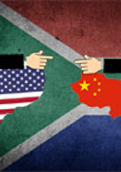
The recent spate of violence in South Africa appears to be rooted in the country’s failure to fully transform itself in the post-apartheid era. If the government fails to effectively...
Existing concepts (e.g. ‘non-interference’ and ‘pragmatism’) remain too vague to provide explanations for China’s increasingly assertive security policy. To avoid this pitfall, this article adopts a narrower focus on Chinese...
China's Belt and Road Initiative helps African countries in reducing the infrastructure gap in the region. However, it also leaves them open to the risk of unsustainable debt.
Facing huge political and security challenges in the Arabian Peninsula, Saudi Arabia now looks westward to the Red Sea and the Gulf of Aden coast for a new regional security...
As the digital infrastructure backed by China becomes increasingly prevalent in the African continent, it is also important for the latter to have enough oversight to ensure that these tools...
With John Bolton conceding that the US has limited resources to compete with the tens of billions of dollars that China is pouring into Africa, it is not clear how...
Prime Minister Narendra Modi’s recent tour of Rwanda, Uganda and South Africa increased to 26 the number of African countries visited by very senior leaders, thus contributing to a significant...
An increased level of engagement of the G20 with Africa could be significant as it could activate the existing G20 initiatives. It is also significant because it proposes to venture...
The media, visual and means of mass communication have often been criticised for presenting a biased and skewed viewpoint on the conflict. However, the power of documentaries like the Ghosts...
In many ways Turkey is reviving its historic relations with Africa with an eye to strengthen economic ties and gain strategic depth, but for some this is a reminder of...