The Doomsday Clock and Existential Risks
- March 18, 2026 |
- Backgrounder
Summary
The Doomsday Clock seeks to capture the severity of the existential threats facing humankind, as understood by the Bulletin of the Atomic Scientists. While initially focused on nuclear weapon dangers, in recent years, threat vectors have shifted to include climate change, emerging disruptive technologies like AI, and biological risks.
Introduction
On 27 January 2026, the Doomsday Clock struck 85 seconds to midnight, the closest it has ever been to Doomsday. The Clock, developed by the Bulletin of the Atomic Scientists (The Bulletin), serves as an influential metaphor for humanity’s proximity to global catastrophe. Originally conceived amid the dawn of the atomic age to convey the urgency of nuclear apocalypse, the Clock has evolved over the years to reflect the challenges of the time. Each adjustment to the clock’s position is accompanied by an official statement from the Bulletin outlining the rationale for the decision. The 2026 statement[i] noted that the existential risks associated with the nuclear arms race, climate crises, misuse of biotechnology, and artificial intelligence (AI) shape the Bulletin’s global threat perception.
85 Seconds to Midnight
According to the Bulletin, the continuation of the Russia–Ukraine war and the emergence of new theatres of armed conflicts in 2025 intensified global nuclear risks. Several other developments, such as the consistent modernisation of nuclear weapons arsenals and delivery systems of Russia, China and the US,[ii] as well as the possibility of a European deterrent[iii] outside of the US nuclear umbrella, further prompted this shift in the clock. As the Bulletin noted on 27 January 2026, New START was nearing its expiration. By 5 February 2026, the treaty formally lapsed, thereby removing any legally binding limits on the strategic nuclear weapons of the US and Russia. The erosion of the nuclear arms control regime was also cited as a key factor in bringing the clock closest ever to midnight.
Risks associated with climate change also played a decisive role in the clock’s movement. The Bulletin cited the rise in sea levels due to glacial melt, intensifying fatal heatwaves worldwide, increasing global temperatures to up to 150 per cent of pre-industrial levels, and the limited effectiveness of the UN Climate Summits in achieving their stated objectives as key reasons for categorising climate change as an existential threat.
The Bulletin’s statement particularly emphasised the human toll of heatwaves in Europe and the displacement caused by severe floods in the Democratic Republic of the Congo (DRC). However, notably absent from the analysis was any mention of extreme weather events across Asia,[iv] Latin America, the Caribbean,[v] and Australia[vi].
The Bulletin further mapped the existential risks posed by biological threats and disruptive technologies. Advances in the life sciences and the application of Large Language Models (LLMs) in biological design have increased the potential for misuse of biotechnology. The lack of legally binding safeguards on biological research under the Biological Weapons Convention (BWC), coupled with the ambiguous status of the biological programmes of countries like China, was cited as a factor amplifying the threats posed by biological toxins.[vii] A substantial portion of the statement, however, focused on the challenges within the US public health infrastructure.
The fourth determinant parameter, which brought the clock to 85 seconds to midnight, is the existential impact of disruptive technologies. The Bulletin delineates that without a governance infrastructure in place, the application of AI models in nuclear command-and-control systems and the deployment of weapons could have detrimental impacts on global security. Emerging disruptive technologies have also revived concerns about a new arms race, as indicated by US President Donald Trump’s proposal to develop a ‘Golden Dome’ missile defence system[viii] with space-based interceptors for Intercontinental Ballistic Missiles (ICBMs).
Origin and Historical Context
The Bulletin of the Atomic Scientists, co-founded by Dr Eugene Rabinowitch and Dr Hyman Goldsmith in 1945, provides a forum for dialogue on the implications of atomic energy within the US and internationally. It was founded post-Hiroshima, at the insistence of Manhattan Project alums, including Dr J. Robert Oppenheimer and Dr Leo Szilard, at the University of Chicago as part of an emergency effort to embed safeguards within the post-war order against nuclear conflict. Its mission was to alert the public to existential dangers in a climate of security hysteria that continues to dominate contemporary political life.
The Doomsday Clock featured on the cover of the Bulletin for the first time in 1949 owes its design and conceptualisation to the artist Martyl Langsdorf. Although the decision to set the clock at 7 minutes to midnight in 1947 was purely driven by aesthetic considerations,[ix] it emerged in a world still grappling with the consequences of the use of nuclear weapons for the very first time. Over time, the Doomsday Clock became one of the most recognisable icons, not only in the scientific world but also in popular culture.
Figure 1. The Doomsday Clock, 1949
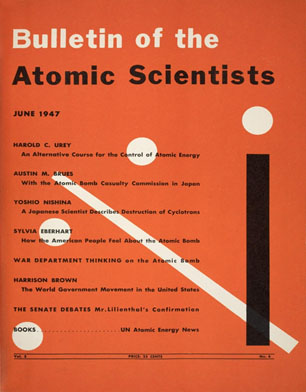
Source: The Bulletin of Atomic Scientists.
Who Sets the Clock and How?
Post-war nuclear scientists from the Metallurgical Laboratory of the University of Chicago and Oak Ridge National Laboratory protested the military control of peacetime nuclear research. Their protest culminated in a campaign for “an organised world community”[x] envisioned as a moral entity—a supranational body responsible for the governance of abstract notions like scientific freedom. This campaign for a sovereign world government was part of a movement by post-war scientists in the West to organise a constitutionally governed international agency with executive power, that would highlight the dangers of nuclear war and implement practical controls on scientific research on atomic energy to mitigate inter-state rivalry in nuclear power.
Until he died in 1973, Dr Eugene Rabinowitch, the editor of the Bulletin, oversaw decision-making regarding the position of the minute hand of the Clock after extensive intellectual dialogue with experts and scientists globally.[xi] At present, a diverse group of subject-matter experts, the Science and Security Board (SSB), meets biannually and, in consultation with the Bulletin’s Board of Sponsors, comprising numerous Nobel laureates, decides the position of the Clock.
The Clock’s position is formally announced at a Chicago press conference in late January, in line with the latest global events. The revisions to the Clock are not undertaken annually, but solely when the Board concludes that consequential global events warrant adjustment. While the decision to move the Clock is ultimately discretionary, certain key parameters reflecting the challenges of the time guide the process.
Figure 2. Graph Depicting the Movement of the Clock from 1947 to 2026 and the Evolution in the Threat Vectors
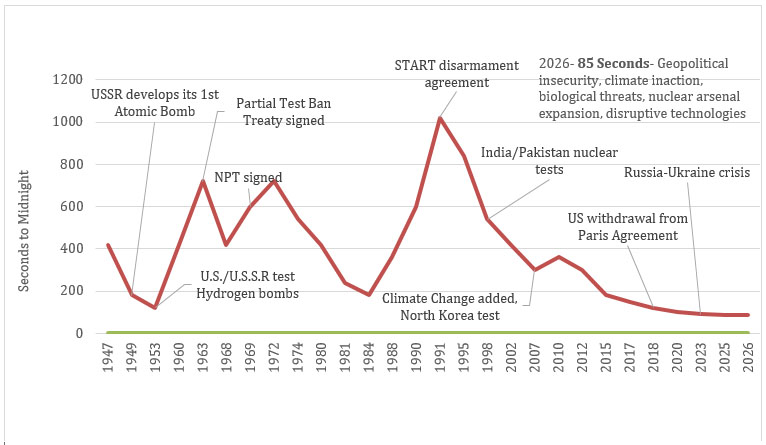
Source: Bulletin of the Atomic Scientists.
Movement of the Clock over the Years
The first ever movement of the Doomsday Clock occurred in 1949. It was the year the Soviet Union conducted its first nuclear test, the RDS 1. To signal the gravity of this development, Dr Rabinowitch moved the hands of the clock to 3 minutes to midnight in the next issue of the Bulletin’s magazine. With the adjustment of the Clock, the Bulletin recognised the official commencement of a new era of global instability and arms race defined by nuclear weapons.
The Clock moved again in 1953, with the introduction of the fusion-based thermonuclear devices. The US demonstrated the capability of a thermonuclear device or the Hydrogen Bomb (H-Bomb) in 1952, but the hands of the clock were moved after the Soviet Union acquired its own device in 1953. The Clock was set at 2 minutes to midnight. The 1953 statement by Dr Rabinowitch offered a cautious warning that the clock was close to striking midnight for Western civilisation.[xii] Situated within the Cold War-era American realpolitik, the analysis of ‘Doomsday’ primarily examined threats to Western civilisation.
For the rest of the decade, the Clock stayed at 2 minutes to midnight, then moved again in 1960. This time around, a positive shift was observed as the clock moved to 7 minutes to midnight. The official statement by the Bulletin,[xiii] justifying this shift, traced the developments over the decade. The scientists decided to move the hands of the Clock further away from ‘Doomsday’ despite the development of intercontinental missiles and the continued horizontal and vertical proliferation of nuclear weapons. They seemed to acknowledge a hopeful trend towards positive peace. The Fragile Armistice in Korea and Vietnam, although not a guarantee of perpetual peace, underscored the immediate reduction in threats to human security, as the agreements ensured the cessation of hostilities. The statement also recognised that the US and Russia had avoided confrontation during the 1956 Suez Canal crisis, which renewed hopes for political rationality in the Bulletin.
This positive trend continued in 1963, even as the world came to the brink of a nuclear confrontation during the Cuban Missile Crisis in 1962. The hands of the Clock moved 12 minutes away from midnight. The Bulletin justified its decision not to consider the Cuban Missile Crisis as an indicator of a nuclear risk in its 1968 statement. The Bulletin stated that the crisis demonstrated the superpowers’ potential to exercise restraint when they reached the brink of nuclear war.[xiv] Central focus was also placed on the Partial Test Ban Treaty, which concluded in 1963, and served as a multilateral acknowledgement of the need for cooperation in reducing nuclear risks, starting with a partial prohibition of nuclear tests.
The next movement of the clock occurred in 1968. The Doomsday Clock struck 7 minutes to midnight yet again. The Bulletin’s statement indicated that developments in the Eastern world since 1963 prompted the decision to move the clock closer to midnight. The India–Pakistan war of 1965, the Arab–Israeli war of 1967, the intensification of the Vietnam War, and the nuclear weapons tests conducted by France in 1960 and China in 1964 were mentioned as some of the key events driving the decisions of the Bulletin in 1968.[xv]
The decade of the 1960s ended as the clock ticked back 10 minutes from midnight. The Bulletin emphasised the importance of the Nuclear Non-Proliferation Treaty (NPT), which came into force in 1969. The NPT, a legal and diplomatic framework for the non-proliferation of nuclear weapons, was considered of symbolic importance by the Bulletin. While India, Pakistan, Israel, and the then West Germany remained outside the ambit of the treaty, the Bulletin remained ‘cautiously optimistic’.[xvi]
In the 1970s, a marked strategic shift towards arms limitation was observed with the signing of the Strategic Arms Limitation Treaty (SALT) and the Anti-Ballistic Missile Treaty (ABM) between the US and the Soviet Union. The Bulletin recognised these developments by moving the clock hands to 12 minutes to midnight in 1972. In 1974, however, the Clock advanced towards midnight again as India tested its nuclear device in 1974. Although termed as a peaceful nuclear explosion, the Bulletin raised concerns over a new theatre of nuclear arms race in South Asia.[xvii] This development also signalled the NPT’s failure to prevent horizontal nuclear proliferation. Hence, in 1974, the Clock was set 9 minutes before midnight.
The 1980s were the decade of intensifying Cold War rivalries,[xviii] and the end of the period of ‘detente’ marked by Arms Control treaties. The clock moved several times to map the security challenges during this period. After 1974, the next shift in the Clock’s position was observed in 1980 as it moved to 7 minutes to midnight. This shift, as per the Bulletin, was attributed to the failure of the SALT II negotiations and the US’s refusal to ratify the treaty. The Clock struck 4 minutes to midnight in 1981, as Ronald Reagan became the new President of the US, and the Cold War confrontations found a new arena of conflict in Afghanistan.[xix] The Bulletin moved the Clock further closer, to 3 minutes to midnight, to reflect the dangers of the accelerating arms race between the superpowers. Towards the end of the decade, however, the US and the Soviet Union could come to terms on a new treaty, the Intermediate-Range Nuclear Forces (INF) Treaty, which prohibited an entire class of nuclear weapons. The decade ended with the clock at 6 minutes to midnight.
The beginning of the next decade,[xx] however, renewed hopes for international security. The fall of the Berlin Wall set forth a series of events that culminated in the disintegration of the USSR and, with it, the end of the Cold War. In 1991, the Bulletin turned back the Clock to 17 minutes[xxi] to midnight, the farthest it has ever been. The development was also marked by the signing of the Strategic Arms Reduction Treaty (START) between the US and post-Cold War Russia. The treaty placed verifiable limits on the number of strategic nuclear weapons that the two parties could possess and deploy. In 1998, however, the Bulletin moved the clock closer to midnight once again, to 9 minutes away from midnight, attributing the shift to the nuclear tests conducted by India and Pakistan the same year.
The shifts in the Doomsday Clock in the 20th century were primarily driven by the nuclear arms race and the existential threats posed by the imminent use of nuclear weapons. However, as the end of the Cold War ignited structural changes, the Bulletin expanded its approach to include other parameters of measuring global existential risks.
New Parameters of Existential Risks
For the first time since the inception of the Doomsday Clock, the Bulletin recognised other weapons of mass destruction, i.e., chemical and biological weapons, in its decision to adjust the Clock in 2002. This development was driven by the release of the 2002 US Nuclear Posture Review,[xxii] which declared nuclear, chemical and biological weapons as ‘credible military options’ for deterrence.
It was in 2007[xxiii] that the Bulletin moved the Clock again to strike 5 minutes to midnight. While the primary focus of the Bulletin’s statement remained on the threats posed by North Korea’s nuclear weapons programme, another consequential development was the formal inclusion of climate change as a threat parameter for global existential risks. In 2010, the Bulletin placed central focus on the drastic impacts of global warming. Disruptions to the monsoon in Asia, devastating wildfires, droughts, glacial melting, and the rise in sea level were considered as much an existential risk as a nuclear catastrophe.[xxiv] The Bulletin moved the Clock to 6 minutes to midnight[xxv] in 2010 to signify the importance of the Copenhagen Accord, in which industrialised and developing countries reached a consensus to limit the global temperature rise to 2 degrees Celsius.
The 2015 statement[xxvi] of the Bulletin highlights another major addition to the threat assessments of existential risks: emerging technologies. As the Bulletin moved the Clock to 3 minutes to midnight, it underscored the role of emerging technologies, including synthetic biological toxins and cyberattacks on government facilities. Over the years, the potential of emerging technologies has expanded from dual-use technologies and cyberthreats to military applications of AI and disinformation campaigns.
Since 2015, nuclear escalation, biological weapons, climate change and disruptive technologies have become the distinct parameters for the Bulletin to measure the level of existential challenges. To reflect the intensified capabilities and complexities of these threat vectors, the Bulletin measured the Clock in seconds for the first time in 2020. Since then, the Clock has remained seconds away from midnight.
In the 2023 statement, the Bulletin moved the Clock to 90 seconds away from midnight, citing the Russia–Ukraine war as the dominant driver for nuclear risks. The biological threats were defined by the unprecedented impacts of the COVID-19 pandemic, and the accelerating carbon emissions and the resulting rise in global temperatures deepened the structural impacts of climate change. The daunting impacts of disruptive technologies were not just measured through cyberattacks and disinformation campaigns but also through high-tech weaponry and an impending space-based arms race.[xxvii] These dangers resurfaced in the Bulletin’s 2025 decision to set the clock at 89 seconds to midnight, followed by its further advancement to 85 seconds in 2026.
Conclusion
The Doomsday Clock, now at 85 seconds to midnight, represents the detailed arguments and claims made by scientists at the Bulletin encapsulating nearly eight decades of existential threats that have evolved from the nuclear perils of the dawn of the atomic age to the multiple crises of today. The Clock, as a symbol, appeals to rationality and serves as a warning against atomic annihilation in response to Soviet tests, Cold War escalations and post-1991 expansions. The adjustment of the clock shows a certain tilt towards the West, as evidenced by the movement of the Clock only after the Soviet possession of the H-bomb despite the US testing it prior. Similarly, the Bulletin did not consider the Cuban Missile Crisis as the brink of a nuclear war and only moved the hands of the Clock closer to midnight in 1968, citing the developments in the East.
In recent years, threat vectors have shifted to include climate change, emerging disruptive technologies like AI, and biological risks. The 2026 adjustment attests to contemporary threats like persistent nuclear modernisation by major powers, the lapse of New START, protracted armed conflicts, and inadequate climate action, all of which amplify humanity’s vulnerability. This trajectory reveals not inevitability, but a clarion call for renewed global leadership and sustained cooperation. Robust arms control, equitable climate mitigation, biosecurity frameworks and ethical AI governance are necessary global reforms to reverse the Clock. These 85 seconds advise that an era of unprecedented risks calls for proactive stewardship towards a safer future.
Views expressed are of the author and do not necessarily reflect the views of the Manohar Parrikar IDSA or of the Government of India.
[i] John Mecklin, “2026 Doomsday Clock Statement”, Bulletin of the Atomic Scientists, 27 January 2026.
[ii] “SIPRI Yearbook 2025”, Stockholm International Peace Research Institute (SIPRI), 2025.
[iii] “Northwoord Declaration”, Government of the United Kingdom, 10 July 2025.
[iv] “Deadly Storms Sweep South And Southeast Asia, Leaving Over 1,600 Dead”, United Nations, 4 December 2025.
[v] “Extreme Weather and Climate Impacts Bite Latin America and Caribbean”, World Meteorological Organisation, 28 March 2025.
[vi] Poppy Johnston, “Australia Makes List of 2025’s Costliest Climate Events”, Financial Review, 28 December 2025.
[vii] “2026 Doomsday Clock Statement”, Bulletin of the Atomic Scientists, p. 10.
[viii] “Defense Primer: The Golden Dome for America”, Congressional Research Service, 29 September 2025.
[ix] Martyl Langsdorf, “The History of the Bulletin’s Clock”, Bulletin of the Atomic Scientists, 1947.
[x] Eugene Rabinowitch, “Forewarned But Not Forearmed”, Bulletin of the Atomic Scientists, 1949.
[xi] Louise Lerner, “The Doomsday Clock, Explained”, UChicago News, 26 January 2021.
[xii] Eugene Rabinowitch, “The Narrowing Way”, Bulletin of the Atomic Scientists, 1953.
[xiii] “The Dawn of a New Decade”, Bulletin of the Atomic Scientists, 1960.
[xiv] Eugene Rabinowitch, “The New Years’ Thoughts, 1968”, Bulletin of the Atomic Scientists, 1968, p. 2.
[xv] Ibid.
[xvi] “NPT: Movement Toward a Viable World”, Bulletin of the Atomic Scientists, 1969.
[xvii] Samuel H. Day Jr., “We Re-Set The Clock”, Bulletin of the Atomic Scientists, 1974.
[xviii] “Was There a ‘New Cold War’ in the Early 1980s”, London School of Economics and Political Science.
[xix] Bernard T. Feld, “The Hands Move Closer to Midnight”, Bulletin of the Atomic Scientists, 1981.
[xx] “Ten Minutes To Midnight”, Bulletin of the Atomic Scientists, April 1990.
[xxi] “A New Era”, Bulletin of the Atomic Scientists, 1991.
[xxii] “Nuclear Posture Review Report”, Federation of American Scientists, 8 January 2022.
[xxiii] “It Is 5 Minutes to Midnight”, Bulletin of the Atomic Scientists, 2007.
[xxiv] “It Is 6 Minutes to Midnight”, Bulletin of the Atomic Scientists, 2010.
[xxv] Ibid.
[xxvi] “Three Minutes and Counting”, Bulletin of the Atomic Scientists, 2015.
[xxvii] John Mecklin, “2023 Doomsday Clock Statement”, Bulletin of the Atomic Scientists, 2023.