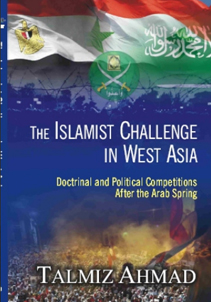
Following the Arab Spring, the West Asia-North Africa (WANA) region is witnessing interactions between the various strands of Islamism-Wahhabiya in Saudi Arabia; the Muslim Brotherhood in Egypt and its affiliates in other Arab countries, and the radical strand represented by Al Qaeda and its associated organisations - in an environment of robust competition and even conflict. This work examines these issues in some details. It provides an overview of the political aspects of Islamic law – the Sharia, as it evolved from early Islam and, over the last two hundred years, experienced the impact of Western colonialism. This book draws on a rich variety of source material which has been embellished by the author’s extensive diplomatic experience in the Arab world over three decades.
The pandemic continues to amplify the crisis in West Asia, making it hard for governments to cope with it individually. In the absence of a coordinated effort at the regional level, the road to economic recovery will be long and uneven.
The COVID-19 crisis would severely impact the four countries at the social, political, economic and humanitarian levels, as these states were already facing multi-vector exigencies at the time of the pandemic’s outbreak.
King Abdullah II’s forthcoming visit to India represents an opportunity to catapult the relationship to the next higher level in strategic, security, political, energy, trade, investment and economic cooperation.
Indian assistance to the Palestinians could not be routed through Israel without political controversy both at home and abroad, and India cannot help the Palestinians constructively without coordinating with Jordan.
Increased security cooperation and the potential for cooperation in the Middle East peace process are likely to be the key areas of discussion during the impending visit of King Abdullah to India.
The most significant outcome of the Jordanian parliamentary election has been the participation of the Islamic Action Front (IAF), the political wing of the officially banned Muslim Brotherhood. In many ways, this election is a test of King Abdullah’s commitment to electoral reforms.
Just when it seemed that the Arab Spring was almost over and the region was entering a phase of political transition, a flurry of developments in the first week of October 2012 has brought the region back into focus.