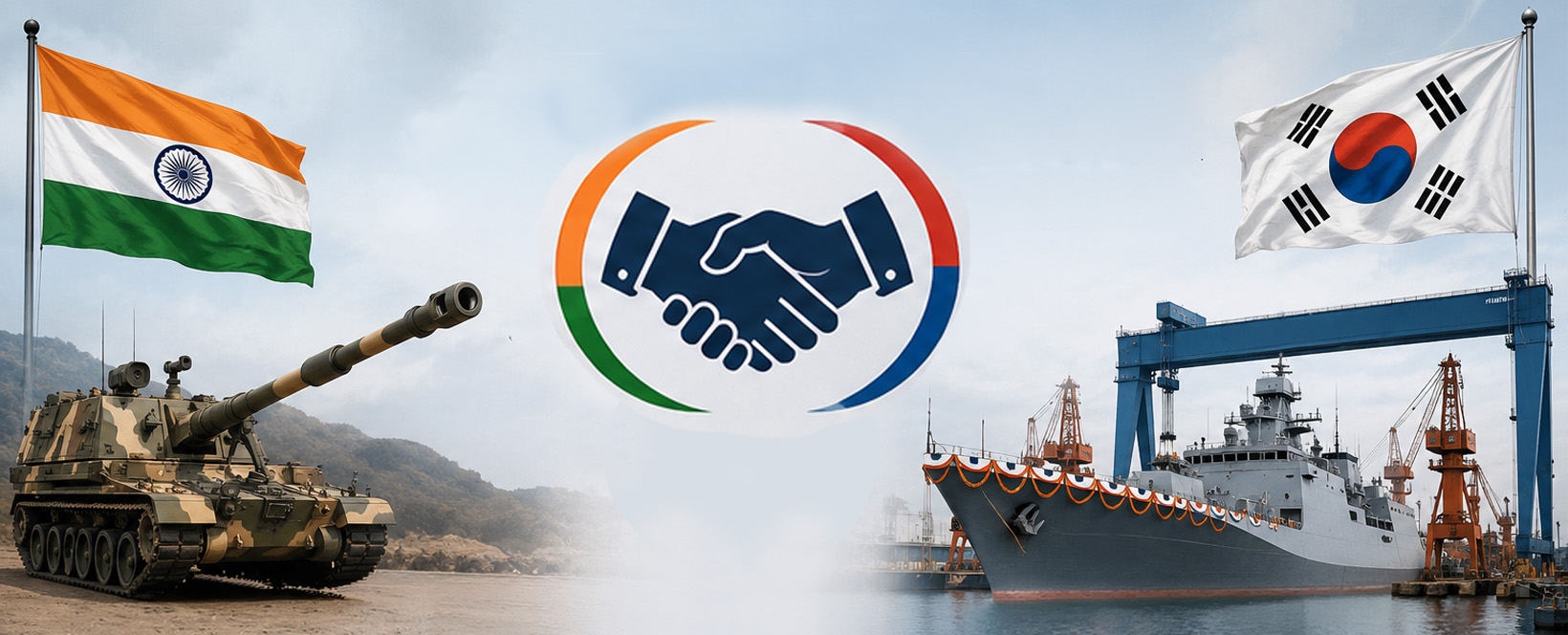
South Korea’s rapid rise as a manufacturing powerhouse and a leading export-oriented economy was made possible due to the active role of the ‘developmental state’ in the country. Despite adopting several neoliberal policies after the devastating Asian financial crisis of 1997, the South Korean state did not fully abandon its role in the country’s economic development. In recent years, selling of military hardware has emerged as one of the ‘new engines of economic growth’ for this export-oriented nation. Furthermore, South Korea’s economic and strategic relations with India have developed significantly, particularly after the end of the Cold War. The arms trade between the two countries has also grown notably. While India’s developing economic and strategic relations with South Korea are well-documented, there is a lack of literature on New Delhi’s increasing arms trade with Seoul. This article explains the challenges and prospects of South Korea’s trade of weapons with India.
India needs to engage more pointedly with South Korea, Japan, the United States and even bilaterally with DPRK to convey its concerns regarding the latter’s strategic cooperation with Pakistan.
South Korean president Park Geun-hye visited India in January 2014 after India and South Korea marked 40 years of diplomatic relations the previous year.1 These developments symbolise a burgeoning relationship between two of Asia’s leading economies and democracies. However, they have added significance as Asia undergoes a shift in the strategic balance of power.
South Korean President’s visit has initiated a common vision and a roadmap between the two countries based on political cooperation, open economic and trade environment and deeper cultural understanding. India’s growing emphasis on its ‘Look East Policy’ and South Korea’s ‘New Asia Diplomatic Initiative’ is pushing the relationship to one of ‘strategic partnership.’
As the first decade of the 21st century ended, India-Republic of Korea (ROK) relationship has assumed robustness in almost all dimensions – political, cultural and economic. As both countries enter the new year, a new dimension – security and strategic – that began in the preceding decade is likely to be seen in the expanding military cooperation, that began in the closing months of the preceding year. The foundation for such a relationship is already in place as both countries have identified a convergence of interests.
The sculpting of a strategic partnership and inking of a Comprehensive Economic Partnership Agreement show that South Korea is keen to engage India on matters where their mutual interests converge.
The India-South Korea bilateral relationship is a remarkable example of how trade is the primary driver in global relationships. Ideology, which marked international relations in the previous decades, has given way to trade - which now is the international marker for relations. An important watershed in the relationship will be the beginning of construction for the POSCO integrated steel plant, which is slated to begin in April 2007 and would constitute the single largest foreign investment in India at US$ 12 b.