Prime Minister Balen Shah’s Visit and India–Nepal Relations
- November 25, 2026 |
- IDSA Comments
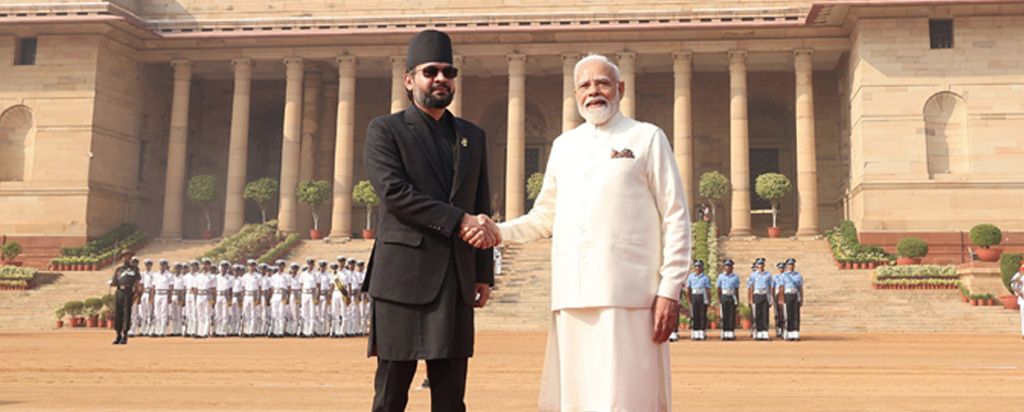
The September 2025 Gen Z protests precipitated a historic political transition in Nepal, bringing a young cabinet led by former Kathmandu Mayor Balendra Shah to power.[1] India’s fundamental importance to Nepal remains unchanged, but the new political dispensation has brought fresh expectations to the bilateral relationship. In this regard, PM Shah’s visit to India on 22–23 November 2026, his first bilateral visit since assuming office in March, marks an important engagement.
For India, the visit provided an opportunity to engage directly with the new leadership in Kathmandu. For Nepal, it offered an avenue to advance its domestic development priorities, particularly economic recovery and reconstruction following the devastating August 2026 floods. More broadly, the visit provided an opportunity to reassess a relationship that, despite its historical and geographical foundations, has periodically encountered political differences over territorial issues, the 1950 Treaty of Peace and Friendship, trade and transit arrangements, and perceptions of political interference.
The two Prime Ministers adopted the Joint Vision, Viksit Bharat and Samunnat Nepal: Re-imagining the Partnership, outlining cooperation, agreements and eight memoranda of understanding (MoUs) across key areas.[2] Its significance lies in the attempt to align India’s development partnership with Nepal’s changing economic and developmental aspirations. The proposed cooperation extends beyond traditional areas of infrastructure, trade and hydropower to include digital public infrastructure, artificial intelligence, education, agriculture, health, tourism and climate resilience.
Economic assistance and reconstruction emerged as important outcomes. The Bhotekoshi flash floods caused an estimated US$ 2.7 billion in damage and economic losses, with reconstruction and recovery requirements projected at approximately US$ 4.8 billion.[3] The disaster affected 13 hydropower projects with a combined capacity of 759 MW, damaged 69 km of roads and disrupted key trade corridors linking Nepal with China.[4] During the visit, India announced a development cooperation package of US$ 1.6 billion, comprising US$ 377 million in grants for post-disaster reconstruction and new infrastructure and US$ 1.24 billion in rupee-denominated credit for energy projects.[5]
Connectivity and economic integration constitute another major dimension. The inauguration of the Ayodhya–Janakpur passenger rail service, the Dharchula (India)–Darchula (Nepal) motorable bridge, and Phase II of the Motihari–Amlekhgunj petroleum pipeline, along with the laying of foundation stones for the Lower Arun Hydropower Project, Banbasa Integrated Check Post, and Jhapa petroleum terminal, provide tangible momentum. The proposed Raxaul–Kathmandu railway, additional transit access through Kandla and Paradip, and the bi-directional Kathmandu–Bhairahawa–Lucknow air route further expand Nepal’s connectivity options.
The joint vision’s proposal for cross-border special economic zones and export-oriented industrial parks is particularly significant because it links infrastructure development with manufacturing, investment and regional supply chains.[6] However, for Nepal, the larger expectation is that connectivity should contribute to productive economic activity, employment generation and reduced trade and transit constraints, rather than remain an infrastructure objective in itself.
Energy and water resources remained central to the partnership. Both sides agreed to advance the Pancheshwar, Saptakoshi and Sunkoshi multipurpose projects and strengthen cross-border electricity transmission. The joint vision also introduces a stronger climate-resilience dimension through hydrometeorological data sharing, glacial lake monitoring, early-warning systems and joint humanitarian assistance and disaster relief exercises.[7]
Institutional and human resource cooperation form another dimension of the partnership. The eight MoUs cover forensic science, police and civil-service training, healthcare, Ayurveda, satellite communications, urban development, livestock and fisheries. The joint vision also proposes exploring an offshore IIT campus, expanding scholarships in emerging fields and strengthening vocational and agricultural research cooperation. Lastly, both sides agreed to accelerate cross-border retail payments.
Despite the breadth of the outcomes, reactions in Nepal reflected both gains and reservations. The government, sections of the diplomatic community and economic stakeholders welcomed the renewed engagement and its potential benefits.[8] Others, however, noted that the agreements largely reiterated commitments made during previous prime ministerial visits. Discussions on the Kalapani–Limpiyadhura–Lipulekh boundary dispute, the revision of the 1950 Treaty, the Eminent Persons Group (EPG) report, Gorkha recruitment and the trade deficit, which Nepal had expected to feature in the talks, did not materialise. Criticism also centred on the lack of prior consultation with political stakeholders and the need for greater scrutiny of the terms and implementation of bilateral agreements.
The unresolved issues, however, require continuous consideration simply because of their distinct political and technical complexities. The boundary dispute involves competing territorial claims and sensitivities surrounding sovereignty, while a review of the 1950 Treaty requires negotiations on provisions governing security, trade and the movement of people. Similarly, the Pancheshwar Multipurpose Project remains constrained by differences over the Detailed Project Report, benefit-sharing and the distribution of costs. The agreed bi-directional Kathmandu–Bhairahawa–Lucknow air route also remains subject to technical consultations, particularly on permitted flight altitudes in Indian airspace.
These issues cannot be settled through a single high-level engagement and need sustained negotiations involving the relevant ministries. The proposed collaboration on developing the East–West Railway in Nepal and other cross-border railway connectivity also raises questions about land acquisition, construction costs, difficult Himalayan terrain, border security and operational coordination. Its long-term viability will depend on addressing these constraints and establishing commercially sustainable passenger and freight operations.
The visit should therefore be assessed as the beginning of a renewed negotiating process rather than an occasion for immediate resolution. Importantly, the political engagement and agreements established during the visit provide a basis for advancing these issues through regular consultations and institutional follow-through.
The future of the relationship will consequently depend on the effectiveness of its institutional mechanisms. India–Nepal ties are sustained by over 40 established bilateral arrangements, including the India–Nepal Joint Commission and sectoral consultations. The decision to reactivate the High-Level Monitoring Group, with meetings at least once every six months and reporting to the Joint Commission, is therefore significant.[9] Its ability to monitor implementation, facilitate clearances and address delays will be more consequential than the announcements themselves.
Beyond the bilateral dimension, the engagement must be situated within Nepal’s wider geopolitical context. A Chinese commentary in Global Times interpreted PM Shah’s shortened itinerary, limited ceremonial engagements, and the RSP-led government’s emphasis on functional cooperation as an effort to depoliticise diplomacy and insulate foreign policy from domestic political contestations.[10] Conversely, the United States has maintained active engagement with the Nepali government through high-level diplomatic visits, development cooperation and defence engagement, alongside its post-flood assistance. This reflects Washington’s continued interest in Nepal’s political stability, economic recovery and regional role.
In conclusion, the visit has provided renewed political momentum and an expanded framework for bilateral cooperation. The challenge is to adapt a historically interdependent relationship to the developmental aspirations and evolving strategic priorities of a changing Nepal. For India, this requires recognising Kathmandu’s domestic expectations and political sensitivities while remaining responsive to its own legitimate economic and security interests. For Nepal, the visit’s domestic significance also lies in its potential to reinforce political stability ahead of the local-level elections scheduled for March 2027, amid growing reservations over Shah’s style of decision-making and coordination. Translating the commitments into tangible outcomes will require policy consistency and sustained engagement. More broadly, the partnership’s strength will depend on both countries’ ability to deliver projects, manage disagreements, and sustain institutional cooperation amid evolving geopolitical dynamics.
Views expressed are of the author and do not necessarily reflect the views of the Manohar Parrikar IDSA or of the Government of India.
[1] “Balendra Shah Sworn in as Prime Minister”, The Kathmandu Post, 27 March 2026.
[2] “Viksit Bharat and Samunnat Nepal: Reimagining the Partnership”, Prime Minister’s Office, India, 23 November 2026.
[3] Binod Dhakal, “Bhote Koshi Flood: A 360-degree Look at Causes, Casualties, USD 4.8 billion Losses and Climate Justice Push”, Nepal News, 15 September 2026.
[4] Anish Mijar, “Nepal’s Hydropower Sector Faces Devastation from Natural Disasters”, Ratopati, 16 September 2026.
[5] “Joint Press Release on the State Visit of the Prime Minister of Nepal to India”, Ministry of External Affairs, Government of India, 23 November 2026.
[6] Ibid.
[7] Ibid.
[8] Suraj Kunwar, “India Agreements Open New Opportunities for Nepal’s Tourism”, The Kathmandu Post, 24 November 2026.
[9] “Nepal, India to Activate High-level Mechanism to Monitor Implementation of Agreements”, Online Khabar, 23 November 2026.
[10] Zhang Jiadong, “Nepalese PM’s Shortened India Visit Reflects New Diplomatic Approach”, Global Times, 23 November 2026.