Forward-Deployed Engineering and AI in Defence Operations
- September 09, 2026 |
- Issue Brief
Summary
The modern military faces a challenge in translating the enormous capabilities of AI into reliable operational outcomes. This gap between technological capability and operational value of AI in defence operations depends on the specific data, context, systems, workflows, and operational conditions under which it is deployed. Forward-Deployed Engineering offers an institutional mechanism to close this gap by embedding engineers close to users and feeding lessons from deployment back into product development.
Introduction: Conceptualising Forward-Deployed Engineering
Modern military capability is increasingly defined by and dependent on software, Artificial Intelligence (AI), cloud infrastructure, data and digital networks. Despite this, the outcome of a mission remains of paramount importance to the military, not just the acquisition of the latest technology.[1] These missions are often complicated and dynamic, dependent on data and operational context.[2] Workflows change quite regularly depending on the battlefield reality, while the data remains classified. Additionally, different military administrations may have very different needs.
Two military units might both want AI for intelligence, but one may need help analysing drone footage. In contrast, the other may need to combine satellite imagery with other intelligence sources. There isn’t necessarily one standard product that works for all of them. Even within a single military unit, mission objectives differ. Counter-proliferation, counter-terrorism, and logistics all have different requirements. A one-size-for-all approach or product rarely fits.
When Palantir Technologies, an American software company established in 2003, first encountered this problem with its clients in the American defence establishment, its solution was simple: embed its engineers on-site.[3] They created a model in which software engineers were embedded with operational users or deployed alongside them, allowing them to observe problems first-hand, modify software rapidly, and continuously incorporate user feedback into the product development cycle. This is what led to the emergence of Forward Deployed Engineering, or FDE in short.
The term originates in the military, where a ‘forward-deployed’ soldier is posted on the field, close to the action and ready to respond.[4] In the world of technology, the FDE (Forward Deployed Software Engineer) is deployed on-site with a client/user to help them adopt complex software and solve real problems, feeding what they learn back into the core product.[5] At Palantir, the FDEs were initially named ‘Deltas’, with their mission being ‘to deploy and customise Palantir platforms to tackle critical business problems, and measure success by the customer’s outcomes’.[6]
For a defence/military force trying to integrate AI within its infrastructure, an FDE can assume a hybrid role, combining several roles—that of an engineer who understands the technology and can modify or build software, a product strategist who understands what the military actually needs and figures out how the technology should be adapted to meet that need, and finally that of a field operator who spends time with the actual military users of the technology and understands how things work in real operational conditions.
Figure 1. Role of a Forward-Deployed Engineer
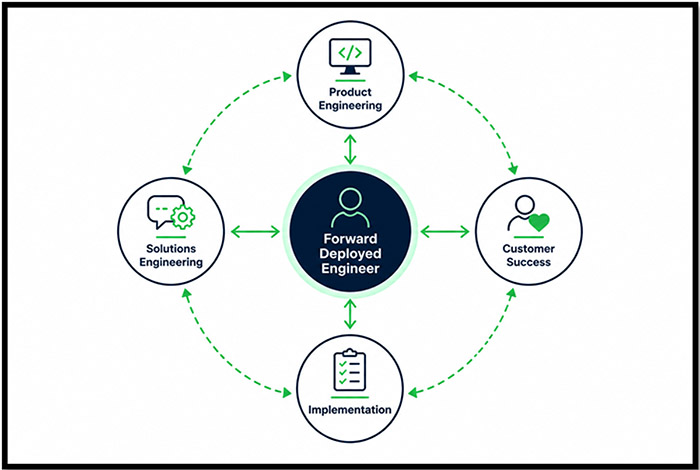
Source: “What is a Forward Deployed Engineer? Role, Skills, and Why It Matters”, Datacamp, 17 July 2026.
Defining Forward Deployed Engineering
Even though the practice and the term were both put forth by Palantir way back in 2006, Forward Deployed Engineering lacks a proper academic definition. The current definitions or explanations can be found in job postings at OpenAI or SarvamAI, as well as in some blog posts.[7] A paper published earlier in 2026 claims to define the term for the first time in an academic fashion. It sheds light on the concept through three properties and, in the process, also helps distinguish the practice from other forms of engineering or traditional consulting. It defines a Forward Deployed Engineer as a software engineer embedded at a client organisation by its parent product organisation ‘to deploy, customise, and co-evolve the company’s technology, while maintaining a direct feedback loop to the product organisation’.[8]
Forward Deployed Engineering is defined as an organisational practice that deploys such engineers, characterised by three fundamental properties:
- Product ownership: The embedded/forward deployed engineer remains an employee of the parent company with direct influence on a proposed design plan of the product.[9] By virtue of working for the parent technology company, they can also bring their on-field observations back to the company’s product development team. This serves many purposes—an FDE can build on the existing product platform rather than reinventing the wheel. So, if a military organisation wants a solution to a specific combat issue, the FDE can take existing technological and product capabilities and adapt and combine them to address that problem.
This helps the FDE to focus on domain-specific defence integration of the platform, tailoring it to a specific military context, rather than building a new platform or product from scratch. The FDE’s incentive, thus, lies in solving the problem rather than perversely prolonging the engagement.[10] This is crucial from both military technology and economic perspectives, since it reduces costs while accelerating adoption of military technology.
- Bi-directional knowledge flow: An FDE does not simply bring a company’s technology tool or platform to the military, nor does it just bring military requirements back to the company. The FDE model creates a continuous two-way exchange of knowledge between the technology developer and the military user.[11] Essentially, the FDE acts as a bridge between the two sides. It briefs a military unit on the capabilities of its technology/AI platform and how to use it in different situations, helping the military understand the technology and exploit it more effectively.
But the flow doesn’t stop there. The military informs the FDE about the issues they actually encounter and what they need the technology to do in specific scenarios. They share information about system failures, unforeseen situations that developers may not have anticipated, etc. Subsequently, the FDE takes these observations back to the parent company. This bi-directional knowledge flow creates a loop that converts initial deployment friction into informed product development. This distinctive feature, which institutionalises a two-way flow of knowledge, has the potential to address one of the core problems associated with AI in defence infrastructure: the gap between AI capabilities and their adaptation for use in military combat operations.
- Field-Driven Productisation or Productisation Feedback Loop: FDE’s custom solution to a military client isn’t the end of the product loop. The lessons learned from one client are shared with the parent company’s software developers. They actively look for common patterns in these solutions and turn them into a standard capability that many other customers can reuse. Thus, field work generates new product features, which some analysts have labelled as ‘Field-Driven Productisation’.[12] Many features of Palantir’s most valuable products have also originated from FDE field work.
The following example illustrates this feature: a military unit wants an AI system to integrate information from multiple sensors and present it in a way that fits its existing intelligence workflow. An FDE deployed with the unit builds a custom solution for that unit. Rather than a hard stop here, the FDE and its core product team can turn this custom solution into a standard feature of the company’s product. Each iteration eventually makes the next deployment easier and faster. The productisation loop thus means the operational environment becomes part of the company’s product development process.[13] For a defence organisation, this is important because the operational environment is dynamic, and the FDE model provides a system that institutionalises its core complexity.
When Palantir started out implementing this idea, they didn’t just embed a single engineer into the client site. The organisation sent out two people—a Delta (the FDE) and an Echo (the Deployment Strategist).[14] The Delta was tasked with the technical work of writing production code, AI agent design, etc., while the Echo (generally a former military officer or a domain/military expert) brought in domain and institutional knowledge and fundamentally understood how an institution actually worked on the inside.
Palantir reasoned that pairing these profiles and embedding them on-site together was crucial. A Delta on its own had little idea of operational relevance, even though it brought a strong technical skill set. At the same time, an Echo could not generate anything substantial with a mere change in operational strategy. This two-person complementary unit ensured that solutions were technically robust and that the client’s actual needs were at the centre of the process, all leading to better overall technology adoption.
The Emergence of FDE: Addressing the Deployment Gap
The proliferation of AI use across various industries has brought significant focus to the concept of FDE.[15] AI has ceased to be a mere assistant or helper and has instead transformed into the worker itself.[16] But AI technologies have a unique property: they can do many things in principle, but their application/usage is highly contextual/specific.[17] This is because these technologies are tested and trained in controlled development environments where the context is well-defined and the data that the models operate on is structured and predictable.[18] The real-world scenario where the AI model is eventually deployed is messy and riddled with uncertainty. When confronted with such issues, the model experiences a severe performance decline. Thus, the problem isn’t about AI capability but about its integration into a specific operational fabric of an organisation. In technical terms, this is called the deployment gap.[19]
In the military, a deployment gap may arise during the integration of AI into its existing infrastructure due to its databases and information systems, security requirements, workflows, classified and unclassified information, different levels of access, legacy systems, etc. It surely can address these constraints. But it isn’t explicitly trained to face these situations. The algorithms an AI model is built on are robust, but the design is not resilient enough to sustain uninterrupted real-world operations.[20] Hence the gap.
A research study conducted in 2025 by MIT backs the deployment gap theory: 95 per cent of AI pilots fail due to enterprise silos and hard-to-integrate organisational data.[21] Therefore, AI’s operational application relies on a specific set of data, systems, workflows, and operational conditions in which it is deployed. This causes a gap between technological ability and operational value. Forward-Deployed Engineering offers an organisational or institutional mechanism to reduce this gap by placing engineers close to military users of the technology. AI specifically needs this to convert its generic technological competency into context-specific military capability.
Project Maven’s use of FDE in its Defence AI Platform
Over the last few years, AI has moved from the fringes of defence experimentation to the centre of the actual combat stack.[22] It has developed into a useful medium for processing large quantities of data generated towards military operations and in providing an all-inclusive view of the battlefield.[23] Machine learning algorithms trained on military data can identify enemy positions, analyse operational tactics, and optimise targeted strikes.[24] All this points to a growing belief that AI is actively shaping battlefield decisions as well.
Project Maven, for example, was launched in 2017 by the Pentagon to leverage AI’s capabilities in warfighting.[25] It was prompted to do so since the quantum of data generated via the drones during operations in Iraq and Afghanistan was far more than analysts in the loop could actually look into.[26] So it started by using machine learning to analyse images and videos from drones operating in the field. Fast-forward nine years later, Project Maven’s Smart System is now a core military command-and-control platform.
During ongoing operations in Iran, the Maven Smart System’s (MSS) AI capabilities helped the United States Armed Forces strike more than 1,000 identified targets, a figure 10 times greater than would have been possible without MSS.[27] Additionally, AI models under Project Maven provided direct battlefield support, specifically in targeting tasks, to the Ukrainian Forces in the Russia–Ukraine war.[28] These models operated as Decision Support Systems, continuously presenting a dynamic view of the battlefield to Ukrainian commanders.[29]
The architecture of a modern military operation has, therefore, changed. At the lowest level of this architecture are objects/tools that help gather intelligence and information about the battlefield, such as sensors, satellites, drones and military personnel. The structure at the top-most layer of this architecture is that of the military commander or unit leading the operation. The new architecture adds a layer that acts as a facilitator between them. This is the AI/ML platform layer that analyses all the data and fuses it to aid the commander on the battlefield.
Platforms such as the Maven Smart System (MSS) serve this purpose. This is relevant to this study because there is evidence that MSS employed personnel, or ‘project specialists’, to perform functions analogous to FDEs, eventually helping the Special Operations Forces (SOFs) adapt the technology to their mission.[30] What started as a computer vision-cum-ISR (intelligence, surveillance, and reconnaissance) initiative to operationalise AI within the American Armed Forces expanded significantly, evolving into the MSS over time. The added capabilities of MSS now include battlespace management, target management, AI-enabled deliberate planning and execution, machine-assisted disclosure, etc., amongst other features.[31] Curiously, the entire project has been managed and executed by Palantir Technologies since 2018, after Google, the initial contractor, backed out following internal employee protests regarding military applications of its AI technology.[32]
A Case for FDE within India’s Defence Ecosystem
India’s defence sector requires not only cutting-edge technologies but also unconventional thinking to avoid falling behind competitor militaries in its neighbourhood and around the world.[33] And critical technologies like AI have opened up a vast array of prospects for militaries around the world to develop on their existing capabilities. India, too, has started integrating AI into its warfighting architecture.[34] Therefore, the emergence of AI-driven FDE can’t be brushed aside as a passing trend that doesn’t merit immediate attention.
India already has significant institutional infrastructure to implement an FDE-style model. Still, it differs structurally from other countries, such as the United States, where a private organisation like Palantir exercises considerable control and autonomy over its software platforms, engineers and deployment processes. India has various actors in the ecosystem, such as iDEX/DIO for start-up engagement and innovation, DRDO for R&D and technology development, Service Headquarters for operational requirements, TDF for industry-led defence technology development, DRDO Industry–Academia Centres of Excellence, etc.
DRDO also has dedicated AI capabilities through CAIR and DYSL-AI. At the same time, TDF also supports industry-led development of various defence technologies, including AI.[35] iDEX explicitly aims to enable co-creation and faster development/adoption of defence technologies.[36] It works with start-ups/MSMEs and academia and currently has DISC, ADITI, and Open Challenge pathways. Its framework also envisages co-creation, piloting and indigenisation.[37] An operational bridge between technology developers and users, during and after development, though, appears to be missing. Therefore, the use of existing institutions with an explicit FDE pathway that places technical personnel alongside military users and connects their observations directly to technology development would definitely help.
For instance, DISC challenges at present include building an ‘AI Module for UAS for Autonomous Recognition, Identification and Targeting’.[38] With the FDE model, DIO, HAL, or another defence start-up that produces the prototype solution to this problem should look to embed its engineers on-site with the eventual military users of the AI Module to discover what needs to be done before the capability becomes genuinely useful. In the current software solution cycle, a hard stop occurs upon reaching the prototype milestone. Through the FDE implementation, embedded engineers would continue to gather vital information during the next phase of technology deployment, which includes user testing, pilot testing, operational experimentation, and iteration. This is also in alignment with iDEX, as it places substantial responsibility on the Nodal Agency for technical guidance, milestone reviews, and the validation and acceptance of the product.[39] Embedded engineers can also be institutionalised through formal mechanisms within DRDO/DPSUs.
Limitations to FDE
The military technology ecosystem has so far included soldiers, officers, scientists, researchers, engineers, etc. FDE adds another layer to the ecosystem: the embedded software engineer as an operationally informed technology intermediary. While the defence ecosystem is slowly adopting AI, the FDE model appears to be a good fit, capable of delivering significant payoffs on the battlefield with the right planning. But the bespoke quality it brings is both an attraction and a risk.[40]
For starters, FDEs that build the distinctive use case for a client establishment or a military customer are employees of a different parent organisation that embedded them with the client establishment and won’t stay on-site indefinitely. Therefore, when the commitment between two parties, i.e., the military unit and an AI firm, ends, the client inherits an environment that requires machine learning and AI skills within its organisation to maintain it. That is a situation any organisation needs to be prepared for before deploying FDEs.
Second, as established before, the FDEs spend a good chunk of their time understanding the organisation, its requirements, data, etc., together with the military/operation planners. This effectively allows them to shape military requirements later on, rather than simply responding to them. This can also lead to a military becoming dependent upon the firm and creating a technological lock-in, a major strategic headache for the military. No military wants to encounter such a scenario.
Lastly, even though the FDE model doesn’t incentivise prolonged engagement between the client and the parent organisation, it is crucial to implement it around defined milestones (e.g., successful deployment) rather than an open-ended engagement.[41] FDEs do add cost to the client party; therefore, embedding engineers must be time-bound.
Conclusion
The limitations point to the need to train FDEs internally within the Armed Forces in the long term, without relying on any external or intermediary entity. The Indian Army maintains a Corps of Engineers, which also provides its services to the Defence Research & Development Organisation (DRDO). Within the Corps of Engineers is the Military Engineer Services (MES), which comprises a multidisciplinary team of architects, civil, electrical and mechanical engineers, structural designers, quantity surveyors, and contract specialists for the planning, design and supervision of works.[42] The Armed Forces can leverage these structures to create an FDE talent pipeline. The Indian Armed Forces are striving to integrate AI into their defences, and developing an internal FDE capability also provides a mechanism to ensure that advanced technologies like AI are not just acquired but integrated and adapted in real-world operations.
The rapid proliferation of AI in the military domain is proof of its impact on military strategy. AI provides new and unforeseen levels of awareness about on-field operations to military commanders. It complements other elements of the military technology stack and can handle bulk information more effectively and faster than a team of human analysts. Its integration into recent conflicts in the Russia–Ukraine war and in Gaza points to its notable impact on the ground.[43] This suggests that the military that thrives in the AI age will be the one that masters the skill of deploying and using AI confidently, and that can be achieved via the FDE model. This exercise isn’t a passing trend or a newly coined job title, but the institutionalisation of a longstanding reality: complex technologies often call for technical expertise embedded close to operational military users to tap into their capabilities fully.
Views expressed are of the author and do not necessarily reflect the views of the Manohar Parrikar IDSA or of the Government of India.
[1] Joe Perovich, Robert Kreft and Michael Roth, “The Rise and Role of the Forward Deployed Engineer”, Alvarez & Marsal, 21 April 2026.
[2] Alexander Treiblmaier, “Improving Efficiency Through Data-Driven Decision-Making in a Military Environment”, The Defence Horizon Journal, 27 October 2022.
[3] Siddhesh Prabhugaonkar, “The Rise of the Forward Deployed Engineer: History, Myths, and Why It’s Back”, Azure Authority,10 May 2026.
[4] Ibid.
[5] “What is a Forward Deployed Engineer? Inside Tech’s Hottest New Job—and How to Prepare for It”, Illinois Tech Blog, 2026.
[6] Ibid.
[7] “Forward Deployed Engineer (FDE) – SF”, Open AI Careers, 2026; “Forward Deployed Engineer”, Sarvam AI, 2026.
[8] Jiun Kim and Hyuntae Hwang, “Forward Deployed Engineering: A Taxonomy and Definition”, SSRN, 9 March 2026.
[9] Rocio Wu, “The Uncomfortable Truth About FDEs”, Forbes, 5 February 2026.
[10] Lee Chong Ming, “An OpenAI Exec Explains How His Growing Team Helps Companies Move from AI Hype to Adoption”, Business Insider, 28 November 2025.
[11] Tao An, “Forward Deployed Engineers: AI’s Answer to the SaaS Customization Paradox”, Medium, 9 October 2025.
[12] Michael Kerkhoff, “Forward Deployed Engineers: Why the Palantir Model is Becoming the Operating System of Enterprise AI”, Context Studios Blog, 17 August 2026.
[13] Diogo Silva Santos, “A Comprehensive Analysis of Palantir’s Forward Deployed Engineering Model”, Medium, 8 April 2026.
[14] “How Palantir Invented the Forward Deployed Engineer Model and Why AI Startups Are Adopting It”, FDE Academy, 25 March 2026.
[15] Marc Vartabedian and Yuliya Chernova, “AI Startups Have a New (Old) Secret Weapon: Forward Deployed Engineers”, The Wall Street Journal, 13 October 2025.
[16] Joe Schmidt, “Trading Margin for Moat: Why the Forward Deployed Engineer is the Hottest Job in Startups”, Andreessen Horowitz, 4 June 2025.
[17] “The Rise of the Forward Deployed Engineer: History, Myths, and Why It’s Back”, no. 3.
[18] Anamta Shehzadi, “AI Agent Deployment Challenges: The Hidden Gap in Production”, Tech Bullion, 13 October 2025.
[19] “The AI Deployment Gap: Why 87% of AI Projects Never Reach Production”, Magure, 14 May 2026; Lee Chong Ming, “An Openai Exec Said the Company is Using a New Engineering Role to Get Big Customers’ Projects Going Fast”, Business Insider, 23 July 2025.
[20] Anamta Shehzadi, “AI Agent Deployment Challenges: The Hidden Gap in Production”, no. 18.
[21] Jennifer Riggins, “Why the Forward-Deployed Engineer is Tech’s Hottest Job”, The New Stack, 30 January 2026.
[22] Manoj Joshi, “AI in Modern Warfare: India’s Strategic Challenges and Opportunities”, Observer Research Foundation, 27 February 2026.
[23] Pranoy Jainendran, “AI in Real-Time Warfare: Lessons from Project Maven”, Observer Research Foundation, 30 December 2025.
[24] David Kirichenko, “Artificial Intelligence’s Growing Role in Modern Warfare”, War Room Online Journal, 21 August 2025.
[25] “Establishment of Algorithmic Warfare Cross-Functional Team (Project Maven)”, Department of Defense, United States of America, 26 April 2017.
[26] Matt Mande and Gregory C. Allen, “What is Maven Smart System, and What Does It Do?”, CSIS, 2 June 2026.
[27] Ibid.
[28] Anna Nadibaidze, Ingvild Bode and Qiaochu Zhang, “AI in Military Decision Support Systems: A Review of Developments and Debates”, Center for War Studies, November 2024.
[29] Ibid.
[30] Will Irwin and Isaiah “Ike” Wilson III, “The Fourth Age of SOF: The Use and Utility of Special Operations Forces in a New Age”, Joint Special Operations University, 2022, p. 92.
[31] “What is Maven Smart System, and What Does It Do?”, no. 26.
[32] Daisuke Wakabayashi and Scott Shane, “Google Will Not Renew Pentagon Contract That Upset Employees”, The New York Times, 1 June 2018.
[33] Cherian Samuel, “Helping Start-ups Cross the ‘Valley of Death’: The Main Challenge for iDEX”, Issue Brief, Manohar Parrikar Institute for Defence Studies and Analyses (MP-IDSA), 11 December 2020.
[34] Lt. Gen. Deependra Singh Hooda (Retd.), PVSM, UYSM, AVSM, VSM & Bar, “Implementing Artificial Intelligence in the Indian Military”, Delhi Policy Group, 16 February 2023.
[35] “Welcome to TDF”, Defence Research and Development Organisation (DRDO), Government of India.
[36] “Innovations for Defence Excellence”, Innovations for Defence Excellence (iDex).
[37] Ibid.
[38] “AI Module for UAS for Autonomous Recognition Identification and Targeting”, Innovations for Defence Excellence (iDex).
[39] “FAQ”, Innovations for Defence Excellence (iDex).
[40] Marty Cagan, “Forward Deployed Engineers”, Silicon Valley Product Group (SVPG), 17 September 2025.
[41] Rocio Wu, “The Uncomfortable Truth About FDEs”, Forbes, 5 February 2026.
[42] “Military Engineer Services”,Department of Defence, Government of India.
[43] Priyesh Mishra, Prakhar Pandey, Leah Cole and Seungmi Hong, “Code, Command, and Conflict: Charting the Future of Military AI”, Belfer Center for Science and International Affairs, 12 December 2025.