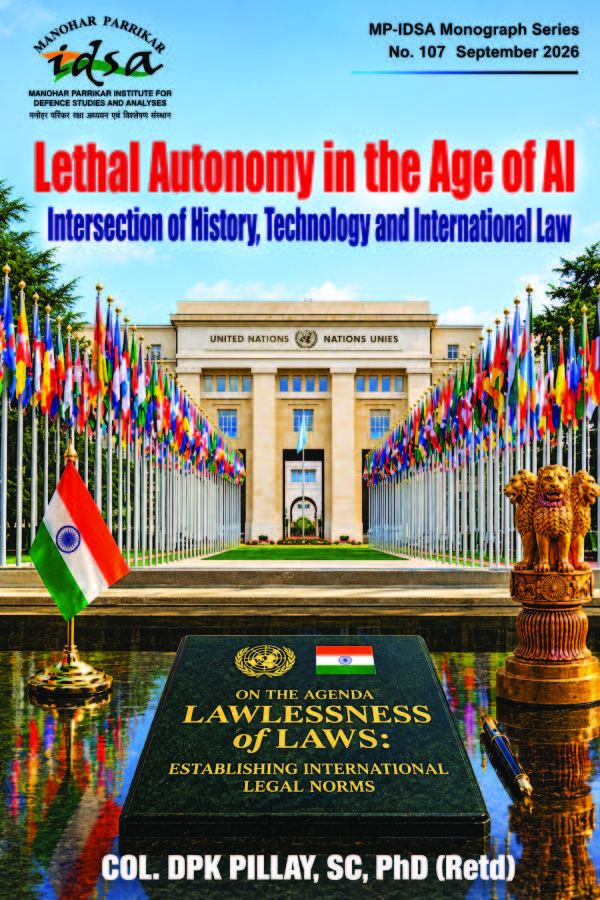
Lethal Autonomy in the Age of AI: Intersection of History, Technology and International Law
- 2026 |
- Monograph
About the Monograph
The delegation of decisions over life and death has long been one of warfare’s most enduring ethical, legal, and strategic dilemmas. The emergence of Artificial Intelligence (AI) has transformed this debate from a theoretical concern into an immediate challenge through the development of Lethal Autonomous Weapon Systems (LAWS). This monograph examines how existing International Humanitarian Law (IHL) addresses autonomous weapons by analysing the historical evolution of the laws of armed conflict, deliberations within the Convention on Certain Conventional Weapons (CCW), international governance initiatives, state practice, military doctrine, and contemporary battlefield experience. It compares national approaches to regulating AI-enabled warfare, evaluates India’s evolving position, and identifies the legal, ethical, and operational challenges posed by increasing autonomy. The monograph argues that preserving meaningful human judgement and accountability remains fundamental and offers recommendations to strengthen India’s legal, policy, technological, and institutional preparedness for the age of AI-enabled warfare.
About the Author
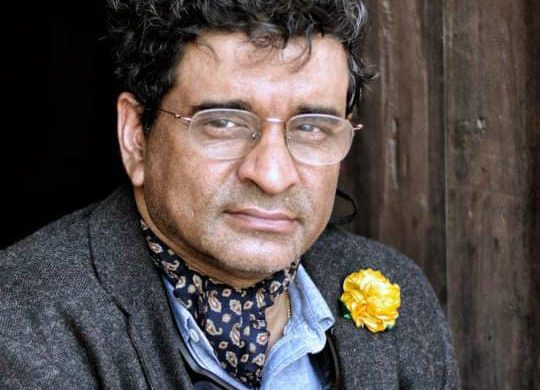
Colonel D.P.K. Pillay, SC, PhD (Retd.) is a Research Fellow at the Manohar Parrikar Institute for Defence Studies and Analyses (MP-IDSA), New Delhi. A decorated Indian Army officer he was severely wounded in combat while leading counter-insurgency operations in Manipur. Following his operational service, he served in the Ministry of Defence and the National Security Council Secretariat, where he worked on international humanitarian law, arms control, defence reforms, defence diplomacy, environmental security, sustainable development, and emerging military technologies. He represented India at the United Nations General Assembly, the Convention on Certain Conventional Weapons in Geneva, the United Nations Environment Programme, and other international forums. He contributed to several national policy initiatives, including defence industrial reforms, the corporatisation of the Ordnance Factory Board, defence diplomacy, and the implementation of the Group of Ministers’ recommendations following the Kargil Review Committee. He also served as a Military Adviser to the International Committee of the Red Cross, contributing to After Action Reviews of conflicts in Iraq, Syria, and Yemen. He trains military officers, UN peacekeepers, Judge Advocate General Branch officers, and security practitioners on International Humanitarian Law, refugee law, protection of civilians, and contemporary armed conflict. His research focusses on military history, human security, radicalisation, and emerging technologies.
Keywords: Artificial Intelligence, Warfare