India and China’s Economic Engagement in Sri Lanka Post-2022 Crisis
- June 15, 2026 |
- Issue Brief
Summary
India is transforming into a comprehensive development partner and re-establishing its strategic and economic presence in Sri Lanka. China has cautiously recalibrated the BRI, focusing on direct FDI projects as well as existing and small-scale projects.
Introduction
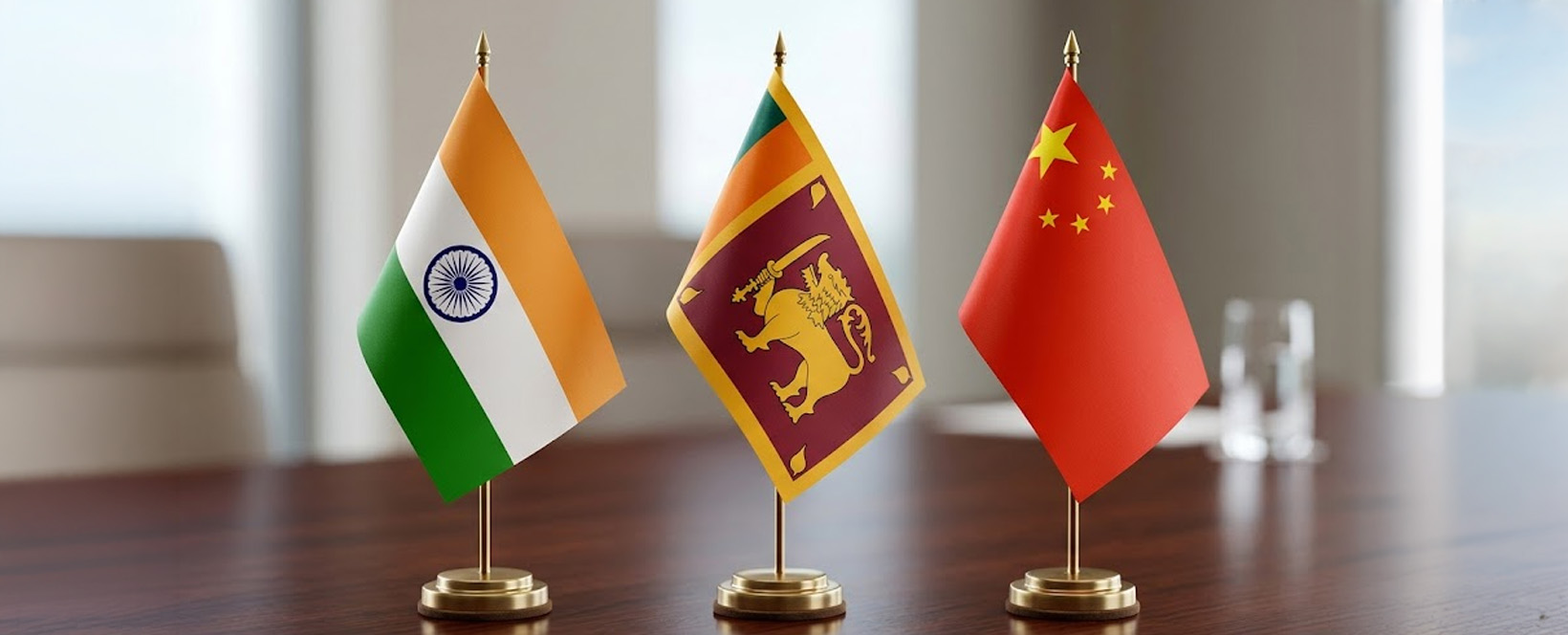
India’s acquisition of a 51 per cent controlling stake in Colombo Dockyard in April 2026, through its state-owned enterprise (SOE), Mazagaon Dock Shipbuilders Ltd (MDL), which is India’s very first international acquisition in the shipbuilding sector, reflects a strategic deepening of economic engagement in Sri Lanka. India has proactively scaled up engagement through the roll-out of the United Payments Interface (UPI), the Trincomalee oil tank, and increased Foreign Direct Investment (FDI). China has also consolidated existing projects and invested in new ones, such as the Hambantota oil refinery. The brief analyses India’s and China’s economic engagement with Sri Lanka, specifically in the post-2022 crisis period.
China’s Economic Engagement
The end of the three-decade-long civil war (1983–2000) in Sri Lanka saw China’s mega infrastructure-led development viz. the Hambantota Port, Mattala Rajapaksa Airport, Colombo Port City, Nelum Pokuna Theatre, the South Container Terminal of the Colombo Port, and several highways. China’s Exim Bank lent US$ 307 million in 2007 for the construction of the Hambantota Port at 6.3 per cent, higher than ADB’s 3 per cent, to CM Ports, a Chinese SOE. By 2020, China’s total financial assistance amounted to US$ 20 billion,[1] with infrastructure projects alone accounting for US$ 12 billion[2]
In 2017, the Sri Lankan government spent 83 per cent of its revenue on debt repayments, of which a quarter was allocated to repaying foreign borrowings alone, with the remainder allocated to domestic borrowings. This affected Sri Lanka’s ability to repay its Chinese debt, particularly the Hambantota port debt, which led the Sirisena Wickremsinghe government to lease the port in a debt-for-equity swap. The port lease (US$ 1.12 billion) in 2017 to a Chinese firm for 99 years, wherein CM Ports holds 69.55 per cent shares, and Sri Lanka Ports Authority (SLPA) holds the remaining 30.45 per cent, with a buy-back arrangement of 20 per cent of shares in 10 years,[3] was highly controversial.[4]
Hambantota International Port Services Company (HIPS) and Hambantota International Port Group (HIPG) were created. CM Ports and SLPA were to have a 70–30 per cent split, respectively. In HIPS, SLPA has a 50.7 per cent share and CM Ports has a 49.3 per cent share, while in HIPG, CM Ports has a majority stake of 85 per cent and SLPA has 15 per cent. However, financial experts have stated that CM Ports holds majority stakes in both HIPG and HIPS.[5]
In 2022, Sri Lanka became the first-ever country in Asia-Pacific to declare a sovereign default. Foreign exchange reserves fell from US$ 7.6 billion (2019) to US$ 250 million (2022), and the debt-to-GDP ratio exceeded 110 per cent of GDP. China, the largest bilateral debtor, accounted for 13 per cent of Sri Lanka’s external debt. Sri Lanka’s commercial debt, that is, the debt it accrued by borrowing from the private international financial market, accounted for 42 per cent of the country’s external debt, with 85 per cent of this commercial debt being from International Sovereign Bonds (ISBs). About debt servicing, which refers to the periodic repayment of a loan’s principal and interest, Chinese debt repayments accounted for 20 per cent of Sri Lanka’s total debt servicing. In comparison, ISB’s accounted for 50 per cent.
China’s BRI, excessive debt and financial mismanagement all contributed to Sri Lanka’s debt troubles. China offered a paltry sum of US$ 75 million of emergency aid, 10,000 tons of rice and medical supplies in June 2022. China restructured its bilateral debt of US$ 4.2 billion, but was reluctant to join the official creditors group and co-operate with the IMF process, which it did only in late 2023.
Post-crisis, China suffered severe losses (US$ 7 billion) due to debt restructuring, in which it had to forgive portions of the original loan amounts and extend loan repayment timelines, all of which led to China losing 7 billion. Post-restructuring, Sri Lanka’s outstanding debt to China fell from US$ 8 billion in 2022 to US$ 4.9 billion in 2025. China’s share of external bilateral debt decreased from 57 per cent in 2022 to 45.3 per cent in 2024–2025,[6] though it remains the largest bilateral lender. The decrease in external bilateral debt could be temporary, as debt repayments have been deferred until 2028.
China recalibrated from the mega BRI infrastructure projects to smaller, low-risk, local projects promoted as ‘small but beautiful’.[7] The Hambantota oil refinery (US$ 3.7 billion) project, handed over to the Chinese SOE Sinopec, is an FDI initiative to address energy security, generate foreign exchange through export revenues, and create employment opportunities. The debt crisis exposed Chinese policy banks (State-Owned Financial Institutions), in this case China EXIM Bank and China Development Bank (CDB), to financial losses and to providing debt relief for delayed projects, leading to the discontinuation of their aggressive lending strategies.
Incomplete BRI projects and delayed disbursements, along with loading penalty costs, are hampering Sri Lanka’s economic recovery. Even the Hambantota Oil refinery project continues to face delays due to China’s insistence on securing a higher percentage of the output for domestic sale. China argues that the current agreement to export 80 per cent of its output while selling 20 per cent locally in Sri Lanka is unsustainable and insists on selling 30 per cent of its output locally, which it argues would give it a higher return on investment (ROI).[8]
India’s Economic Engagement
India, on the other hand, extended multi-level assistance to Sri Lanka in the post-2022 crisis period. India, as a first responder, extended US$ 4 billion in debt relief, a US$ 500 million Line of Credit (LoC), a fuel import facility, and a currency swap to Sri Lanka. The State Bank of India (SBI) also provided a US$ 1 billion import credit facility. India was appointed as the co-chair of the official creditors group alongside Paris Club creditors viz. Japan and France.[9] In March 2023, the IMF approved an Extended Fund Facility (EFF) arrangement of US$ 3 billion for a period of 48 months. India’s role as a leading creditor and lender of last resort, its support in implementing the IMF’s EFF programme, and assistance of US$ 4 billion, greater than the IMF-EFF, are unmatched in scale and size. This helped India to regain its strategic and economic influence in Sri Lanka.
India, a regional heavyweight and a longstanding major economic partner, significantly expanded its economic engagement post-2022 and transitioned from a traditional donor to a comprehensive development partner in infrastructure projects. The war-affected Trincomalee Oil lease with India in 2003 was scrapped by the Rajapaksha government in 2009 and recommenced in 2022 under President Wickremsinghe. In 2022, 14 of the 99 British-era oil tanks were leased for 55 years to Indian Oil Corporation (IOC), with 24 tanks held by Ceylon Petroleum Corporation (CPC), and 61 remaining vested in Trinco Petroleum Private Ltd, a joint venture between India’s IOC and Sri Lanka’s CPC.[10]
The 2006 Sampur coal project, scrapped by President Rajapaksha, was also relaunched in 2025 as a solar power project, alongside the proposed undersea oil pipeline, which has become essential for Sri Lanka’s energy security.[11] Similarly, the East Container Terminal project offered to the Indian firm Adani Ports was unilaterally cancelled by President Gotabaya in 2019. Instead, Adani Ports was offered management of the West Container Terminal, which it took over in 2025.
In 2025, Sri Lanka signed an MoU with India and the UAE to jointly develop Trincomalee as an energy hub. One of the Connectivity projects is the ferry service from Nagapattinam, Tamil Nadu, to Kankesanthurai port near Jaffna in Sri Lanka, which India has also been developing through a US$ 65 million grant project since 2024.[12] The acquisition of the Colombo dockyard in 2026, one of the busiest maritime lanes and a key point on the East–West Shipping route, is a significant development.[13] It gives India a strategic foothold, since the dockyard is located on the same premises as the Chinese-operated Colombo International Container Terminal, which China has operated since 2013. This upward economic and infrastructure engagement shows geopolitical manoeuvring by Sri Lanka and expands India’s economic engagement in the island country.[14]
Other projects where India has invested include the High Impact Community Development Projects (HICDP), such as the Indian housing project (4th phase), which aims to build 10,000 houses for plantation Tamils, and the Jaffna cultural centre project (US$ 11 million). India’s speedy Ditwah cyclone[15] relief package (US$ 450 million), Operation Sagar Bandhu, and the Indian army’s assistance in building multiple Bailey bridges to provide humanitarian and disaster relief (HADR) are other relief measures provided to Sri Lanka.
The introduction of India’s UPI services in Sri Lanka through collaboration between India’s NPCI International Payments Ltd and Lanka Pay, the national payment network of Sri Lanka, along with the designation of the Indian rupee as a trade settlement currency, has strengthened bilateral trade. India has become Sri Lanka’s largest trading partner, and in 2024, bilateral trade surpassed US$ 5.5 billion. India’s exports to Sri Lanka and Sri Lanka’s exports to India stood at US$ 4.7 billion and between US$ 0.88 billion and US$ 1.4 billion,[16] respectively. Despite the India–Sri Lanka FTA (ISFTA) signed in 2000, utilisation of the ISFTA has remained asymmetric: 70 per cent of Sri Lankan exports utilised the ISFTA, while only 5 per cent of Indian exports utilised it.
However, non-tariff barriers, including conformity assessment procedures (CAP) and the non-recognition of foreign compliance certificates for Sri Lanka’s key exports, such as bakery products, limit the growth of bilateral engagement. Sri Lanka has the largest unrealised trade potential—the economic value of untapped trade opportunities, of around US$ 800 million with India. Sri Lanka has the trade potential to raise its exports to India by 91 per cent and its imports from India by 18 per cent.[17] Despite 14 rounds of negotiations done so far, the Economic and Technology Cooperation Agreement (ETCA) has yet to be signed.
India emerged as the second-largest FDI investor (US$ 213 million), with Singapore as the largest, in FY 2025, as Sri Lanka hit a record FDI of US$ 1.06 billion[18]. However, China remains the dominant long-term investor, with an accumulated FDI presence of US$ 15 billion over two decades. Indian private sector investment in Sri Lanka also increased with Adani’s Colombo West International Container Terminal (CWIT) project (US$ 700 million), ITC’s Ratnadwipa Colombo hotel project (US$ 300 million), Amul’s entry into dairy production, and longstanding Indian companies such as Ashok Leyland and Tata.
Despite a rise in its economic engagement, India-led projects face financial non-viability issues, for example, Adani’s withdrawal from the Wind Power project in the Gulf of Mannar, with the firm stating the project’s financial non-viability, when the talks with the Sri Lankan government on tariff negotiations failed, as the reason for withdrawal.[19] Further, on the political front, the JVP government is yet to fulfil the promised constitutional reforms, return confiscated land to Sri Lankan Tamils in the North and East Provinces, and hold provincial polls, all of which remain a significant conundrum for India.
A Comparative Framework
A five-factor comparative framework between China and India, namely: (1) scale and nature of engagement post 2022, (2) financing and institutional model, (3) sectoral focus and depth, (4) mode of economic engagement, and lastly (5) trade impact, is shown in Table 1.
Table 1. India and China: Comparative Framework of Economic Engagement
| Dimension | China | India | |
| 1. | Scale & Nature of Engagement | 1. Transition from large-scale infrastructure projects.
2. Consolidation of existing projects. 3. Shift to smaller, low-risk initiatives. |
1. Proactive multi-scale engagement.
2. Expansion of large infrastructure projects. 3. Expansion of development assistance and humanitarian support. |
| 2. | Financing & Institutional Model | 1. Transitioning from a loan-based framework to an FDI-dominated model.
2. Ownership by Chinese SOE with no joint stakeholder participation. |
1. Hybrid model combining state support (LoC’s, grants).
2. Joint partnership with Sri Lankan SOEs. 3. Increase in FDI investment. 4. Expansion of private sector participation. |
| 3. | Sectoral Breadth & Depth | 1. Historically, BRI-centric.
2. Has broad-based engagement across energy, trade, connectivity, digital finance, services, and production sectors. 3. Grant-based projects in the education sector. |
1. Also has developed broad-based engagement across energy, trade, connectivity, digital finance, services, and production sectors.
2. Grant-based education projects to multi-ethnic and tri-lingual schools catering to Indian origin Plantation Tamil community |
| 4. | Mode of Economic Engagement | 1. Largely project-centric.
2. Limited integration into local trade and production structures. |
1. Increasingly integration-driven.
2. Advancing trade linkages, financial connectivity, energy interdependence, and supply chains. |
| 5. | Economic & Trade Impact | 1. Significant infrastructure creation.
2. Limited export integration. 3. Persistent trade asymmetries and large deficits for Sri Lanka. |
1. Greater potential for trade integration.
2. Improved market access and supply-chain linkages. 3. Positioning India favourably in addressing Sri Lanka’s external imbalances. |
Source: Author’s own.
Conclusion
China has cautiously recalibrated the BRI, focusing on direct FDI projects as well as existing and small-scale projects. At the same time, India has scaled its engagement threefold and made it multi-sectoral, extending LoCs and development assistance with growing private-sector engagement. The above analysis also shows Sri Lanka’s pragmatic balancing in action, wherein it continues to pursue development projects with both China and India, especially in the maritime infrastructure and energy sectors.
India, the largest trading partner and a major source of FDI, is increasingly strengthening its economic engagement in Sri Lanka. Sri Lanka continues to have a large trade deficit with China, at US$ 4 billion in 2024, with 2026 estimated at US$ 5.9 billion, while the trade deficit with India remains comparatively lower at US$ 2.84 billion. Upgrading the ISFTA, removing major non-tariff barriers, assisting supply chain integration, and supporting the Indian private sector in deepening its investments would sharpen India’s robust economic engagement in Sri Lanka.
Mr Himanshu Kulkarni, Research Intern, South Asia Centre, MP-IDSA
Views expressed are of the author and do not necessarily reflect the views of the Manohar Parrikar IDSA or of the Government of India.
[1] K. Malathi and R Jaylakshmi, “China’s Developmental Finance in South Asia: Geopolitical and Strategic Implications for India”, International Journal of Political Science and Governance, Vol. 7, No. 10, 2025, pp. 50–53.
[2] Aditya Gowdhara Shivamurthy, “The Changing Nature of Chinese Influence in Sri Lanka and Maldives”, Raisina Debates, Observer Research Foundation (ORF), 15 January 2025.
[3] Umesh Moramudali, “The Hambantota Port Deal: Myths and Realities”, The Diplomat, 1 January 2020.
[4] Chellaney, Brahma, “China’s Creditor Imperialism”, Project Syndicate, 20 December 2017.
[5] “Hambantota Port Deal Signed; Minority Stake for SLPA in Both New Companies”, The Sunday Times, 30 July 2017.
[6] “Statistical Debt Bulletin: Third Quarter 2025”, Public Debt Management Office, Ministry of Finance, Planning and Economic Development, Sri Lanka, 29 November 2025.
[7] “Small and Beautiful Projects”, International Development Cooperation: China’s Practice, No. 5, China International Development Cooperation Agency (CIDCA), February 2025.
[8] “USD 3.7 bn H’tota Refinery: China Wont Launch Project Without Bigger Local Market Share”, Sunday Island, 4 May 2026.
[9] “Brief on India- Sri Lanka Bilateral Relations”, Ministry of External Affairs (MEA), Government of India, November 2024.
[10] A. Jathindra, “Trincomalee as Regional Oil Hub: Sri Lanka’s Strategic Choice with India”, Trincomalee Centre for Strategic Studies, 25 March 2026.
[11] Kelum Bandara, “Trincomalee Energy Hub Back in Focus as Sri Lanka Deals with Fallout from Middle East War”, Daily Mirror, 22 April 2026.
[12] “India Has Granted USD 65 Mn to Expand KKS Port”, Daily Mirror, 7 September 2024.
[13] “How a 26.8 Million Deal is Changing the Indian Ocean Landscape”, India’s World, 18 April 2026.
[14] Aditya Gowdhara Shivamurthy, “Politics and Protectionism: Decoding the Challenges to Connectivity”, Observer Research Foundation, 20 November 2025.
[15] Meera Srinivasan, “India Pledges to USD450m to Sri Lanka’s Recovery from Cyclone Ditwah”, The Hindu Business Line, 23 December 2025.
[16] “Brief on India- Sri Lanka Bilateral Relations”, no. 9.
[17] Dinuk De Silva, Jules Hugot and Chetna Ranatunga, “Unlocking Sri Lanka’s Trade with India”, ADB Briefs, No. 386, April 2026.
[18] “BOI Announces USD 1 BN Success in 2025”, Department of Government Information, Sri Lanka, 23 January 2026.
[19] Malaka Rodrigo, “India’s Adani Withdraws from Controversial Sri Lanka Wind Power Project”, Mongabay, 21 February 2025.