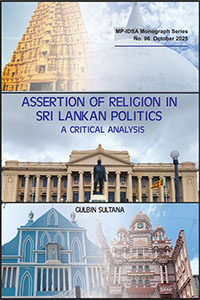
The monograph presents an in-depth analysis of the role of religion in Sri Lankan politics and its impact on the country in the social, political, security, and foreign policy domains. It focuses on the politics of the Sinhala-Buddhist and Muslim communities, as they have explicitly utilised their religions for political purposes in the post-independence period. To comprehend the role of religion in contemporary Sri Lankan politics, the monograph traces the evolution of the country's social and political structures, as well as the relationship between the state and religion, under various political systems and administrations from the ancient period till date. The historical and current political developments are analysed by applying the integrative theory in the context of religion and politics in Sri Lanka.
At the close of two years, the National Unity Government (NUG) of Sri Lanka has failed to maintain the confidence and trust of the people it enjoyed during the first three months of its tenure. Having said that, political crisis or instability in Sri Lanka remains unlikely. The NUG is likely to complete its full term, but it will not be a cakewalk.
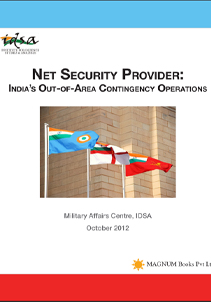
The report analyses previous deployments of the Indian military outside its borders, including in United Nations Peacekeeping Operations (UNPKO), evacuation of Indian citizens from conflict zones and in active operations like Sri Lanka from 1987–90 and the Maldives in 1988. It then examines the current capacity and trends for executing such operations. Finally, it makes recommendations not only for the Armed Forces but for other relevant agencies as well, such as the Ministries of Defence and External Affairs, the National Security Council and the Cabinet Secretariat.
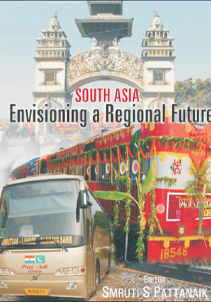
This volume includes a collection of papers contributed by eminent scholars and analysts from the South Asian region on how they visualise South Asia a decade hence. It is recognised that the region suffers from several constraints that has made common challenges difficult to address; nevertheless, there is an optimism that the region will move forward steadily albeit slowly, to evolve a common agenda, and shape a regional identity that would form the bedrock of any cooperative endeavour.
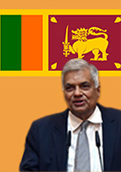
The ambitious policy measures taken by the Ranil Wickremasinghe government to revive the economy have yielded some positive outcomes though concerns remain over their implementation.
Though the Janatha aragalaya (people’s struggle) against the Rajapaksas was spontaneous, the role of the Left organisations in galvanising this into a movement that ousted the Rajapaksa family is an important landmark in Left politics.