
Temjenmeren Ao

Dr Temjenmeren Ao is an Associate Fellow at the South East Asia and Oceania Centre of MP-IDSA. He specialises in international relations and security issues in South East Asia. He has published extensively that includes chapters in edited books, journal articles and has also edited and co-edited books. He has participated in a number of national and international dialogues and conferences and also delivered lectures that includes Air Force Command Seminars and Squadron Officers Capsules. He has also participated in the International Visitor Leadership Program (IVLP), sponsored by the United States Department of State on the theme ‘Enhancing Regional Maritime Governance and Cooperation in the Quad’ in 2023.

Prior to joining MP-IDSA he worked as a Research Fellow on Southeast Asia at the Indian Council of World Affairs (ICWA), New Delhi (2017-2023) and as an Associate Fellow at the Centre for Air Power Studies (2015-2017), where he completed a project titled, “China’s Aerospace Sector: A Study on its Rise through Transfers of Technology”. He is an alumna of St Edmund’s College, Shillong and has a Master’s Degree in Economics from the Centre for Economics Studies and Planning, School of Social Sciences, Jawaharlal Nehru University (JNU), Delhi, and holds a PhD in International Relations from School of International Studies, JNU.


Associate Fellow

Publication

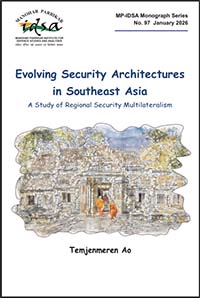
Evolving Security Architectures in Southeast Asia: A Study of Regional Security Multilateralism

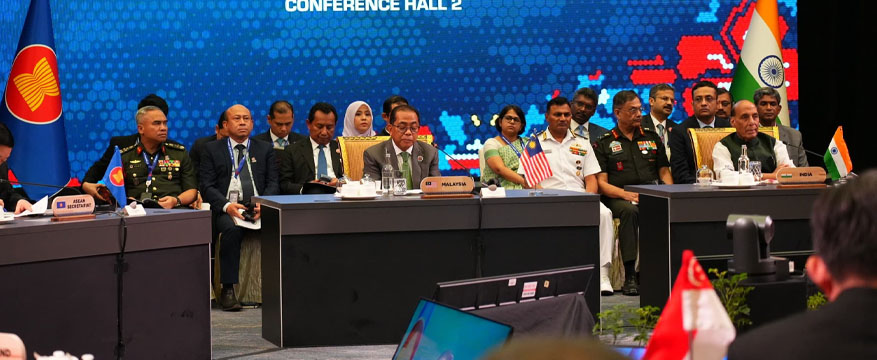
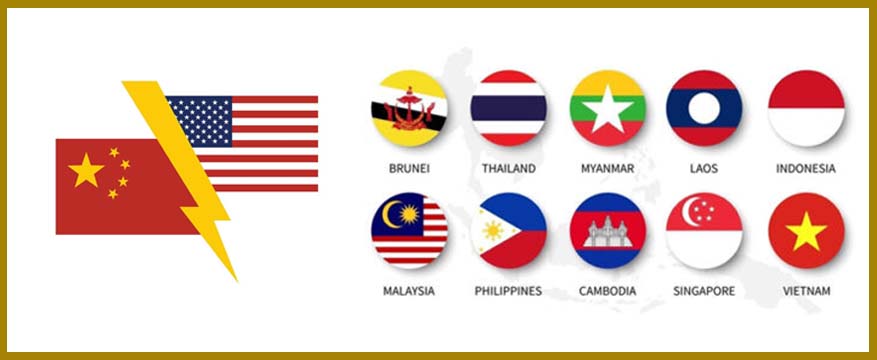
The central theme of this monograph is to analyse the emerging security architecture in Southeast Asia. The evolving internal and external developments which confronts Southeast Asian countries has led to the emergence of a complex regional security environment. The ongoing United States-China rivalry in which Southeast Asia finds itself at the centre, is a key factor in shaping the regional security outlook. The study examines the role of ASEAN in shaping the security architecture centered on its norms and upholding multilateralism. However, the ineffectiveness of ASEAN as an informal security arrangement raises concern over the future of security multilateralism. Further, at a time of weakening multilateralism, along with the emergence of new and renewed security alignments being witnessed in the Indo-Pacific; the ASEAN's centrality comes under increasing pressure. Therefore, an examination into the role of major powers and the new bilateral and mini-lateral security arrangements, provides the future roadmap for security multilateralism in Southeast Asia.

India’s Participation in the Quad: From Hesitation to Proactivity

The ‘Indo-Pacific’ region has become one of the epicentres of global issues, with the emergence of multilateral mechanisms such as the ‘Quadrilateral Security Dialogue’ (Quad). This group comprises Australia, India, Japan and the United States of America. India is considered to be the ‘weakest link’ in the Quad. However, this is only partially true. The authors of this article are of the view that, being the only country in the group that is not a formal US ally, India’s participation in Quad has been ‘different’ rather than ‘weak’ – moving from being hesitant to being more proactive, while maintaining its strategic autonomy.