Trans-Arctic Transport Corridor and India–Russia Cooperation
- April 23, 2026 |
- Issue Brief
Summary
Russia’s newly planned Trans-Arctic Transport Corridor (TATC) and India’s emphasis on developing multimodal connectivity to strengthen its Eastern ports and maritime infrastructures can open new potential business opportunities between the two countries. TATC and its extension via CVMC can offer broader economic partnerships among BRICS countries.
Introduction
In March 2025, Russian President Vladimir Putin unveiled a new plan to enhance Arctic connectivity. The Trans-Arctic Transport Corridor (TATC) aims to connect key Russian ports from St. Petersburg through Murmansk to Vladivostok and link them to Russia’s inland cities and towns via land, rail, sea and inland waterway systems.[1] Domestically, the TATC seeks to enhance Russia’s cargo-handling capacity at key ports by developing digital logistics infrastructure and integrating it with the country’s multimodal transport networks. Internationally, TATC aims to connect the world’s industrial, agricultural and energy centres with consumer markets, particularly in Asia, via shorter, safer and more cost-effective routes.
The Northern Sea Route (NSR), which earlier was emerging as a shorter alternative route for enabling maritime connectivity between Asian and European ports via the Arctic, would now become a ‘key section’ of this larger, more comprehensive TATC. In the past, India and Russia have shown interest in joint development of the NSR and the Eastern Maritime Corridor (EMC), also known as the Chennai–Vladivostok Maritime Corridor (CVMC).[2] This brief argues that the development of Russia’s TATC and its further extension to Asia, particularly India, offer tremendous new business opportunities for both India and Russia, thereby strengthening bilateral cooperation between the two countries.
Trans-Arctic Transport Corridor: An Overview
The proposed TATC is Moscow’s new comprehensive connectivity development project aimed at enhancing connectivity in the Russian Arctic. Russian experts argue that, as a result of rising Russian hydrocarbon and mineral exports, cargo flows along the NSR are expected to reach around 109 million tons by 2030.[3] These estimates could further increase due to growing uncertainties in West Asia. To benefit from emerging opportunities, policymakers in Russia believe there is a need to strengthen and expand multimodal transport connectivity networks within Russia and link them to emerging maritime routes in the Russian Arctic and beyond. The newly proposed TATC, therefore, aims to link Russia’s domestic railway network from its northwestern regions to its Far East, with ports along the NSR and the country’s inland waterways. Through TATC, Russia seeks to enhance its overall cargo-handling capacity by interlinking the country’s inland rivers—the Lena, Yenisei and Ob—with Arctic ports along the NSR via existing and new road and railway networks, to enable faster, more efficient logistics supply chains in the future.
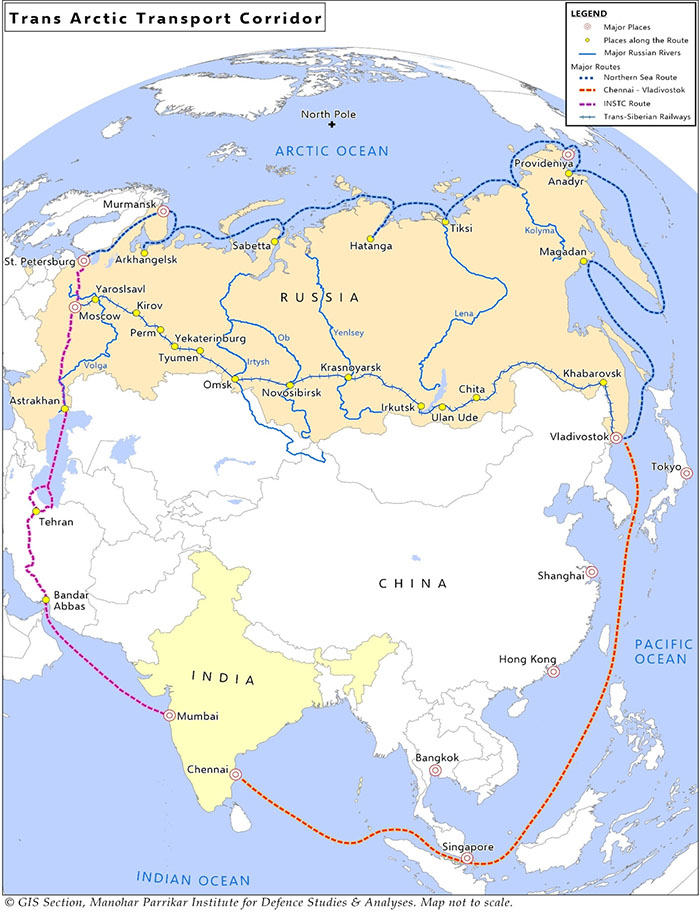
Russia has outlined the ports of Ust-Luga, Murmansk, Arkhangelsk, Dudinka, Sabetta, Tiksi, Pevek and Vladivostok for developing these as key transport hubs along the NSR.[4] The main objective of the TATC is to enable a more economical, shorter and safer transit shipping route between Europe and Asia, providing uninterrupted access to Southeast Asia, India, the Persian Gulf and Africa. Emphasis on enabling and ensuring year-round navigation has been outlined as a key component of this new project, with the development of Russia’s nuclear icebreaker fleet and the modernisation of port infrastructure as priority areas on the Russian state agenda. Lastly, there are plans to integrate other international transport corridors, such as the International North-South Transport Corridor (INSTC), with TATC to further enhance connectivity with Asian countries.
Prospective Areas for Enhancing India–Russia Cooperation
Shipbuilding and Ship Repair Facilities
President Putin has emphasised that to enhance shipping via the NSR and encourage countries to use the TATC, it is necessary to provide affordable shipping and icebreaker support services for cargoes transiting via NSR, so that overall transit costs do not increase drastically. To do so, the Russian president has called not only for strengthening domestic shipbuilding and developing cutting-edge high-technology shipyards in Russia, but also for partnering with like-minded partners.[5] Russian assessments suggest that demand for ship repair services would also increase significantly as a result of increased cargo shipping via TATC. Therefore, to meet the rising demand for ship repairs, the Russian government plans to more than double its ship-repair capacity along the NSR.[6] Further, Russia is also seeking partnerships with like-minded countries and international shipping companies that have merchant fleets capable of transporting petroleum products and liquefied natural gas using TATC.[7]
The Government of India in March 2026 allocated Rs 70,000 crore for shipbuilding, shipbreaking, maintenance and overhauling under the ‘Make in India’ initiative.[8] Such initiatives would align with each country’s national interests and offer a win-win outcome for both in the near future. Russia’s growing demand for new ship construction and its emerging requirements for ship repairs offer tremendous high-value business opportunities for Indian shipbuilding and ship repair companies.
In the past, Russia has placed orders with Indian shipbuilding companies to build 24 river-sea-class ships.[9] There were even reports of advanced discussions from the Russian side with India’s Cochin Shipyard (CSL) and Reliance Naval and Engineering for the construction of four new non-nuclear-powered icebreakers for the Russian state atomic energy company Rosatom.[10] Despite the significant business potential and complementary interests in the shipbuilding sector, progress on these projects has been slow due to global geopolitical challenges. Indian shipbuilding companies that have previously received Russian shipbuilding orders need to fast-track their execution to demonstrate India’s credibility to global clients. This would not only enhance the global reputation of Indian shipbuilding companies but would also enable them to secure new future global orders in shipbuilding.
Logistic Operations and Port Infrastructure Development
In the development of the TATC, Russia has called for the upgradation of existing ports and related infrastructure, along with the development of new ports with advanced, innovative and environmentally friendly solutions. There are plans to further develop infrastructure capabilities, including unmanned and automated cargo-handling systems, at these new ports to enhance the overall capacity and cargo turnover potential of its northern ports. President Putin, further, in his remarks on TATC, has highlighted that Russia remains open for joint ventures with international logistics operators who wish to invest and seek business opportunities in this domain in Russia. Many Indian port operators and port infrastructure development companies already have the expertise to develop port infrastructure abroad. The development of such infrastructure capabilities in TATC opens significant opportunities for both India and Russia to benefit from each other.
To involve Indian companies in executing such projects in Russia, there is a need for serious outreach efforts from the Russian side in India. Indian port infrastructure development companies with limited or no business exposure in Western countries could be good starting points for developing TATC.
Opportunities for Indian Labour and Manpower
The above-highlighted aspects of potential cooperation between India and Russia in developing TATC are highly labour-intensive. The completion of such grand projects requires significant manpower (skilled, semi-skilled and unskilled). According to the Russian Ministry of Labour, Russia is expected to witness a workforce gap of 3.1 million people by 2030.[11] The negative demographic trend in Russia is highlighted as a serious concern, and the Russian government is taking several initiatives to address it.[12] Despite best efforts, the problem is expected to become further complicated by the ongoing conflict in Ukraine. Such ongoing challenges can create serious problems for the timely execution of the proposed large-scale development projects in Russia.
To overcome this issue, India and Russia signed a labour mobility agreement during President Putin’s visit to New Delhi in December 2025.[13] For 2026, the Russian side has set a quota of around 70,000 Indian citizens to work in Russia. Official estimates suggest that by the end of 2025, 70,000 to 80,000 Indian citizens were working in Russia.[14] These numbers are expected to grow further in the near future. Such initiatives need to be further strengthened, as they can provide job opportunities for the young Indian population and offer immediate workforce solutions for Russian development projects. This would also further enhance people-to-people connections between India and Russia, yielding long-term benefits for future generations on both sides.
Strengthening Alternative Maritime Connectivity
Emphasis on developing Eastern Maritime Connectivity and cooperation, on the development of NSR, has received significant support from both India and Russia in the past.[15] However, the pace of such developments has slowed considerably since 2022 due to the Ukraine–Russia conflict and Western sanctions. During President Putin’s visit to New Delhi in December 2025, India and Russia concluded a formal Memorandum of Understanding (MoU) for training Indian seafarers for shipping operations in polar waters.[16] This highlights the strong mutual trust and the urge for greater Indian engagement, not confined to labour but also to specialised domains, that can contribute to the development of the Russian Arctic and its far-eastern regions.
The newly proposed TATC presents tremendous new business opportunities for India to enhance wider connectivity with Russia. It offers easy prospects for moving goods between Russia’s Siberia, the High North, and its Eastern regions, and for connecting those with Indian coastal regions on the East via CVMC and vice versa. This comprehensive Russian vision of developing the entire connectivity corridor stretching from St. Petersburg to Vladivostok via a multimodal transport network would bring Russia’s industrial infrastructure, even in its remote regions, closer to the Arctic and its Far Eastern ports. Like the NSR, once fully operational, the CVMC also has the potential to become a key international extension of TATC, serving as a strategic alternative maritime route not only between Russia and India, but also between Russia and other Southeast Asian countries and beyond.
From Net Energy Imports to Long-Term Investments
The OPEC World Oil Outlook 2025 report recently stated that India’s oil demand is expected to reach 8.2 million barrels per day by 2050, driven by growth in transportation, petrochemicals and industrial activity.[17] Similarly, according to the International Energy Agency (IEA), India’s demand for Liquefied Natural Gas (LNG) is set to reach 103 billion cubic meters (BCM) annually by the end of this decade.[18] The ongoing crisis in West Asia has clearly exposed the vulnerabilities of states that primarily rely on hydrocarbon imports from this region. In a scenario where India’s domestic exploitation potential for oil and gas is far less than its projected future requirements, there is an urgent need not only to secure reliable, diversified import sources but also to pursue existing avenues for long-term investments and joint hydrocarbon development projects to meet India’s future energy needs. Since the outbreak of the Ukraine–Russia conflict, India’s imports of Russian oil have increased significantly due to favourable prices and other economic factors. However, the existing potential of Russian LNG remains under-exploited.
Despite the European Union’s (EU) rigorous sanctions on Russia and its consistent efforts to target India’s hydrocarbon imports from Russia, the EU’s own LNG imports from Russia in the first quarter of 2026 have surpassed 2025 record levels. From January to March 2026, 97 per cent of the EU’s LNG cargoes (69 out of 71) were received from Russia’s Yamal LNG project in Siberia. This accounted for approximately €2.88 billion in LNG purchases by the European Union from Russia in just the first three months of 2026.[19] Russia’s significant push and open call for joint investments in oil, gas, metals, and other minerals development projects in the Russian Arctic, as part of the TATC development plan, create opportunities for Indian companies to pursue long-term investments in such Russian projects. The ongoing Western sanctions on large projects like Arctic LNG-2 hinder Western partners from making joint investments in them. This, on the other hand, provides an excellent window of opportunity for states that can afford to take calculated risks when competition for investment from others is fairly low.
It is also important to highlight that India is emerging as a global refining powerhouse. India currently accounts for 258 million metric tonnes per annum (MMTPA) of refined crude oil, and this is expected to reach 310 MMTPA by 2030, with further expectations of reaching 400–450 MMTPA in the future.[20] Reliance’s refinery in India’s Jamnagar is currently one of the largest and most complex single-site refineries in the world, with a capacity to process 1.4 million barrels of crude per day (MMBPD). Putin’s emphasis on developing high-value-added production facilities in petrochemistry and natural gas conversion as a crucial aspect of TATC, in addition to just the exploitation of raw hydrocarbons, offers potential business opportunities for the Indian and Russian sides to form joint ventures in this domain. Indian long-term investments in Russian oil and gas projects in the Arctic, or near-site investments to set up refining capabilities along the TATC in partnership with Russia, can strengthen India’s energy security and bolster India–Russia economic partnerships in the long run.
Opportunities in Developing Digital Infrastructure and Artificial Intelligence Systems
As the development plans for the TATC transition into reality, Russia’s Arctic coast and its remote locations in the Far Eastern region will require significant investments to build new Digital Infrastructure (DI) and integrate those with Artificial Intelligence (AI) systems. Creation of these would further enhance business, social and economic activities throughout the corridor and open new avenues for the region’s overall development. This element is being repeatedly emphasised in President Putin’s consistent remarks on TATC.[21] Russia recently successfully tested a fully autonomous truck that completed a 1,600 km journey between Kazan and St. Petersburg in just 24 hours. This trip would have taken a conventional truck driver 58 hours.
This highlights Russia’s serious efforts to develop autonomous freight systems using new digital innovations and smart technologies. The integration of such smart solutions into the Rail, Road and Sea network components of TATC could revolutionise logistics operations and significantly enhance cargo-handling capabilities across these corridors. For India, this aspect of TATC remains important, as India can offer low-cost IT solutions to Russia to build digital infrastructure for these projects. Further, technological cooperation and business opportunities with Russia to develop autonomous freight solutions to enhance India’s logistics capabilities could also be explored.
It should be noted that the efficient functioning of logistics operations across all domains of TATC (rail, road and maritime) requires substantial, advanced and uninterrupted computing capabilities. Keeping track of the geographical positions of rails/vehicles/vessels, analysing sea ice conditions, studying weather patterns, undertaking search-and-rescue operations, and enabling overall command and control of these systems would require data centres and servers at nearby sites to achieve operational efficiency and mitigate latency. There are already plans to build nuclear-powered data centres in the Russian Arctic that can offer uninterrupted services to these projects.[22]
The Government of India is also placing significant emphasis on developing the overall AI ecosystem. Under the ‘IndiaAI’ mission, the Indian government has allocated Rs 10,371.92 crores over the next five years to develop India’s capabilities across multiple AI domains. India has also launched the ‘Semicon India Programme’ to develop the semiconductor and display manufacturing ecosystem in India and support its AI ecosystem.[23] Therefore, the existing potential for cooperation in such areas on both sides offers immense avenues for collaboration.
Conclusion
Russia’s Trans-Arctic Transport Corridor and India’s emphasis on developing multimodal connectivity to strengthen its Eastern ports and maritime infrastructure under government initiatives like PM Gati Shakti and the Sagarmala programme have tremendous potential to enhance the total cargo turnover capacity of ports and open new business opportunities between India and Russia. Assessments suggest that the Chennai–Vladivostok Maritime Corridor can significantly reduce ‘net maritime shipping distance and time’ between India and Russia (from approximately 40 days to 18–20 days), if shipping cargoes are picked/dropped at Russia’s Vladivostok and India’s Chennai and other Eastern ports and vice-versa.
Western sanctions, particularly those targeting Russia’s oil and gas sectors, have created challenges in executing large-scale development projects. Still, it would be difficult for these states to maintain these sanctions against Russia for much longer. Recent research published by the Hungarian Institute of International Affairs highlights that if the EU maintains these sanctions against Russia, it will shrink the European economy by nearly 12 per cent, drastically lowering living standards across Europe.[24]
European Union’s record purchases of Russian LNG, Japan’s uninterrupted imports of Russian gas from its Sakhalin project despite being strong western ally, US’ selective approaches in providing exemption for states like Hungary and some German-run, Russian-owned refineries (PCK Schwedt, MiRo, Bayernoil) in the west are clear indications of serious vulnerabilities that exist for even these Western economies if Russian energy resources are completely removed from global supply chains.
For India and Russia, if their ‘high-value’ economic partnership has to move beyond cooperation in defence and energy sectors, TATC is one such avenue which offers new potential. Both countries, since the advent of the Ukraine–Russia war, have successfully managed the impacts of Western sanctions, and there is no doubt that these can’t be managed in the future. Finally, India, through its ongoing BRICS presidency, can also consider leveraging its position by calling for enhanced Eastern maritime connectivity, in which TATC and its extension via CVMC can facilitate broader economic partnerships among BRICS countries. This new maritime route can take regional trade figures to new heights and secure future trade and energy shipments against traditional and non-traditional security threats persisting in the Western Indian Ocean Region.
Views expressed are of the author and do not necessarily reflect the views of the Manohar Parrikar IDSA or of the Government of India.
[1] Vladimir Putin, “6th International Arctic Forum, The Arctic: Territory of Dialogue”, Full Speech, President of Russian Federation, 27 March 2025.
[2] “Joint Statement Following the 23rd India-Russia Annual Summit”, Ministry of External Affairs, Government of India, 5 December 2025.
[3] Valery P. Zhuravel and Sergey N. Grinyaev, “Trans-Arctic Transport Corridor: Political, Economic and Strategic Potential for Russia”, Arctic and North, No. 60, 2025, pp. 112–125.
[4] Ibid., p. 115.
[5] Vladimir Putin, “6th International Arctic Forum, The Arctic: Territory of Dialogue”, no. 1.
[6] “Northern Sea Route’s Ship Repair Capacity to Double by 2035 — Ministry”, TASS, Russian News Agency, 13 March 2026.
[7] Vladimir Putin, “6th International Arctic Forum, The Arctic: Territory of Dialogue”, no. 1.
[8] “English Rendering of PM’s Remarks in the Rajya Sabha on the Ongoing Conflict in West Asia”, Press Information Bureau, Prime Minister’s Office, Government of India, 24 March 2026.
[9] John C. K. Daly, “India to Build 24 Cargo Vessels for Russian Use in Caspian Trade”, Eurasia Daily Monitor, Vol. 20, No. 179, 20 November 2023.
[10] P. Manoj, “Russia Eyes Indian Yards to Build Four Non-nuclear Icebreaker Ships to Back its Northern Sea Route Plan”, ET Infra, 10 October 2024.
[11] “Russian Economy’s Needs for Human Resources to Exceed 3 mln by 2030 – Deputy PM Golikova”, Interfax, 23 December 2024.
[12] “Measures Taken to Boost Birth Rates in Russia Not Enough – Putin”, Interfax, 8 December 2025.
[13] “Agreement Between the Government of the Republic of India and the Government of the Russian Federation on Temporary Labor Activity of Citizens of One State in the Territory of the Other State”, Ministry of External Affairs, Government of India, 4 December 2025.
[14] Evgeniy Dyuk and Murali Krishnan, “Russia Looks to India to Fill Labor Shortage”, Deutsche Welle, 25 January 2026.
[15] “India and Russia Explore Northern Sea Route (NSR), Eastern Maritime Corridor (EMC) in an Effort to Widen Maritime Cooperation”, Press Information Bureau, Ministry of Ports, Shipping and Waterways, 13 September 2023.
[16] “Memorandum of Understanding Between the Ministry of Transport of the Russian Federation and Ministry of Ports, Shipping and Waterways of the Government of the Republic of India on the Training of Specialists for Ships Operating in Polar Waters”, Ministry of External Affairs, Government of India, 4 December 2025.
[17] “India’s Energy Demand Expected to Double by 2050 as Oil & Gas Expected to Remain Central to Global Energy Mix”, Press Information Bureau, Ministry of Petroleum & Natural Gas, Government of India, 28 January 2026.
[18] “India’s Natural Gas Demand Set for 60% Rise by 2030, Supported by Upcoming Global LNG Supply Wave”, International Energy Agency (IEA), 12 February 2025.
[19] Ian Johnston, “EU Boosts Imports of Russian Gas as Middle East Crisis Squeezes Supplies”, Financial Times, 10 April 2026.
[20] “India to Emerge as Global Refining and Energy Hub: Shri Hardeep Singh Puri at Energy Technology Meet”, Press Information Bureau, Ministry of Petroleum & Natural Gas, Government of India, 28 October 2025.
[21] Vladimir Putin, “Address to International Transport and Logistics Forum Participants”, President of Russia, 1 April 2026; Vladimir Putin, “6th International Arctic Forum, The Arctic: Territory of Dialogue”, no. 1.
[22] “Arctic Data Processing Centers May Serve Trans-Arctic Transport Corridor — Expert”, TASS, Russian News Agency, 28 November 2025.
[23] “IndiaAI Mission Expands AI Ecosystem with Affordable Compute and Startup Support”, Press Information Bureau, Ministry of Electronics & IT, Government of India, 25 March 2026.
[24] Philip Pilkington, “How Much Economic Pain Have the Russian Sanctions Caused Europe?”, Hungarian Institute of International Affairs, 2 March 2026.