
Lifecycle Cost Analysis in Indian Naval Aircraft Acquisition
- November 19, 2026 |
- Issue Brief
Summary
Systematic integration of Lifecycle Cost analysis at the acquisition stage, supported by performance-based logistics, contractual accountability for sustainment and independent cost verification, will materially improve the long-term operational efficiency and availability of Indian Navy aircraft, with broader applicability across the aviation assets of all three Services.
Introduction
The Indian Navy’s air arm has grown from a coastal adjunct into a decisive instrument of maritime strategy. It presently operates over 280 aircraft of 17 types from a network of 10 commissioned naval air stations.[1] The Atmanirbhar Indian Naval Aviation Technology Roadmap 2047 envisages a fleet of some 400 aircraft over the next two decades.[2] Expansion on this scale is a strategic gain, but it carries a less visible obligation. A naval aircraft, like any military aircraft, is not a single purchase; it is a 30–40 year financial and engineering commitment, and the greater part of its cost is incurred long after the contract is signed.
The challenge lies in how acquisition decisions are taken. Indian procurement has long been organised around the lowest bidder, or L1, and around the price quoted at the point of sale. That price, however, captures only the platform. Operations, maintenance, spares, training, mid-life upgrades, and eventual disposal together account for most of what the aircraft will actually cost the exchequer. Where these elements are not examined at the time of purchase, they reappear later as unscheduled expenditure, extended downtime and reduced availability. They are the hidden cost of the lowest bid.
Military aircraft are expected to deliver high availability in demanding roles, often in harsh environments. Maritime aircraft, for instance, operate in salt-laden and humid conditions that accelerate corrosion and wear. Many of their critical components can be repaired only by the original equipment manufacturer (OEM). The true test of an acquisition decision is therefore what the aircraft costs to own, operate, and keep available for its entire life. Life Cycle Cost (LCC) analysis is the discipline that makes this test explicit.
This brief argues that systematically integrating LCC analysis at the acquisition stage, supported by performance-based logistics, contractual accountability for sustainment, and independent cost verification, will materially improve the long-term operational efficiency and availability of Indian Navy aircraft. The dominance of the lowest bidder and the separation of acquisition from sustainment are features of the defence procurement framework common to all three Services, and the framework proposed, though developed for naval aviation, applies to aircraft acquisition by each of them.
The Economics of Aircraft Ownership
LCC is the total cost of owning and operating an asset from defining the requirement to final disposal. For a military aircraft, the acquisition element recovered within the purchase price is a minority of the total. For fixed-wing aircraft, United States Department of Defense (DoD) guidance places research and development at 7 per cent, investment (procurement) at 28 per cent, and operating and support at 64 per cent (Figure 1).[3] A live illustration is the F-35: of a projected lifecycle cost exceeding US$ 2 trillion, about US$ 442 billion is acquisition and US$ 1.58 trillion is sustainment.[4] Analysts focused on the Indian context place the sustainment share at 65–75 per cent.[5] The proportions vary with platform, role and environment, but the ordering does not. Sustainment, not acquisition, dominates.
Figure 1. Distribution of Life Cycle Cost for Fixed-Wing Military Aircraft
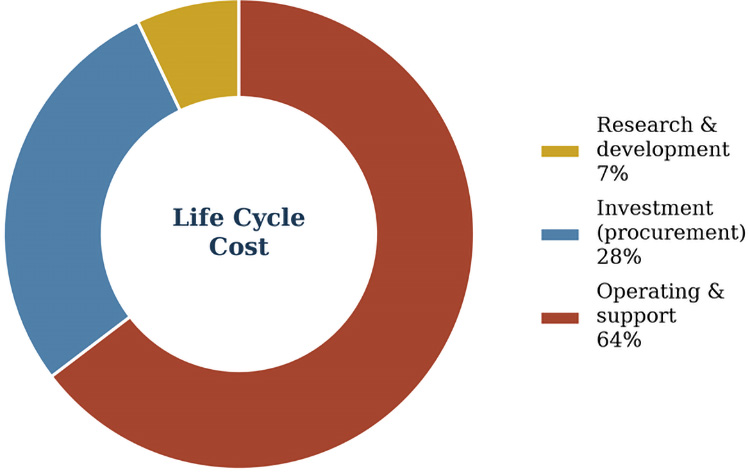
Source: US Department of Defense, Operating and Support Cost-Estimating Guide, 2020. Figures exclude military construction.
The drivers of this submerged cost are well understood. Reliability determines how often a system fails; maintainability determines how long it takes to restore it; supportability determines whether the spare part, test bench, and trained technician are available when needed.[6] They are designed in, or designed out, and they are heavily influenced by the contract concluded at acquisition. An aircraft bought with a high mean time between failures, a low mean time to repair and a guaranteed supply of spares will cost less to keep available than one bought on price alone, even if the latter is cheaper on the day of signature.
Two further mechanisms widen the gap between price and true cost. The first is the fleet-sizing penalty. Holding 30 aircraft on task requires about 38 airframes at 80 per cent availability, but 60 at 50 per cent, a difference of 22 aircraft and everything that accompanies them: hangarage, crews and spares.[7] A platform that appears cheaper at purchase but delivers lower availability can therefore prove more expensive once you count the fleet needed to deliver the same output. The second is cost escalation: every year of delay in concluding a major contract adds to its price, and sustainment left to piecemeal annual demands forfeits the leverage held at the point of purchase.
Despite these mechanics, Indian military aircraft acquisition, across all three Services, remains dominated in practice by purchase price, a product of procurement rules and budgeting structures rather than any single Service’s choices. The capital cost of an aircraft is visible and budgeted as capital; its sustainment is met from revenue, spread thinly across many years and many heads.[8]
The Acquisition–Sustainment Disconnect
The gap between the theory of lifecycle costing and its practice in India is one of enforcement, not knowledge. The Defence Procurement Procedure of 2006 introduced the concept, requiring vendors to furnish operating, maintenance, overhaul and training costs.[9] The Defence Acquisition Procedure (DAP) 2020 goes further. The Request for Information must itself seek the maintenance and lifecycle support proposed for the platform, and a lifecycle support contract is to be signed along with the main contract, providing product support for at least three to five years beyond warranty.[10] The draft DAP 2026 retains that framework.[11] Provisions exist. What is missing is their application. Follow-on support is discretionary, not mandatory; it is negotiated after the award and funded from revenue. The vendor is therefore not bound to the support costs on which the award was taken, and the user Service returns to the negotiating table when its leverage has already been spent.
The lowest-bidder method remains the default. Under L1, metrics such as the system’s average life, differences in capability, and operating and maintenance costs do not factor into the comparison. In 2021, the then Chief of the Army Staff publicly called for a rethink of L1, and the Ministry of Finance subsequently indicated that quality-cum-cost based selection could be used for suitable procurements.[12] The direction of travel is clear, but the practice lags.
Where LCC has been attempted, the implementation has often been partial. A study in Trade, Law and Development found the Indian Air Force’s Total Cost of Acquisition model to be a heavily reduced version of lifecycle costing: the signed contract binds the supplier only to the direct cost of acquisition, not to the sustainment costs quoted during bidding.[13] In the Pilatus trainer case, a declared lifecycle cost of about Rs 4,160 crore was followed after award by a follow-on support demand reported to be substantially higher than the estimate on which the vendor was selected.[14] The A330 MRTT case, where a lower lifecycle cost matched a higher purchase price, showed the method’s value when applied.[15]
The disconnect is structural. Acquisition and sustainment are funded from different budgets, managed by different organisations, and governed by contracts that are not linked to one another. The Service negotiates from its strongest position when it has the most leverage but the least information, and from its weakest when it has the most information but the least leverage.
The Indian Navy’s Aircraft Acquisition Challenge: Scale, Cost and Consequence
The scale of the Indian Navy’s aviation enterprise has changed markedly, and with it the financial stakes. India was the world’s fifth-largest military spender in 2025 at US$ 92.1 billion, and within the defence budget the Navy’s share has risen from about 15 per cent to 21 per cent.[16]
The first and most visible consequence is the cost of keeping aircraft serviceable. Because many critical components of foreign-origin aircraft, such as sensors, line-replaceable units and limited-life assemblies, can be repaired only by the OEM, unserviceable items must be dispatched abroad. In the author’s professional experience, the reverse-logistics chain is long. From the moment an item is removed to the moment a serviceable replacement returns, the process commonly takes 8–12 months, and in many cases 12–18 months.
The second consequence is what happens when spares are scarce. Without contractual obligations on the OEM to supply, and with demands raised piecemeal through annual reviews, availability suffers. Units respond by cannibalising aircraft. This keeps some aircraft flying at the expense of others, degrades the maintenance culture, and slowly erodes the deep-repair skills that underpin long-term sustainment.
The third consequence is measured directly in availability. The MiG-29K fleet offers the clearest public evidence. An early audit found serviceability ranging from roughly 16–38 per cent, with most engines withdrawn from service because of design-related defects.[17] A fleet held at such levels cannot deliver the sortie rates its role demands, and the shortfall reflects support arranged, or not arranged, years earlier.
The cumulative effect is a growing mismatch between the assets the Service operates and the money it has to sustain them. The manpower bill continues to crowd out the equipment and sustainment heads.[18] Industry estimating practice adopts an escalation of 5 per cent to 7.5 per cent a year where index-based escalation is not feasible.[19] The average cost overrun on a major defence contract has been estimated at 40 per cent.[20] The United States Government Accountability Office has similarly found that aircraft mission-capable rates across its fleets generally did not meet their goals.[21]
Evidence from Indian Navy Acquisition Contracts
This section examines three acquisitions, the MiG-29K, the MH-60R and the P-8I, for the presence or absence of lifecycle provisions at the time of purchase, and for the consequences that followed. Together they show that the gap lies in the defence procurement framework rather than in any single programme.
The MiG-29K was acquired under a contract dated 20 January 2004, with the aircraft inducted from 2010. The contract was concluded without the associated support package, and the Comptroller and Auditor General found that facilities for operating the type were not synchronised with its induction.[22] No long-term maintenance or spares support agreement was concluded with the aircraft contract, and the average repair-return time rose to about 18–19 months.[23] It was not until October 2022 that an agreement was reached with Hindustan Aeronautics Limited on module-level repair of the RD-33MK engine.[24] Had repair facilities been contracted for at the outset, the audit estimates, turnaround could have been reduced to 3–4 months.
The MH-60R acquisition, concluded by a Letter of Offer and Acceptance dated 25 February 2020 under the United States Foreign Military Sales route, shows that the issue is not confined to any one source country. The contract covered operator-level test equipment, tools, and ground support equipment for one main operating base. A dedicated five-year sustainment package, covering follow-on support and supply and establishing intermediate-level repair facilities in India, was concluded in November 2025.[25] The Royal Australian Navy, acquiring the same aircraft type, concluded a support contract worth about US$ 185.8 million and trained its maintainers for 12 months with hands-on experience alongside United States squadrons.[26] The comparison is not about resources alone; it is about what each buyer chose to put in the contract.
The P-8I, which benefitted from platform commonality with a civil airliner, has been supported through a series of sustainment contracts with Boeing covering performance-based support, in-country component overhaul with Indian MRO partners, heavy maintenance at a commercial facility, and depot-level maintenance.[27] The result is a platform with comparatively robust support and markedly higher operational availability. The lesson is not that the P-8I was acquired with a lifecycle contract, for it was not, but that sustainment was arranged afterwards. The Indian Navy has itself begun to close this gap, as the P-8I support contracts and the 2025 MH-60R sustainment package show; the framework proposed here would make such arrangements the rule at acquisition rather than a correction afterwards. Table 1 summarises the three contracts.
Table 1. Support and Sustenance Provisions in Selected Indian Navy Aircraft Acquisition Contracts
| Aircraft (contract) | Long-term sustainment contract at acquisition | In-country repair capability | Outcome |
| MiG-29K (January 2004) | None concluded | No deep-repair facility at induction; engine module repair agreed in 2022 | Serviceability 15.93–37.63%; 40 of 65 engines withdrawn from service |
| MH-60R (February 2020) | None at induction; five-year follow-on support package concluded in November 2025 | Intermediate-level component repair and periodic maintenance facilities to be established in India | Sustainment assured from 2025 |
| P-8I (January 2009) | None at acquisition; OEM sustainment contracts concluded from 2017 | Component overhaul through an Indian MRO partner from 2024; heavy maintenance at a commercial facility | Three-year sustainment contract, 2017; component MRO partnership, 2024; maintenance contract, March 2026 |
Source: Compiled by the author from the audit reports and official releases cited.
What Changes When LCC Decides
Applied to the selection of a deck-based fighter, using a multi-criteria framework in which operational capability, lifecycle cost, reliability, maintainability, supportability and growth potential are weighted by the Analytic Hierarchy Process (AHP), with indicative data for the MiG-29K, the Rafale and the F/A-18, the method is instructive (Table 2).[28] The Rafale, though not the cheapest to acquire, emerges with the highest weighted score, because its advantages in reliability, maintainability and supportability offset its higher purchase price. When support costs are stressed by 20 per cent, every aircraft’s score falls, but the ranking is unchanged. The absolute figures are illustrative; the ordering is not. Procurement cost alone misleads.
Table 2. Multi-Criteria (AHP) Evaluation of Candidate Deck-Based Fighters
| Criterion | Weight | MiG-29K | Rafale | F/A-18 |
| Operational capability | 33% | 8 | 9 | 7 |
| Lifecycle cost | 23% | 7 | 9 | 6 |
| Reliability (MTBF) | 16% | 6 | 9 | 7 |
| Maintainability (MTTR) | 11% | 7 | 9 | 6 |
| Supportability | 11% | 7 | 9 | 6 |
| Growth potential | 6% | 8 | 8 | 7 |
| Weighted score (out of 10) | 100% | 7.23 | 8.94 | 6.55 |
| Score after 20% support-cost stress | – | 6.91 | 8.53 | 6.27 |
Source: Author’s indicative assessment. Weights are the normalised principal eigenvector of a pairwise comparison matrix on the Saaty 1–9 scale; consistency ratio 0.001.
International Benchmarks: Making LCC Binding
In the United States, law and acquisition regulations require lifecycle costing. Every major programme must produce a lifecycle sustainment plan and an independent cost estimate, and the Truth in Negotiations Act obliges a bidder to certify the cost data it submits, which the Defense Contract Audit Agency may examine.[29] In the United Kingdom, whole-life cost modelling runs across its Concept, Assessment, Demonstration, Manufacture, In-Service and Disposal (CADMID) cycle, and its contracting-for-availability arrangements pay the contractor for delivering an agreed level of availability, with gain-share and pain-share incentives.[30] Australia acquires and sustains platforms under one organisation, the Capability Acquisition and Sustainment Group, with sustainment governed by agreements carrying agreed prices and performance indicators.[31] In each case, the cost and availability promised at bid become contractual obligations, verified independently and enforced through incentives.
The enabling mechanism that ties these strands together is performance-based logistics (PBL). Under PBL, the contractor is compensated for delivering an outcome, a specified level of availability or reliability, not for performing tasks. The buyer stops paying for repairs and starts paying for readiness, and the contractor’s profit aligns with the user’s requirement, not the volume of failures.[32]
An Integrated LCC Decision Framework
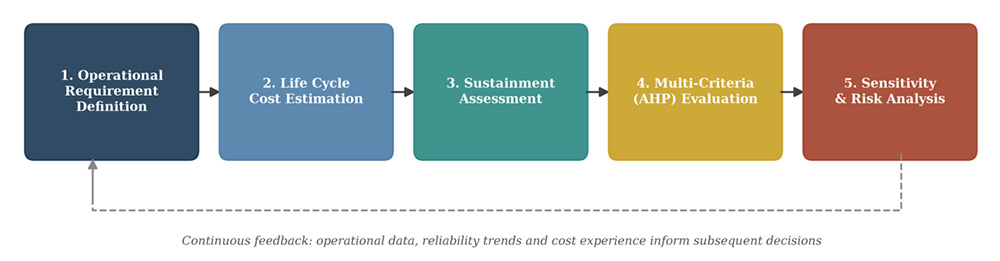
If the diagnosis is that sustainment is under-weighted at acquisition, the prescription must be a method that makes sustainment impossible to neglect. The integrated LCC decision framework proposed here has five stages and applies to any major military aircraft acquisition (Figure 2). It does not replace judgement; it disciplines it.
Figure 2. Integrated Life Cycle Cost Decision Framework for Indian Naval Aircraft Acquisition
Source: Author’s original framework.
Operational Requirements
The qualitative requirements should state, from the outset, the availability the Service expects, the mean time between failures and mean time to repair it will accept, the maintenance concept it intends to operate, and the level of in-country repair capability it requires.
LCC Estimation
Total ownership cost should be estimated for each candidate in present-value terms and validated independently.[33] Each vendor should provide cost data on a standard template covering acquisition, operations, maintenance, logistics support, training, upgrades and disposal.
Sustainment Assessment
The evaluation should ask whether critical components can be repaired in-country, and if not, by when; whether there is a pathway to indigenise spares and repairs; and what transfer of technology, source code and technical data is required.[34]
Multi-Criteria Evaluation
Cost and capability should be combined in a single, transparent comparison, with the weights set explicitly by the competent authority for each acquisition.
Sensitivity and Risk Analysis
Support costs, fuel prices, utilisation rates and obsolescence should be varied across plausible ranges. Where the ranking is stable, confidence is warranted; where it is not, identify the reason before award.
A framework that ends at evaluation is incomplete. The analysis must be carried into the contract through PBL; risk apportionment, so that the user does not bear all the risk of equipment failure; long-term spares agreements with buy-back provisions; source-code and technical-data escrow, so that the Service is not stranded when a supplier exits; and independent verification of the data on which the award was made. This is not a novel prescription in Indian defence writing. An IDSA volume on acquisition best practices concluded in 2013 that requests for proposals should progressively include integrated logistics and maintenance programmes for as extended a period as practicable.[35]
Counter-Arguments
The first objection is that LCC estimates are notional, and that Indian processes are not mature enough to handle notional figures.[36] This is answered not by abandoning the method but by disciplining it: independent verification of vendor-supplied data, explicit statement of assumptions, and sensitivity analysis. Second, LCC is a Western concept, designed for procurement within a domestic industrial base. The response is to adapt the framework, not to discard it. Even in a single-source purchase, LCC can be estimated, recorded and used as a negotiating position, and the binding force can come from the contract itself rather than from a statute such as the Truth in Negotiations Act.[37]
The third and most serious objection is that cost must not trump capability. Operational capability carries the largest weight in the evaluation, and LCC, while material, does not dominate. It is a decision-support tool, not a decision rule; its purpose is to ensure that cost is visible when capability is weighed. A fourth objection is that binding sustainment to a single vendor risks lock-in for three or four decades. This argues for careful contract design: open architectures and technical data rights, source-code escrow, indigenisation of spares and repairs over time, and arrangements that preserve competition in the sustainment market. The final objection is that sophisticated analysis slows acquisition. Against this must be set the cost of the alternative. The status quo has produced extended turnaround, serviceability below the Service’s own standard, and contracts that buy aircraft without their support.
Recommendations
In the immediate term, LCC should be institutionalised as a mandatory evaluation criterion for all major aircraft acquisitions, with a standardised estimation template and an explicit statement of assumptions. Every statement of requirement should specify the availability, reliability and maintainability parameters the Service requires. A dedicated cost analysis and verification cell, independent of the acquiring directorate, should validate vendor-supplied LCC and reliability data, and each vendor should provide a disaggregated LCC breakdown at the Request for Information stage. LCC-based evaluation may also be proposed for incorporation in the Defence Acquisition Procedure 2026 during its finalisation, so that L1 for major aircraft acquisitions is determined on lifecycle cost, with the support contract concluded alongside the main contract. This would remove the need for case-by-case approvals and ease the procedural hurdles in applying lifecycle costing.
In the short term, within one to three years, long-term maintenance and spares support agreements should be concluded at the same time as the main acquisition contract. PBL should be adopted for suitable platforms, as specified in the Request for Proposal, with availability-based payment, defined performance metrics, and incentives rather than purely penalty-based provisions. Embed maintainability evaluation within field evaluation trials, and include risk-apportionment clauses, source-code and technical-data escrow, and buy-back provisions for spares.
In the medium term, within three to five years, contract deep-repair facilities for every new platform at acquisition, and ensure they are in place no later than the fifth year after induction. A technically qualified officer, supported by a small team, should be responsible for sustainment analysis within the directorate that acquires aircraft in each Service; a project management team should persist for each major acquisition until the sustainment obligations are in place; and a field-level team of pilots, air operations officers, air technical officers and technicians at the operating base should hold defined responsibilities and financial powers. Maintainer training should include on-the-job training on the type during induction, and an indigenous sustainment ecosystem of MRO facilities, spares manufacture, and repair should be built up over the first half of the platform’s service life.
In the long term, five years and beyond, the Services should adopt digital lifecycle management, including condition-based maintenance, health and usage monitoring and predictive analytics, with the necessary data rights mandated in contracts. The five-stage framework should be developed into a unified, indigenised LCC framework applicable to both imported and indigenous platforms, supported by an indigenous cost database.
Conclusion
Aircraft acquisition is a long-term strategic investment whose financial consequences extend far beyond the purchase price. Acquisition cost alone provides an inadequate basis for decision-making, because operations, maintenance, logistics support, training and mid-life upgrades together constitute the majority of ownership cost. Indian practice has recognised this in policy for two decades. Yet, the consequences are visible in the fleet: extended repair turnaround, serviceability below the Service’s own standard, cannibalisation and the loss of deep-repair skills all trace back to sustainment arrangements not made when the aircraft was bought.
The P-8I shows what sustainment is worth, and a usable method now exists: a five-stage framework that makes sustainment visible and material at each acquisition, carried into the contract through performance-based logistics, risk apportionment and independent verification of cost data. The framework is not a substitute for judgement, and it is only as good as the data it rests on and the institutional will to apply it. Nor is the problem confined to the Navy; the framework, though developed for naval aviation, is equally relevant to aircraft acquisition by the Army and the Air Force.[38] Applied consistently, it offers a practical route to higher availability at lower whole-of-life cost.
Cdr Akhil RS is an Aviation Technical Specialist from the Naval Staff and Technical Management Course (NSTMC) at the Naval War College.
[1] Johnson Odakkal, “Guardians of the Maritime Sky: 70 Years of Indian Naval Aviation”, JOI4U, 11 May 2023.
[2] “Indian Navy Reveals Atmanirbhar Roadmap 2047, Focuses on Naval Aviation & Innovation”, Aviation Today, 13 February 2025.
[3] Operating and Support Cost-Estimating Guide, Office of Cost Assessment and Program Evaluation, US Department of Defense, September 2020.
[4] “F-35 Sustainment: Costs Continue to Rise While Planned Use and Availability Have Decreased”, GAO-24-106703, US Government Accountability Office, April 2024.
[5] Rajendra Kumar Joshi, “Redefining Value in Aerospace: Integrating Lifecycle Costing, Operational Availability, and Sustainability in Defence Procurements”, The Management Accountant, Vol. 61, No. 5, May 2026, pp. 17–24.
[6] M. Gerdes, D. Scholz and D. Galar, “Effects of Condition-Based Maintenance on Costs Caused by Unscheduled Maintenance of Aircraft”, Journal of Quality in Maintenance Engineering, Vol. 22, No. 4, 2016, pp. 394–417.
[7] Rajendra Kumar Joshi, “Redefining Value in Aerospace: Integrating Lifecycle Costing, Operational Availability, and Sustainability in Defence Procurements”, no. 5.
[8] Sameer Patil, “The Role of Life Cycle Cost in Defence Procurement”, ORF Special Report, Observer Research Foundation, October 2022.
[9] Ibid.
[10] “Defence Acquisition Procedure 2020”, Ministry of Defence, Government of India, September 2020, Chapter II, paras 5(c), 5(f) and 51, and Appendix F to Chapter II.
[11] “Defence Acquisition Procedure 2026 (Draft)”, Ministry of Defence, Government of India, 2026.
[12] Sameer Patil, “The Role of Life Cycle Cost in Defence Procurement”, no. 8.
[13] Sandeep Verma, “Life Cycle Costing in Defence Acquisition: The Challenges of Transforming Complex Aspirations into Factual Ground Realities”, Trade, Law and Development, Vol. 7, No. 1, 2015, p. 120.
[14] “Performance Audit Report on Capital Acquisition in Indian Air Force”, Comptroller and Auditor General of India, 2019; Sameer Patil, “The Role of Life Cycle Cost in Defence Procurement”, no. 8.
[15] Sameer Patil, “The Role of Life Cycle Cost in Defence Procurement”, no. 8; Sandeep Verma, “Life Cycle Costing in Defence Acquisition”, no. 13.
[16] “Trends in World Military Expenditure, 2025”, SIPRI Fact Sheet, Stockholm International Peace Research Institute, 2026; “A Record over Rs 6.81 Lakh Crore Allocated in Union Budget 2025-26 for MoD, an Increase of 9.53% from Current Financial Year”, Press Information Bureau, Ministry of Defence, Government of India, 1 February 2025; “India’s Naval Push Goes Slow amid Project Delays”, Business Standard, 13 March 2026.
[17] “Performance Audit on Construction of Indigenous Aircraft Carrier”, Report No. 17, Comptroller and Auditor General of India, 2016.
[18] Laxman Kumar Behera, India’s Defence Economy: Planning, Budgeting, Industry and Procurement, Routledge, London, 2021.
[19] “Outsourcing Manual”, Rev 05, Hindustan Aeronautics Limited, 2024.
[20] Jacques S. Gansler, Affording Defense, MIT Press, Cambridge, MA, 1989.
[21] “Weapon System Sustainment: Aircraft Mission Capable Goals Were Generally Not Met and Sustainment Costs Varied by Aircraft”, GAO-23-106217, US Government Accountability Office, 2022.
[22] “Functioning of the Aviation Arm of the Indian Navy”, Report No. 7, Comptroller and Auditor General of India, 2010; “Compliance Audit on Air Force and Navy”, Report No. 20, Comptroller and Auditor General of India, 2011.
[23] “Performance Audit on Construction of Indigenous Aircraft Carrier”, no. 17.
[24] “HAL to Support MRO of RD33 Mk Engine of MiG 29/KUB Aircraft”, PSU Connect, 20 October 2022.
[25] “MoD Inks Letters of Offer & Acceptance with US for Sustainment Support of Indian Navy’s Fleet of MH60R Helicopters through Follow on Support and Follow on Supply Support Worth Approx Rs 7,995 Crore”, Press Information Bureau, Ministry of Defence, Government of India, 28 November 2025.
[26] “Lockheed Martin Awarded US$185.8m Contract to Support RAN MH-60R Fleet”, Defence Connect, 6 February 2020; “Major Projects Report 2014-15: Project Data Summary Sheet – AIR 9000 Phase 8, Future Naval Aviation Combat System Helicopter”, Australian National Audit Office, 2015.
[27] “Boeing Wins Three-Year Contract to Support Indian Navy P-8I Fleet”, Boeing, 19 June 2017; “Boeing Partners with AIESL for Component MRO to Support Indian P-8I Fleet”, Boeing, 13 August 2024; Press Trust of India, “Govt Inks Twin Defence Deals Worth Rs 858 Crore”, ThePrint, 27 March 2026; Greg Waldron, “GMR Aero Technic to Conduct P-8I Heavy Checks in Hyderabad”, FlightGlobal, 14 May 2026.
[28] Thomas L. Saaty, The Analytic Hierarchy Process, McGraw-Hill, New York, 1980.
[29] Operating and Support Cost-Estimating Guide, no. 3; Sandeep Verma, “Life Cycle Costing in Defence Acquisition: The Challenges of Transforming Complex Aspirations into Factual Ground Realities”, no. 13.
[30] “Contracting for Availability”, in Applied R&M Manual for Defence Systems (GR-77), Issue 2012, Version 2.0, Ministry of Defence, United Kingdom; “Defence Support Modelling and Analysis Framework”, Policy Paper, Ministry of Defence, United Kingdom, 2024.
[31] “Defence’s Management of Materiel Sustainment”, Australian National Audit Office, 2017; “The CASG Business Framework”, Department of Defence, Australia, 2017.
[32] US Department of Defense, Performance-Based Logistics Guidebook: A Guide to Developing Performance-Based Arrangements, Department of Defense, Washington, DC, March 2016; Michael Biorn, “Military Aircraft Through Life Sustenance: An Explanation of Life Cycle Cost & Performance Based Logistics”, Indian Aerospace and Defence Bulletin, 30 January 2022.
[33] Wolter J. Fabrycky and Benjamin S. Blanchard, Life-Cycle Cost and Economic Analysis, Prentice Hall, Englewood Cliffs, NJ, 1991; Rajendra Kumar Joshi, “Redefining Value in Aerospace: Integrating Lifecycle Costing, Operational Availability, and Sustainability in Defence Procurements”, no. 5.
[34] Stanislav Szabo and Ivan Koblen, “Aviation Technology Life Cycle Management: Importance for Aviation Companies, Aerospace Industry Organizations and Relevant Stakeholders”, MAD – Magazine of Aviation Development, Vol. 5, No. 2, 2017, pp. 15–24.
[35] Laxman Kumar Behera and Vinay Kaushal (eds), Defence Acquisition: International Best Practices, IDSA and Pentagon Press, New Delhi, 2013.
[36] Sameer Patil, “The Role of Life Cycle Cost in Defence Procurement”, no. 8.
[37] Sandeep Verma, “Life Cycle Costing in Defence Acquisition: The Challenges of Transforming Complex Aspirations into Factual Ground Realities”, no. 13.
[38] “Performance Audit Report on Capital Acquisition in Indian Air Force”, no. 14; Sandeep Verma, “Life Cycle Costing in Defence Acquisition: The Challenges of Transforming Complex Aspirations into Factual Ground Realities”, no. 13.