Indian Maritime Doctrine 2025: An Assessment
- March 09, 2026 |
- Issue Brief
Summary
India’s Maritime Doctrine 2025 doctrine formalises the No War, No Peace (NWNP) operational category, emphasises multi-domain operations, prioritises emerging technologies, and underscores jointness and integration across the armed forces.
The release of India’s Maritime Doctrine 2025 (IMD-25) arrives at an inflexion point in Indo-Pacific security. Grey-zone operations have blurred the boundaries between peace and war, disruptive technologies are reshaping naval warfare, and intensifying great power competition has transformed the Indian Ocean Region from a strategic backwater into a contested space. Against this backdrop, on 2 December 2025, Admiral Dinesh K. Tripathi, Chief of the Naval Staff, unveiled the IMD-25—the Indian Navy’s latest articulation of its operational philosophy and strategic outlook.
The release marks a significant milestone in the Indian Navy’s doctrinal evolution. Sixteen years have elapsed since the last comprehensive doctrine in 2009, and a decade since the unveiling of the maritime security strategy in 2015. During this period, the maritime security environment has undergone a profound transformation. Major naval powers have expanded their presence in the Indian Ocean, non-traditional threats have demanded sustained responses, and technological advances in autonomous systems, artificial intelligence and cyber capabilities have altered the character of naval operations.
IMD-25 presents a comprehensive framework for addressing these challenges. The doctrine formalises the No War, No Peace (NWNP) operational category, emphasises multi-domain operations, prioritises emerging technologies, and underscores jointness and integration across the armed forces. It lays the doctrinal foundation for realising India’s vision of harnessing the oceans for Viksit Bharat 2047. This brief examines the doctrinal contents of IMD-25, draws comparative analysis with the 2009 version, traces its evolutionary trajectory, and offers a critical assessment of its strategic significance.
Indian Maritime Doctrine 2025: Key Highlights
The opening section of the IMD-25 articulates the Raison d’être of doctrine as a framework of principles and structured concepts to guide the operational philosophy and strategic outlook of the Indian Navy. Designated as Naval Strategic Publication 1.1 (NSP 1.1), IMD-25 occupies the apex of the Indian Navy’s doctrinal hierarchy and serves as the capstone publication, providing the guiding framework for the employment of India’s naval power in both conflict and peacetime.[1] It elucidates India’s national interests in the maritime domain. It highlights higher-level national directives for securing them against the challenges of the global maritime environment, thereby clearly articulating the Navy’s role as an instrument of national power. IMD-25 builds upon the core strategic constructs of its predecessor doctrines, advancing them along an evolutionary trajectory by incorporating innovative concepts and features that merit detailed examination.
No War No Peace (NWNP)
Among the new concepts introduced by IMD-25 is the NWNP theory. This concept refers to a security exigency arising from the emergence of a degraded security situation in relations with another state or non-state actor. A NWNP situation is typically characterised by elevated levels of distrust, cross-border tensions and internal violence, with a looming threat of escalation, creating a complex security environment that represents neither war nor peace.[2] Addressing an NWNP situation requires heightened military readiness to prepare for contingencies and, if necessary, mount a calibrated kinetic response to influence adversary behaviour. While IMD-25 recognises the ambiguity in defining the contours of an NWNP situation, it identifies certain distinguishing characteristics of such an environment, particularly in the inter-state context.[3]
In the domain of bilateral relations, NWNP may manifest as diplomatic tensions, hostile political rhetoric, and infringements on issues of sovereignty. In the military realm, an NWNP situation may unfold as sporadic skirmishes and aggressive maneuvering across the land, maritime, or aerial domains, leading to heightened readiness and buildup of the armed forces without total mobilisation. At the geopolitical level, NWNP may intensify strategic competition, undermine regional stability, and erode established international protocols and agreements. A NWNP phase may not have a defined timeframe and can range from short-term tensions to prolonged strategic stalemate.[4]
The incorporation of the NWNP concept in IMD-25 reflects the Indian Navy’s recognition of the growing salience of irregular warfare, hybrid warfare and Grey Zone Operations (GZO) in shaping the contemporary global maritime security environment.[5] These challenges have progressively blurred the line distinguishing peace and war at sea, generating security threats that fall below the conventional armed conflicts yet carry strategic impact. This trend has been reflected in several recent maritime challenges, including the Red Sea Crisis and attacks on Critical Undersea Infrastructure (CUI), such as sub-sea cables and pipelines. These incidents underscore how non-state/quasi-state actors, often operating with tacit support of state actors, are capable of disrupting good order at sea.
These emerging challenges have compelled modern navies to recalibrate and reorient their force posture, fleet composition, surveillance architecture and response mechanisms to address persistent and ambiguous threats. By emphasising the NWNP concept, IMD-25 provides a framework to guide the Indian Navy in shaping new operational philosophies to address complex and evolving maritime security challenges. Recognising the doctrinal ambiguity surrounding irregular warfare, hybrid warfare and GZO, IMD-25 seeks to impart greater conceptual clarity of these terminologies, thereby enabling naval practitioners to formulate operational strategies to address these threats effectively and coherently.[6]
Multi-Domain Operations (MDO)
In recognition of modern warfare’s increasing reliance on highly coordinated, integrated military operations across multiple domains, the IMD-25 emphasises the concept of Multi-Domain Operations (MDO). In the military context, the concept of domain is defined as a critical macro manoeuvre space whose access or control is vital to the freedom of action and the superiority required by the mission.[7] The doctrine identifies Land, Sea, Air, Space, Cyber and Cognitive domains as vital spaces in modern warfare. Given the vulnerability of these domains to compromise during military operations, the doctrine emphasises the need to establish comprehensive control over them to gain both tactical and strategic advantage over the adversary through synchronised MDO.
The IMD-25 defines MDO as the coordinated, integrated and synchronised employment of military and non-military national capabilities across the Land, Sea, Air, Space, Cyber and Cognitive domains to achieve decisive control over them. Consequently, the doctrine stresses the necessity for understanding the distinct characteristics, operational tempos and challenges associated with each of these domains. This understanding would enable the formulation of strategies to guide practitioners and policymakers in executing seamless MDO during the conduct of war, limited armed conflicts or NWNP scenarios. The IMD-25 emphasises harnessing the potential of Artificial Intelligence (AI) and Machine Learning (ML) to strengthen the Indian Navy’s ability to execute MDO effectively and decisively.[8]
Harnessing New-Age Technologies
In line with preceding doctrines and strategic documents, IMD-25 also recognises that technology underpins a range of operational concepts in modern naval operations. These concepts include MDO, Network Centric Operations (NCO), Maritime Domain Awareness (MDA) and Underwater Domain Awareness (UDA). IMD-25 builds upon the conceptual understanding established by the previous doctrine of these elements by incorporating the transformative impact of AI-driven new-age technologies, including unmanned systems and autonomous platforms. The doctrine explores the operational and tactical relevance of these technologies across the full spectrum of naval operations. It also highlights the scope for utilising AI and ML to achieve a decisive operational edge in modern battle spaces. This includes processing vast volumes of real-time operational data, generating predictive analytics, enabling autonomous decision-support tools, and enhancing threat-detection capabilities.[9]
Jointness and Integration
The concepts of jointness and integration have progressively gained greater traction in successive Indian Maritime Doctrines since 2004. This can certainly be attributed to the growing discourse over the theaterisation of the Indian Armed Forces over the last two decades. Fostering greater operational synergy through jointness and integration has been a key principle of war in IMD-25.[10] The concept of Jointness in a military context refers to the high degree of cooperation, coordination and collaboration between the various service arms of a nation’s armed forces.
At a tactical level, jointness enables a nation’s armed forces to seamlessly execute synchronised military operations, thereby enhancing overall operational effectiveness and warfighting capabilities across domains. At a strategic level, jointness enables a nation’s military leadership to establish unity of command[11] and maximise the economy of effort through cohesive planning, mobilisation and execution of large-scale military operations.[12] To enhance jointness in the Indian Armed Forces, IMD-25 emphasises establishing integrated organisational structures, conducting combined training exercises, and adopting common procurement policies and planning processes.[13]
Preferred Security Partner and First Responder
Besides articulating the concepts and principles for guiding India’s Naval Power, across the spectrum of conflicts and providing a framework for capability development, the IMD-25 also sets out a strategic template for shaping the Indian Navy’s maritime engagement across the Indian Ocean. Since 2019, concepts such as Preferred Security Partner and First Responder have gained prominence in India’s strategic discourse. The concept of Preferred Security Partner was used as a replacement for the Net Security Provider to recalibrate the external perceptions of the Indian Ocean littoral states towards India. On the other hand, the concept of First Responder has been increasingly invoked in high-level official statements to articulate India’s role as a key stakeholder in the Indian Ocean. Both concepts gained formal recognition through a speech by former President Shri Ram Nath Kovind at the Presidential Fleet Review in February 2022.[14] In this presidential address, both these concepts were used to describe India’s vision and commitment towards the Indian Ocean during times of crisis and security exigencies.
The IMD-25 refers to these concepts as a strategic template for strengthening India’s regional cooperation and strategic partnerships with other Indian Ocean littoral states.[15] As a result, both these concepts have gained doctrinal recognition, indicating a shift from rhetorical articulation to structured strategic intent. Their incorporation into the IMD-25 institutionalises India’s commitment and the Indian Navy’s central role in upholding the security and stability of the Indian Ocean Region (IOR). These concepts are likely to be further elaborated in the forthcoming Indian Maritime Security Strategy document, which will guide the Indian Navy in envisaging force structuring, capability acquisition and partnership frameworks necessary to operationalise these concepts.
Tracing Doctrinal Evolution: A Comparative Analysis of the 2004, 2009 and 2025 Doctrines
In the subsequent decades after independence, India, despite its peninsular geography and rich maritime history, was unable to accord priority to naval expansion. This was primarily due to land-centric security exigencies that emerged soon after independence and persisted in the subsequent decades, necessitating that India prioritise expanding the capabilities of its Army and Air Force. However, this did not result in the total neglect of naval development. Rather, it led to incremental development of naval capabilities through institution-led advocacy, selective procurement, and organisational learning, rather than a doctrinally promulgated maritime vision.[16] Apart from this, the experiences gained through the wartime application of force and security interventions in India’s maritime neighbourhood in the latter decades of the 20th century continued to shape and guide the Indian Navy’s operational philosophy, despite the absence of formally established doctrinal precepts.
However, at the turn of the century, transformative changes in the global maritime environment, driven by post-Cold War dynamics and the unprecedented rise of non-traditional security challenges, necessitated the articulation of a formal doctrine to establish a common language and a uniform understanding of naval strategy and operations.[17] This need eventually led to the publication of the maiden edition of India’s Maritime Doctrine (IMD-04) in April 2004. In the foreword to this first edition, the then CNS Admiral Madhvendra Singh highlighted that the growing complexity of the 21st-century maritime environment had ushered in unprecedented changes in the character of naval operations. He thereby emphasised the imperative of clearly articulated doctrinal precepts to guide the Indian Navy in shaping its operational philosophy, capability development trajectory, and long-term strategic vision.[18]
The first edition established the foundational conceptual framework and common doctrinal template, which have been subsequently refined and updated in the second edition, published in 2009 (IMD-09), and the third edition, IMD-25. An examination of these three editions reveals a discernible coherence and continuity in the evolution of the Indian Navy’s doctrinal precepts, reflecting calibrated responses to shifts in the global maritime environment over the last two decades. This comparative analysis identifies key evolutionary threads across the three editions to assess how the Indian Navy’s doctrinal framework has progressively evolved in response to the changing dynamics of strategic, operational and security challenges. The scope of analysis is confined to the three editions of the Indian Maritime Doctrine and excludes the maritime strategy documents published in 2007 and 2015. This comparative analysis of the three editions reveals the following key evolutionary threads.
Integrating Contemporary Naval Aspirations with Civilisational Maritime Legacy
The first chapter of all three editions, titled “Maritime Doctrine in Perspective”, essentially establishes the scope, ambit and conceptual framework for the precepts expounded in the subsequent chapters. In the first edition, the ambit of this chapter is largely confined to establishing the theoretical foundations of the doctrine, outlining its nature, constituent elements and guiding framework concisely.[19] However, in the second and third editions, the ambit expands considerably to include a historical overview that links India’s contemporary naval aspirations with its maritime past as a seafaring civilisation.[20] This marks a key evolutionary thread, reflecting a conscious effort to doctrinally anchor India’s future seapower trajectory in its maritime past, thereby situating it with a broader civilisational and historical continuum.
Doctrinal Integration within the National Strategic Hierarchy
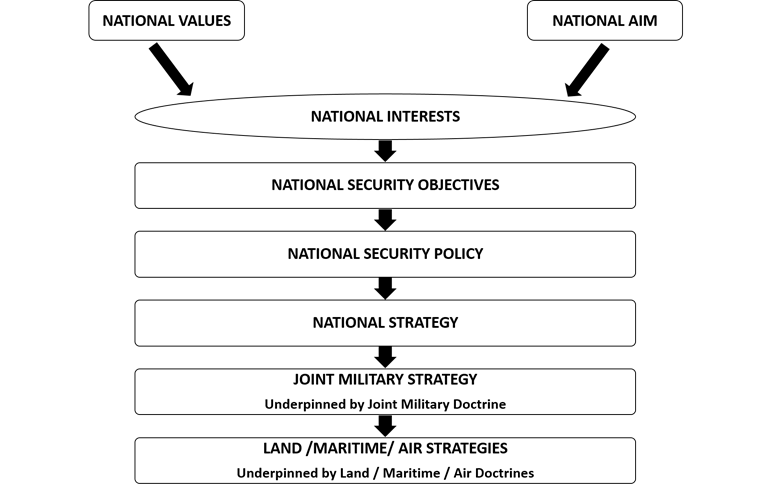
Another key observation from the first chapters of all three editions pertains to the positioning of the maritime doctrine within the echelons of the national security framework. The first edition underscores that a doctrine must be a corollary to the overall national security framework, which articulates the state’s broader priority interests and strategic goals. It states doctrine must exist simultaneously at the grand strategic, military strategic, operational and tactical levels. As a result, the first edition emphasises establishing the hierarchical relationship among the various levels of the national security framework.[21] This element is addressed in the second edition through a more clearly articulated hierarchical framework, illustrated in Figure 1.
Figure 1. Hierarchical Framework of National Security Concepts and Doctrines
Source: Indian Navy, “Indian Maritime Doctrine”, Naval Strategic Publication 1.1, 2009, p. 5.
As illustrated in the figure above, the maritime doctrine serves as a key anchor within this framework, supporting the higher echelons of national strategic thought and linking operational maritime guidance to the upper tiers of policy formulation, ultimately culminating in national interests. The third edition reiterates and consolidates this framework without substantive alteration, thereby reinforcing doctrinal continuity.
Articulating the Spectrum of Maritime Operations
The second chapter in all three editions of the Indian Maritime Doctrine is dedicated to articulating the nature of naval operations across the spectrum of conflict. This encompasses the full range of situations in which naval forces may be required to operate, from stable peace to strategic nuclear war.[22] The first and the second editions present a dichotomous representation of this spectrum, divided between internal and external conflict, with clearly defined levels of operational engagement. However, the third edition expands and modifies this spectrum into a more linear continuum structured around the stages of peace, NWNP and war. The progression of hostilities and the intensity of escalation in operational tempo are conceptualised along this linear continuum, reflecting a shift from categorical classification to a linear escalation-based framework.[23]
Expansion of the Principles of War
All military doctrine and treatises are fundamentally anchored in a set of foundational principles that guide planning, operational conduct, tactical manoeuvres, strategic decision-making, information gathering and the overall prosecution of war. Erudition of these principles of war is a key and consistent focus across all three editions of the doctrine. However, there has been a slight expansion in the number of these principles across the three editions, as illustrated in Table 1. This table lists each principle in the order in which it appears in the respective editions of the doctrine.
Table 1. Principles of War in the Three Editions
| First Edition
(IMD-4) |
Second Edition
(IMD-09) |
Third Edition
(IMD-25) |
|
| I | Selection and Maintenance of Aim | Selection and Maintenance of Aim | Selection and Maintenance of Aim |
| II | Security | Offensive Action | Offensive Action |
| III | Concentration of Force | Concentration of
Force |
Concentration of
Force |
| IV | Economy of Effort | Economy of Effort | Economy of Effort |
| V | Cooperation | Surprise and Asymmetry | Surprise |
| VI | Offensive Action | Flexibility and Management of Change | Flexibility |
| VII | Flexibility | Cooperation and Synergy | Cooperation |
| VIII | Surprise | Logistics | Sustenance |
| IX | Administration | Morale | Security |
| X | Maintenance of Morale | Security | Morale |
| XI | – | Intelligence | Intelligence |
Source: Indian Maritime Doctrine First Edition (pp. 29–37); Second Edition (pp. 35–45) & Third Edition (pp. 38–47)
As indicated in the table above, the scope and ambit of the principles of war have expanded slightly to include intelligence as a key principle. This addition reflects an acknowledgement of the changing character of operations, which increasingly involve a higher tempo of information-driven operational planning. Additionally, the previously narrower principle of logistics, which focused primarily on the physical transportation of men and material, has been broadened to emphasise the establishment of resilient supply chains that sustain and support the prosecution of war.
Expanding Maritime Areas of Interests
The first edition broadly delineates the geographic extent of the Indian Ocean Region, encompassing its chokepoints, straits, gulfs, bays and seas, as India’s maritime areas of interest.[24] Notably, long before the Indo-Pacific emerged as a key concept in global strategic discourse, the first edition had already recognised its geographic significance, referring to the maritime space as the Pacific-Indian Ocean region.[25]
The second edition articulates two broad areas of maritime interest for India, categorising them as primary and secondary.[26] According to this edition, the primary area encompasses the entire IOR, including its critical chokepoints that serve as strategic gateways to the region. While the secondary area extends significantly beyond the IOR, both eastward and westward, indicating a deliberate expansion of India’s strategic horizon. To the east, it includes the South China Sea (SCS), the East China Sea (ECS) and the Western Pacific region, along with their littoral regions. To the west, its ambit extends to the Mediterranean Sea and the West Coast of Africa, along with their respective littoral regions.[27] The secondary areas of interest collectively denote what is contemporarily understood as the Indo-Pacific construct, even though the term itself is not explicitly mentioned in the second edition.
In IMD-25, these earlier primary secondary areas of maritime interest are reframed and articulated sequentially as India, the IOR and the Indo-Pacific, rather than being categorised hierarchically.[28] This shift from a ‘primary-secondary’ distinction to a layered geographic continuum reflects a more integrated spatial imagination, wherein India’s maritime interests radiate outward from the national coastline to the wider Indo-Pacific. Also, this progression indicates that the Indo-Pacific region is no longer an implicit or derivative construct but is doctrinally underpinned within India’s maritime strategic framework, signifying a decisive shift from geographic extension to conceptual incorporation.
Assessment and Strategic Implications
Critical Omissions: Maritime Vision Frameworks
The most striking feature of IMD-25 is not what it includes, but what it conspicuously omits. The doctrine makes no reference to India’s overarching maritime visions articulated by Prime Minister Narendra Modi—namely SAGAR (Security and Growth for All in the Region, unveiled in 2015) and MAHASAGAR (Mutual and Holistic Advancement for Security and Growth Across Regions, unveiled in 2025). This absence is particularly significant given that between 2015 and 2025, the Indian Navy has undertaken numerous security assistance and humanitarian operations across the Indian Ocean Region, explicitly under the aegis of SAGAR.
Furthermore, while IMD-25 references the concepts of ‘Preferred Security Partner’ and ‘First Responder’, it fails to articulate the specific operational parameters, force posture requirements, or capability implications of these roles. The 2015 maritime security strategy document, Ensuring Secure Seas, had previously elaborated on several principles underpinning the concept of India as a ‘Net Security Provider’—a formulation that appears to have been replaced, without explanation, by the ‘Preferred Security Partner’ terminology in IMD-25. This terminological shift deserves analytical attention. Does it signal a recalibration of India’s maritime ambitions? A recognition of capability constraints? Or merely stylistic preference? The doctrine provides no clarity on these questions.
This gap between vision and doctrine is not merely semantic. SAGAR and MAHASAGAR represent India’s effort to articulate a distinctive Indo-Pacific maritime order. The absence of these frameworks from the doctrinal architecture suggests a potential disconnect between political rhetoric and naval planning. It raises the possibility that the Indian Navy views these constructs as aspirational political statements rather than operationally actionable strategic frameworks. The forthcoming maritime security strategy document will need to bridge this gap by translating these broad visions into concrete operational guidance, force development priorities, and partnership modalities.
Doctrinal Maturation and Conceptual Innovation
Notwithstanding these omissions, the comparative analysis of IMD-25 with previous editions reveals significant maturation in India’s maritime strategic thinking. The expansion of existing conceptual frameworks and the incorporation of new operational concepts make IMD-25 a more contemporary and forward-looking doctrine that reflects doctrinal acknowledgement of the evolving dynamics of the global maritime environment. This environment is being shaped by intensifying strategic competition, the resurgence of conventional interstate conflicts, the unabating rise of non-traditional threats, and the emergence of disruptive technologies that are reshaping power asymmetries in the maritime domain.
Strategic Signalling and Regional Context
IMD-25’s release occurs within a specific strategic context that shapes its meaning and significance. The Indo-Pacific region is witnessing broader strategic fragmentation and geopolitical uncertainties. The expanding presence of PLA Navy ships in the IOR further complicates India’s strategic calculus. IMD-25 represents India’s doctrinal response to this transformed maritime environment. The emphasis on NWNP is an attempt to address this reality. The focus on multi-domain operations and jointness reflects recognition that any future conflict would unfold across multiple theatres and domains simultaneously, requiring unprecedented coordination between services and integration of capabilities.
Looking Ahead: From Doctrine to Strategy
It must be recognised that the primary purpose of a doctrine is to articulate core conceptual foundations and to provide a guiding framework for developing future strategies. In this regard, IMD-25 largely succeeds in fulfilling this objective.
The forthcoming maritime security strategy document—expected to update the 2015 Ensuring Secure Seas—will need to address several questions that IMD-25 leaves unanswered. First, it must clarify the operational meaning of ‘Preferred Security Partner’ and ‘First Responder’ roles, specifying force posture requirements, readiness levels, geographic scope, and resource implications. Second, it must integrate SAGAR and MAHASAGAR frameworks into actionable strategic guidance, translating these political visions into concrete naval activities, partnership programmes and capability requirements. Third, it must reconcile doctrinal ambitions with budgetary realities, establish priorities among competing capability requirements, and identify a realistic timeline for force development.
Views expressed are of the author and do not necessarily reflect the views of the Manohar Parrikar IDSA or of the Government of India.
[1] Indian Navy, “Indian Maritime Doctrine 2025”, Naval Strategic Publication 1.1, 2 December 2025, p. 9.
[2] Ibid., p. 22.
[3] Ibid.
[4] Ibid.
[5] Ibid., p. 19.
[6] Ibid.
[7] Ibid., p. 22.
[8] Ibid.
[9] Ibid., p. 97.
[10] Ibid., p. 44.
[11] Ibid., p. 43.
[12] Ibid., p. 42.
[13] Ibid., p. 44.
[14] “Address By the Hon’ble President of India Shri Ram Nath Kovind On the Occasion of Presidential Fleet Review – 2022”, Press Information Bureau, Government of India, 21 February 2022.
[15] Indian Navy, “Indian Maritime Doctrine 2025”, Naval Strategic Publication 1.1, 2 December 2025, p. 4.
[16] Ken Booth, Navies and Foreign Policy, Routledge, London, pp. 15–18.
[17] Indian Navy, “Indian Maritime Doctrine”, Integrated Headquarters, Ministry of Defence (Navy), 2004, (CNS’s Foreword).
[18] Ibid.
[19] Ibid., pp. 3–9.
[20] Indian Navy, “Indian Maritime Doctrine 2025”, no. 1, pp. 2–9.
[21] Indian Navy, “Indian Maritime Doctrine”, no. 17, p. 5.
[22] Ibid., p. 11.
[23] Indian Navy, “Indian Maritime Doctrine 2025”, no. 1, p. 17.
[24] Indian Navy, “Indian Maritime Doctrine”, no. 17, pp. 46–47.
[25] Ibid., p. 66.
[26] Indian Navy, “Indian Maritime Doctrine”, Naval Strategic Publication 1.1, 2009, p. 65.
[27] Ibid., p. 68.
[28] Indian Navy, “Indian Maritime Doctrine 2025”, no. 1, p. 54.