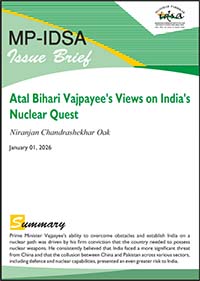
Atal Bihari Vajpayee’s Views on India’s Nuclear Quest
- January 01, 2026 |
- Issue Brief
Summary
Prime Minister Vajpayee’s ability to overcome obstacles and establish India on a nuclear path was driven by his firm conviction that the country needed to possess nuclear weapons. He consistently believed that India faced a more significant threat from China and that the collusion between China and Pakistan across various sectors, including defence and nuclear capabilities, presented an even greater risk to India.
Former Prime Minister (PM) Late Atal Bihari Vajpayee’s contribution to India’s nuclear journey is monumental. He not only led India across the nuclear rubicon overtly but also worked to secure international legitimacy in the nuclear domain. He converted the post-nuclear test difficulties, in the form of sanctions by the US, into an opportunity to reorient India’s external relations, which put the Delhi–Washington relations on a positive trajectory, culminating in the India–US nuclear deal. Vajpayee’s ability to overcome obstacles and establish India on a nuclear path was driven by his firm conviction that the country needed to possess nuclear weapons, a belief he had held since first becoming a Member of Parliament (MP) in 1957 from Balarampur, Uttar Pradesh, representing the Bharatiya Jan Sangh, the predecessor of the Bharatiya Janata Party (BJP).
Vajpayee’s Nuclear Stance in Early Years
During discussions in the Rajya Sabha on 22 December 1964, on the motion regarding the International Situation, Vajpayee brought up China’s nuclear tests conducted in October 1964. He called on the government to discuss India’s potential development of a nuclear bomb with an “open mind”.[1] He gave an example of the use of an atomic bomb by the US against non-nuclear Japan, arguing that if Japan had nuclear weapons, it would have restrained the US from using an atomic bomb there. According to him, China’s possession of a nuclear bomb would alter the regional military balance in the Indo-Pacific, potentially disadvantaging India.
Vajpayee rejected moralistic arguments against the development of nuclear weapons, saying,
If the government says there are difficulties in manufacturing the atom bomb because our economic condition is not good, because we have to develop our country, and, therefore, we cannot utilise our resources for manufacturing an atom bomb, then I am prepared to think about these arguments. But do not talk of morality, non-violence, and Gandhiji… the government must acquire the weapon that can save the country… I want government to seriously consider manufacturing the atom bomb.[2]
In an account of the Vajpayee era, Shakti Sinha, Private Secretary to Vajpayee, recounts how the bombing of Hiroshima and Nagasaki profoundly affected the thinking of Vajpayee, who penned a poem titled ‘Hiroshima Ki Peeda’, in which he wondered what the creators of the atomic bomb must have felt after learning of the destruction it caused. “If they (scientists behind the atomic bomb) had a sense of remorse, then time would not judge them. But if they did not, then history would never forgive them.”[3] He held the firm belief that nuclear weapons serve as a deterrent to warfare, and that India must possess such weapons if it aspires to maintain peace.
Therefore, Vajpayee welcomed India’s Peaceful Nuclear Explosion (PNE) on 18 May 1974, despite being on the opposition benches. While speaking in the Lok Sabha in Hindi on 8 August 1974, Vajpayee commended the scientific community of the country behind the nuclear tests. He presented India’s success in conducting the PNE as representative of developing countries in Asia, Africa and Latin America. “India’s success is not the country’s success alone. Developing countries of Asia, Africa and Latin America are feeling proud of India’s achievements.”[4]
Further, Vajpayee asked whether India should restrict itself to the peaceful use of nuclear weapons and not for its security, given that India faces a security challenge from China.
We should not forget that our neighbour—China—is also nuclear capable, which believes in the inevitability of war, which wants to upend the global order through violence, which has swallowed Tibet and has stationed missiles in Tibet, whose missiles have a range to reach the Indian Ocean.[5]
He claimed that self-protection is also part of the broader definition of peace—deterring the enemy, avoiding war through deterrence, and stopping the enemy before they attack are all integral to the wider conception of peace.[6] Vajpayee argued that Delhi had not signed the Non-Proliferation Treaty (NPT) and opined that it should resist attempts to compel India to sign any treaty prohibiting underground nuclear testing, as none of the other nuclear powers, including China, had signed such a Treaty. For him, India’s autonomy in this matter was paramount. Furthermore, he thought that if need be, India should not hesitate to use nuclear capability for security purposes.[7]
He was consistent in his stance vis-à-vis nuclear-related international treaties, including the NPT and the Comprehensive Test Ban Treaty (CTBT). During the Zero Hour discussion in the Lok Sabha on 2 May 1994, Vajpayee urged the then-Prime Minister, P.V. Narasimha Rao, not to yield to American pressure to sign the NPT. He again contended that the NPT was a discriminatory treaty, unacceptable to India, stating that
China had accumulated a large stockpile of nuclear weapons…and [the country] was not ready to agree to disarmament, and nobody is prepared to put pressure on China in this matter.[8]
Thus, Vajpayee astutely understood the regional security scenario in which India’s “security perceptions were not confined to Pakistan alone”.[9]
Vajpayee as the External Affairs Minister
Vajpayee never hesitated to call out the hypocrisy of nuclear-weapon states regarding their non-proliferation commitments. While speaking in the Lok Sabha on 19 December 1978, as the External Affairs Minister (EAM), in response to the Calling Attention Notice regarding the reported agreement between China and France on the supply of nuclear plant and technology to China by France under authorisation from the US, Vajpayee highlighted the hypocrisy in the US’s implementation of non-proliferation standards in its dealings with China.
France and China had concluded an agreement on 4 December 1978, under which a French firm was to provide nuclear power reactors to China. These nuclear reactors were based on technology originating in the US. Thus, it was implied that the US had granted clearance for the export of such sensitive technology to China. Vajpayee was opposed to the fact that the US had “waived the safeguards condition for China on the ground that China already possessed nuclear weapons”. He regarded this as unfair since such a waiver would permit China to utilise the enriched uranium for its weapons programme.
On the one hand, the USA wants to stop proliferation, and, on the other, it wants to impose all the conditions of non-proliferation on those countries that have already decided not to manufacture nuclear weapons…the USA is adopting a double standard on this issue…India will oppose this double standard.[10]
Vajpayee’s Speeches after Nuclear Tests: Four Themes
India conducted three underground tests on 11 May 1998 and two on 13 May 1998. PM Vajpayee informed the nation of the successful conduct of tests on 11 May 1998. He addressed the nuclear tests in his statement to Parliament on 27 May 1998. He had to convey a message to both the domestic audience and the world.
Continuity from the Past
In a statement to parliament, Vajpayee explained how India was always opposed to nuclear weapons but eventually had to decide to pursue them. He reminded the House of the initiatives India had taken in the 1950s and the 1960s regarding the non-proliferation of nuclear weapons at the international forum and how the international community did not pay heed to them.[11] As a result, India demonstrated its nuclear capabilities for the first time in 1974, and successive governments have consistently prioritised India’s national interests in nuclear decision-making, including the decision not to sign the CTBT in 1996 despite intense pressure.
Therefore, he emphasised that the tests conducted in 1998 were merely a continuation of policies that had been in place for several decades.
These tests are a continuation of the policies set into motion that put this country on the path of self-reliance and independence of thought and action…[12]
India’s Security Situation
Vajpayee drew the attention of the international community towards the security situation around the country. China was a declared nuclear-weapons state, and there were credible reports that Pakistan had also acquired nuclear weapons technology. In a speech delivered to a group of people at his official residence in New Delhi on 2 June 1998, PM Vajpayee clearly stated the worsening situation in India’s neighbourhood.
When we noticed that atomic weapons were being developed and stocked around us and when we realised that the peace in the region is endangered, we decided to allow our scientists, our engineers to make the country capable of carrying out nuclear tests…[13]
In another speech delivered to a group of people at his residence in New Delhi on 30 May 1998, Vajpayee highlighted self-defence as the main aim behind India’s decision to go nuclear, announcing that the “destruction is not the objective, it is self-defence, which we have in our minds”,[14] amidst the worsening security situation in the neighbourhood. Further, he insinuated that Pakistan had already developed its nuclear programme clandestinely, and it announced it publicly only after India’s nuclear tests. “How could they (Pakistan) carry out their tests so instantaneously? Can nuclear weapons be developed in just 16 days? Is it possible to launch missiles at such short notice?”[15]
India against Nuclear Hegemony
Vajpayee severely criticised the nuclear-weapons-states and accused them of doing precious little in the field of disarmament. India’s stand was that it was for universal disarmament but would never accept nuclear apartheid.
At a global level, we see no evidence on the part of the nuclear-weapon States to take decisive and irreversible steps in moving towards a nuclear-weapons-free world. Instead, we have seen that the NPT has been extended indefinitely and unconditionally, perpetuating the existence of nuclear weapons in the hands of the five countries.[16]
Highlighting the hypocrisy of nuclear-weapons states, Vajpayee claimed that “there are countries which do not want others to develop weapons, which they possess, but they are not prepared to reduce their own stockpiles…we are once bitten twice shy.”[17] Further, he pointed to the fact that these countries preach to India about peace, but “they continue to develop new and sophisticated weapons and…to update their old stockpile that create crisis for whole of the world”.[18]
He expressed frustration with the failure to achieve nuclear disarmament on several counts. “Meetings are held, speeches are made, and conferences are organised, but no decisive and meaningful action towards the destruction of nuclear weapons.”[19] Therefore, he justified India’s nuclear tests as a result of the flawed nuclear non-proliferation regime. “Our tests were necessary because of the failure of a flawed non-proliferation regime…”.[20]
Self-Defence and an Assurance about Non-Proliferation
Vajpayee consistently assured the world community of India’s stance against the arms race and proliferation and the country’s views of its own nuclear capabilities for self-defence.
India is now a nuclear-weapon State…We do not intend to use these weapons for aggression or for mounting threats against any country; these are weapons of self-defence, to ensure that India is not subjected to nuclear threats or coercion. We do not intend to engage in an arms race.[21]
Despite unilaterally announcing a moratorium on further nuclear tests, when the United Nations Security Council (UNSC) adopted Resolution 1172 on 6 June 1998 to condemn the tests, Vajpayee expressed his displeasure in a statement in Parliament on 8 June 1998. He called the Resolution redundant, as the country had already committed not to conduct further tests.
We are a responsible and committed member of the international community. The Resolution urges us not to carry out any nuclear weapon test explosions. For India, such an urging is redundant because we have already instituted a voluntary moratorium. We have also indicated our willingness to explore ways and means of converting this undertaking into a de jure obligation.[22]
He claimed that India’s non-proliferation record was exemplary, even better than that of some NPT signatories.
Our record in this regard (non-proliferation) has been impeccable and better than that of some countries that are parties to the NPT or members of the Nuclear Suppliers’ Group or even Permanent Members of the UNSC.[23]
Post-Test Reorientation towards the West
Vajpayee had foreseen that India would face global opprobrium, particularly from the US. Thus, he prepared to address the situation through diplomacy. In the aftermath of the tests, he sent his Principal Secretary, Brajesh Mishra, to Paris and London as a special envoy of the Indian Prime Minister, to present India’s case. Additionally, he wrote a letter to then-US President Bill Clinton explaining the rationale for India’s tests, which was leaked to the US media.
In the letter, he pointed towards China without taking the country’s name as a primary reason India decided to go nuclear.
We have an overt nuclear-weapon state on our borders, a state which committed armed aggression against India in 1962. Although our relations with that country have improved in the last decade or so, an atmosphere of distrust persists mainly due to the unresolved border problem.[24]
In subsequent diplomatic moves, Vajpayee initiated nuclear dialogue with the US amid Washington’s sanctions. He declared that India and the US were “natural allies”.[25] He used this India–US dialogue to fundamentally shift the bilateral relationship, placing it on a positive trajectory. This was a momentous decision, as India had long been aligned with the Soviet Union during the Cold War and had long been suspicious of the US. He nominated Jaswant Singh, veteran politician and later the EAM, to take forward the nuclear dialogue with the US and convince it of the need for nuclear weapons for India. The US nominated Strobe Talbott, Deputy Secretary of State, for the nuclear talks.
The Jaswant–Talbott talks were a significant success, helping to ease bilateral tensions within a year, culminating in President Clinton’s visit to India in 2000. This was the first US presidential visit in 22 years and significantly altered the course of bilateral relations thereafter. The next Bush administration was equally receptive to India, and the two countries subsequently signed the Next Steps in Strategic Partnership (NSSP) agreement, thereby opening bilateral cooperation in sensitive areas, including nuclear and defence matters. Thus, Vajpayee laid the foundation for the bilateral nuclear cooperation and emerged as a principal architect in shaping India–US relations in the 21st century.
Despite laying the groundwork for the India–US nuclear deal, Vajpayee opposed it when it was discussed in Parliament in 2005 under the United Progressive Alliance (UPA) government led by Prime Minister Manmohan Singh. Vajpayee, in a 2005 speech in the Lok Sabha, criticised the deal for impinging on India’s nuclear policy independence.[26] He felt that “India’s offer to identify and separate its civilian and military nuclear facilities and programmes”[27] and acceptance to sign the Additional Protocol for the Civilian facilities would have long-term security implications in the form of intrusion by international inspectors. He was worried about preserving India’s nuclear autonomy.
Nuclear Energy and Self-Reliance
Beyond the hard-power dimension of the nuclear domain, Vajpayee also recognised the potential of nuclear energy early on. In his speech at the Kalpakkam Atomic Processing Plant on 15 September 1998, he correctly observed that energy security had become a subtext of international politics and that nuclear power would play a significant role in India’s energy security in the coming years.[28] However, he maintained that.
The cost of building a power plant, the cost of maintaining it, the cost of reprocessing and storing the spent fuel, and the cost of dismantling the plant at the end of its useful life—must fall.[29]
Vajpayee expressed his aspiration for India to achieve self-sufficiency in the strategic domain, as evidenced by his address to the nation on the test-firing of Agni II in 1999.
India cannot depend on others to defend her. We have to develop our own indigenous capabilities. Agni is a symbol of that resurgent India, which can say: ‘Yes, we will stand on our own feet.’[30]
In another speech, he emphasised that, through self-sufficiency in the defence sector, India can overcome technology denial and control regimes.[31]
Conclusion
There was a linearity in Vajpayee’s thoughts about India’s quest for nuclear weapons. In opposition or in power, he always felt the need for India to pursue nuclear weapons, strictly for defensive purposes. It is this conviction that made him take tough decisions in 1998 and go for nuclear testing overtly. His views about threat perception from China also remained constant throughout. He consistently believed that India faced a more significant threat from China and that the collusion between China and Pakistan across various sectors, including defence and nuclear capabilities, presented an even greater risk to India. He was realistic in recognising early on that China’s nuclear capabilities had altered the military balance in the region, now commonly referred to as the Indo-Pacific. It also shows his foresight.
There was a pragmatic side to Vajpayee’s personality. India’s decision to announce a unilateral moratorium on nuclear tests, the country’s attempts to forge closer relations with the US, which had imposed severe sanctions, were examples of this pragmatism. He consistently criticised the international nuclear regime, as embodied in international treaties such as the NPT and the CTBT. He believed in continuity in domestic politics and security matters. Vajpayee understood the importance of ‘Atmanirbharta’ and nuclear energy early on, and today we are reaping the benefits of his visionary foresight.
Views expressed are of the author and do not necessarily reflect the views of the Manohar Parrikar IDSA or of the Government of India.
[1] “What Is Our Response to China’s Atom Bomb?”, in N.M. Ghatate (ed.), Four Decades in Parliament: Atal Bihari Vajpayee, Vol. III, Shipra Publications, Delhi, 2000, p. 68.
[2] Ibid., p. 69.
[3] Shakti Sinha, Vajpayee: The Years That Changed India, Penguin Random House, India, 2020, p. 99.
[4] “Lok Sabha Debates: Fifth Series, Vol. XLIII No.14”, Lok Sabha Secretariat, New Delhi, 8 August 1974.
[5] Ibid.
[6] Ibid.
[7] Ibid.
[8] “Mr. Prime Minister Don’t Succumb to American Pressure”, in N.M. Ghatate (ed.), Four Decades in Parliament: Atal Bihari Vajpayee, Vol. III, no. 1, p. 158.
[9] Ibid., p. 157.
[10] “Sino-French Agreement to Transfer Nuclear Technology to China”, in N.M. Ghatate (ed.), Four Decades in Parliament: Atal Bihari Vajpayee, Vol. III, no.1, p. 206.
[11] “Prime Minister Atal Bihari Vajpayee: Statement on Nuclear Tests in Pokhran”, Lok Sabha Digital Library, 27 May 1998.
[12] Ibid.
[13] “India Stands for Peace and Development”, in Prime Minister Atal Bihari Vajpayee: Selected Speeches, Vol. I, Publications Division, Ministry of Information and Broadcasting, Government of India, 2000, p. 21.
[14] “Nuclear Tests for National Security”, in Prime Minister Atal Bihari Vajpayee: Selected Speeches, Vol. I, no. 13, p. 18.
[15] Ibid.
[16] “Prime Minister Atal Bihari Vajpayee: Statement on Nuclear Tests in Pokhran”, no. 11.
[17] “Nuclear Tests for National Security”, no. 14, p. 18.
[18] “India Stands for Peace and Development”, in Prime Minister Atal Bihari Vajpayee: Selected Speeches, Vol. I, no. 13, pp. 20–21.
[19] Ibid., p. 21.
[20] “India’s Commitment to Nuclear Disarmament”, in Prime Minister Atal Bihari Vajpayee: Selected Speeches, Vol. I, no. 13, p. 24.
[21] “Prime Minister Atal Bihari Vajpayee: Statement on Nuclear Tests in Pokhran”, no. 11.
[22] “India’s Commitment to Nuclear Disarmament”, in Prime Minister Atal Bihari Vajpayee: Selected Speeches, Vol. I, no. 13, p. 23.
[23] Ibid.
[24] “Nuclear Anxiety; Indian’s Letter to Clinton on the Nuclear Testing”, The New York Times, 13 May 1998.
[25] “India, USA and the World: Let Us Work Together to Solve the Political-Economic Y2K Problem”, A Speech by Vajpayee at Asia Society, New York, 28 September 1998.
[26] “Deal Raises Questions on Independence of Indias’s Nuclear Policy”, Vajpayee’s speech in Lok Sabha, in “Indo-US Nuclear Deal: Why Does BJP Oppose It?”, BJP, 2008, p. 4.
[27] “India-US Understanding A Matter of Concern”, the statement issued by Former Prime Minister Atal Bihari Vajpayee on 20 July 2005, in “Indo-US Nuclear Deal: Why Does BJP Oppose It?”, BJP, 2008, pp. 6–7.
[28] “Committed to Peaceful Harnessing of Nuclear Power”, in Prime Minister Atal Bihari Vajpayee: Selected Speeches, Vol. I, no. 13, p. 216.
[29] Ibid., p. 218.
[30] “Agni—Symbol of Resurgent India”, in Prime Minister Atal Bihari Vajpayee: Selected Speeches, Vol. II, Publications Division, Ministry of Information and Broadcasting, Government of India, 2000, p. 139.
[31] “Make India a Self-Reliant and Secure Nation”, in Prime Minister Atal Bihari Vajpayee: Selected Speeches, Vol. II, no. 30, p. 164.
Niranjan Chandrashekhar Oak
Mr. Niranjan Chandrashekhar Oak is a Research Analyst at Manohar...
read more +