UAE’s Renewable Energy Transition
- April 28, 2026 |
- Issue Brief
Summary
The UAE has built one of the world’s most structured clean energy transitions in the Gulf. The UAE’s renewable energy push is driven by technological innovation, huge investments in ambitious renewable energy projects and foreign collaborations.
Introduction
The Gulf countries are formulating energy policies and implementing strategies to transition from a resource-based economy to a diversified, renewable-energy economy. Historically, oil-producing nations in West Asia have received political and economic leverage due to their geostrategic locations and oil reserves. As the international energy market undergoes transformative change, countries with rentier economies focus on economic diversification and on strengthening global energy governance through cooperation and diplomacy to address environmental and energy-security implications.
The United Arab Emirates (UAE) is emerging as one of the fastest-growing markets for renewables, driven by technological innovation, huge investments in ambitious renewable energy projects and foreign collaborations. The country is expanding its energy sources, leading to diversification in its energy mix and economy. Under its National Energy Strategy 2050, the UAE is committed to contributing up to AED 200 billion to the renewable energy sector by 2030.[1] To meet growing energy demand, the country plans to generate most of its electricity from renewable sources, primarily solar power. The UAE’s installed renewable energy capacity surpassed 7.7 gigawatts (GW) in April 2026.[2]
The Gulf States are seeking to expand their renewable energy footprint to transition towards sustainable power and support low-carbon energy. The shifting geopolitical dynamics also prompted economies dependent on hydrocarbons to navigate changes in global energy markets and redefine their economic and global positioning. On 6 April 2026, Suhail Al Mazrouei, the UAE’s Minister of Energy and Infrastructure, emphasised the creation of green corridors and dry ports to facilitate regional trade. In the wake of Iran’s closure of the Strait of Hormuz amid the US–Israel–Iran conflict, Al Mazrouei confirmed the prioritisation of energy security, evidenced by a 20-fold increase in capacity at eastern ports since the conflict began.[3] The UAE’s transition from hydrocarbons to sustainable energy reflects not only environmental commitments but broader considerations for regional influence and energy security.
Net-zero announcements and long-term development strategies, such as the UAE’s Clean Energy Strategic Vision 2050, account for institutional embeddedness in redefining energy security. With state-backed investments and ambitious national targets, the UAE aims to build a more resilient energy sector characterised by a sophisticated grid system, technology transfer and infrastructure development. In an effort to build a diversified economy beyond oil, the UAE is working on a model that is developmental, commercial and diplomatic.
Evolution of the UAE’s Renewable Energy Strategy
The UAE has built one of the world’s most structured clean energy transitions in the Gulf. The UAE implemented its first national development strategy in 2010 with the launch of ‘Vision 2021’—a long-term plan focused on environmental sustainability and the transition to a diversified knowledge-based economy.[4] The UAE’s energy transition originated with the establishment of Masdar, also known as Abu Dhabi Future Energy Company, in 2006, marking a major milestone in the country’s systematic expansion of renewable energy policy. Progressively, Masdar, a state-owned renewable energy company, shaped the UAE’s national framework for energy security, which prioritised energy diversification, global expansion and strategic investment.
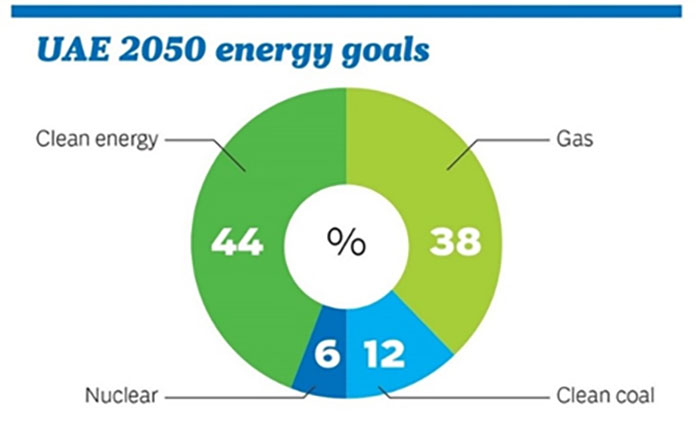
The company has emerged as a pioneer in investing in and developing renewable energy projects in more than 30 countries worldwide. With a target of 100 GW by 2030, the company’s capacity grew from 20 GW to 51 GW between 2022 and the end of 2024.[5] Masdar has increased its renewable energy capacity from 51 GW in 2025 to 65 GW in January 2026, marking 20 years of leadership in the renewable energy sector.[6] Moreover, the first unified national energy policy was launched in 2017 as ‘UAE Energy Strategy 2050’. With an investment of US$ 15 billion, the UAE’s Energy Strategy 2050 outlines long-term national energy goals. The strategy was updated in 2023 to include new objectives: increasing installed capacity from 14.2 GW to 19.8 GW by 2030 and achieving Net Zero emissions by 2050.[7]
Figure 1. UAE 2050 Energy Goals
Source: Embassy of the United Arab Emirates, Washington, DC, 2023
As global demand increasingly focuses on decarbonisation targets and clean energy initiatives, the UAE is developing an export-oriented hydrogen industrial strategy. The UAE’s National Hydrogen Strategy 2050 aims to position the country as one of the largest producers and suppliers of green hydrogen by 2031, with a production capacity of 1.4 million tons per annum (mtpa).[8] Launched in 2023, the National Hydrogen Strategy 2050 emphasises supply chain advancement, research and development and regional collaboration. With the potential to become a crucial exportable commodity in the future, investments in green hydrogen initiatives and projects present an opportunity for the UAE to become one of the leading players in the decarbonised energy sector. The country aims to become a regional leader in clean energy export while providing sustainable solutions through collaborations and joint ventures. These initiatives and policies signify the country’s dedication to sustainable technology investments, furthering sustainable energy integration.[9]
Furthermore, the hosting of the 8th Conference of the Parties to the UN Framework Convention on Climate Change (COP28) in 2023 has contributed to the UAE’s reputation as a responsible global actor promoting sustainability and innovation. The launch of initiatives such as Green Fujairah and the UAE government’s Guidelines on Sustainable Energy Fuel provides a strong foundation for addressing climate change. As per the Guideline, at least 1 per cent of the total fuel supplied to the UAE’s airlines at the UAE’s airports in 2031 will be sustainable and produced locally.[10] The strategic initiatives reflect the UAE’s efforts to lead global cooperation on sustainable energy and climate change. The emergence of new industrial sectors such as solar manufacturing, green hydrogen, and international project development reflects the UAE’s broader understanding of energy security, ensuring access to technology, digital security, and infrastructure resilience.
The federal strategy with emirate-led execution is the distinctive feature of the UAE’s policy approach. Abu Dhabi capitalised sovereign capital, Masdar and Emirates Water and Electricity Company (EWEC), to accelerate the deployment of renewable energy sources and infrastructure in other parts of the world. The Independent Power Producer Model (IPP Model) and Dubai Electricity and Water Authority (DEWA) have leveraged Dubai to create their own sustainable energy ecosystem. The UAE’s energy model outlines long-term strategic goals, visionary leadership, and an innovative approach to utilising natural resources while integrating clean energy into its energy landscape, thereby establishing a technology-driven economy.
Key Renewable Energy Projects
Solar energy is the fastest-growing sector in the UAE’s energy mix. Large-scale renewable energy projects not only demonstrate the country’s adoption of sustainable alternatives for power generation but also provide leverage through long-term purchase agreements and investments in sustainable technologies. To triple the contribution of renewable energy and increase the share of renewable energy sources to 30 per cent in its energy mix by 2030 under the UAE Energy Strategy 2050, the UAE transition framework focuses on policy implementation, regulatory tools and technological advancements.[11]
The UAE’s flagship projects pave the way for the country’s initiatives to be operationalised as clean energy systems. Noor Abu Dhabi, a solar plant with a total capacity of 1.2 GW, is one of the first projects to supply clean energy while simultaneously contributing to the goals of the UAE’s energy strategy 2050 by reducing carbon emissions in power generation.[12] In an effort to achieve clean energy solutions, the UAE launched the Al Dhafra solar PV Project in 2023, which is the world’s largest single-site solar power plant. It has emerged as a pioneering project with a 2 GW capacity for clean power generation, supplying electricity to 200,000 homes.[13] By developing local renewable capacity, the UAE can buttress against price volatility and external power disruptions.
Dubai’s Mohammed Bin Al-Makhtoum Solar Park serves as the infrastructural backbone of Dubai’s clean energy initiative. Based on the Independent Power Producer (IPP) Model, the solar park has a production capacity of 3,860MW, which will exceed to 8000MW by 2030.[14] The project has emerged as a significant milestone in Dubai’s long-term energy strategy. Dubai Electricity and Water Authority (DEWA) and Abu Dhabi Future Energy Company (Masdar) have collaborated to implement the current sixth phase of the solar park to support the UAE Energy Strategy 2050.[15]
The nuclear power generation capacity is rising significantly in the UAE’s current energy mix. The Barakah Nuclear Energy Plant is the first nuclear energy plant in the Arab world. The four reactors, which are currently operational, generate about 4 terawatt-hour (TWh) of energy annually. The Barakah plant was developed by Emirates Nuclear Energy Corporation (ENEC) with a consortium led by Korea Electric Power Corporation (KEPCO).[16] The electricity generated by the nuclear power plant reflects the UAE’s diversifying energy mix and contributes to its key goal of achieving net-zero emissions by 2050. The operational plant provides about 25 per cent of the UAE’s electricity.[17]
The country is actively seeking to diversify its energy mix. The UAE Wind Program, launched in 2023, reflects the UAE’s effort to expand renewable energy sources beyond solar. The program, developed by Masdar, is expected to provide electricity to 23,000 UAE homes. The project is also expected to reduce 120,000 tonnes of carbon dioxide emissions while integrating wind energy into the UAE’s electricity grid.[18]
Another key project is the hydroelectric power plant in Hatta, which will export clean energy to Dubai. Developed by DEWA, the plant is the first of its kind in the entire GCC region with a production capacity of 250MW. With an investment of US$ 1.421 billion, the plant increases Dubai’s renewable energy storage capacity by 1,500 MWh.[19] The current and upcoming renewable energy projects and initiatives assume the UAE as a key regional player in sustainable power generation and renewable system management. This transition is reflected in grid modernisation, energy diversification, international cooperation, and the expansion of clean power capacity.
The UAE is linking water security to the clean energy transition through a desalination project commissioned by DEWA and ACWA. Veolia, a world leader in water technology, will provide engineering services and key technologies. The plant is expected to begin its operations in 2026 and will reach full capacity in 2027. With a total capacity of 818,000 cubic metres per day (180 MIGD), which is enough to provide potable water to two million people daily, it will be the world’s largest desalination solar power plant and second largest reverse osmosis facility worldwide.[20]
Foreign Collaboration as the Pillar of Transition
The core strength of the UAE’s renewable energy transition model lies in foreign collaboration and international expansion. Through foreign technology partnerships and cross-border financing, the UAE has successfully set the direction using domestic credibility to become a global hub for clean energy solutions while simultaneously diversifying its energy economy. The UAE seeks to expand its global presence in the renewable energy sector through outward investment, demonstrating the country’s contribution to promoting clean power and decarbonization in the region and across the globe.
International collaborations are extremely significant in the UAE’s renewable energy policy. One key example is Masdar, the world’s largest owner and operator of renewable energy, which supports the UAE in strengthening its position in a fast-growing energy market. As in the UAE, in partnership with Emirates Water and Electricity Company (EWEC), Masdar is set to implement its biggest project to date with the capital investment of more than AED 22 billion.[21] The project, to be completed in 2027, aims to combine a 5.2 GW solar PV plant with a 19 GWh battery energy storage system to provide clean power generation and supply.[22]
With a global footprint across Europe, Asia and West Asia, Masdar has planned to deploy US$ 30–35 billion by 2030. In Europe, Masdar is in partnership with TERNA ENERGY in Greece and with ENEL and Endesa in Spain. The company is currently working on offshore wind projects in the United Kingdom and Germany in partnership with companies such as Iberdrola.[23] Masdar has acquired a 49.99 per cent stake in four Spanish plants with a combined capacity of 446 MW. It has signed key agreements with PLN in Indonesia to develop floating solar projects. In Saudi Arabia, Masdar, along with its partners, signed a long-term supply deal on the 2 GW Al Sadawi PV project.[24] The shared clean energy goals help strengthen bilateral relations among Gulf nations through collaboration and partnerships. In April 2026, ACWA Power signed a Power Purchase Agreement (PPA) with the Saudi Power Procurement Company for the expansion of the Rabigh 2 power plant in Saudi Arabia. With an investment of 11.2 billion Saudi riyals, the plant will increase the Kingdom’s power generation capacity by 2.3 GW and contribute to Saudi Arabia’s sustainable energy goals.[25]
Another UAE-based developer, Global South Utilities, is also expanding its presence through partnerships and collaborations, particularly in developing regions. Providing renewable energy access through the development of a US$ 200 million solar industrial complex in Egypt and a 200 MW plant in Madagascar is leading to providing clean energy infrastructure solutions in Africa and West Asia.[26] Joint ventures also allow countries to cooperate through complementarity. In April 2026, Adani Green Energy Ltd.’s UAE-based arm signed a joint venture agreement with Minerva to develop renewable projects in India. Under the agreement, Adani Green Energy Ltd. will invest up to a 20 per cent stake in Minerva Renewables Holding RSC Limited (JVCo).[27] This partnership will improve India’s operational efficiency in clean energy and support its commitment to sustained growth in the renewable energy sector.
Challenges
Despite notable achievements and impressive progress, the UAE’s renewable energy transition faces structural limitations. The gap between project success and industrial depth reinforces the idea that the UAE needs to build an industrial ecosystem grounded in indigenous technological capabilities. The UAE has become a world-class developer and investor. Still, strategic resilience in the long run will also require capabilities in manufacturing, digital systems, critical technology services and innovative research. UAE’s Hydrogen policy, however, partly addresses this hurdle through plans for supply chain management and an R&D centre. The implementation of these policies will determine the UAE’s success in becoming a low-cost project host and a diversified clean-energy economy.
Environmental conditions pose another limitation. Because solar cells are affected by operating temperature, the UAE’s hot, arid climate reduces their efficiency.[28] Therefore, the UAE’s success depends not only on commissioning solar plants but also on developing technologies and maintenance systems suited to the region’s climate. The other challenges range from policy and regulatory barriers to technological hurdles, insufficient battery energy storage systems, and land-use concerns. The gap between policy expectations and the actual potential for implementation can be bridged through public awareness, technological advancements and knowledge exchange. For that, Abu Dhabi should have a portfolio of renewable energy technologies that are economically feasible, domestically manufactured, and contribute to energy efficiency.[29]
Another challenge lies in balancing hydrocarbon continuity with the credibility of the transition to green leadership. The UAE remains a major oil and gas producer, and its transition strategy is designed in part to preserve that position by decarbonising domestic consumption and redirecting hydrocarbons towards exports and petrochemical value chains. This is rational from a national-strategy standpoint, but it also means that the UAE’s green leadership will continue to be judged against the scale and pace of its wider fossil-fuel policy. The country’s strategic success will depend on whether it can sustain both economic realism and climate credibility without compromising one over the other.
Conclusion
The UAE’s renewable transition is best understood as an ongoing strategic project rather than a completed transformation. Its significance lies in the fact that it has already changed the terms of energy policy in the Gulf by demonstrating that clean energy can serve not only environmental goals, but also state resilience, economic diversification and geopolitical influence. The scale of the UAE’s projects remains a distinguishing feature of its energy policy. The integration of finance, diplomacy and clear roadmaps has made the UAE an emerging global leader in clean energy.
Views expressed are of the author and do not necessarily reflect the views of the Manohar Parrikar IDSA or of the Government of India.
[1] “UAE Energy Strategy 2050”, Telecommunications and Digital Government Regulatory Authority, United Arab Emirates, 30 December 2024.
[2] “UAE Expands Renewable Footprint as Capacity Crosses 7.7GW”, Fast Company Middle East, 7 April 2026.
[3] “UAE Minister Confirms Energy Security as Eastern Port Capacity Increased by 20-fold”, Middle East Economy, 7 April 2026.
[4] Alisherbek Ilyassov, Yermek Chukubayev and Oksana Morgunova, “Energy Policy and Diplomacy of the UAE and Other Resource-oriented Countries in the Transition to Technological Development”, Frontiers in Political Science, Vol. 7, 28 November 2025.
[5] “Masdar’s Capacity Up By 150% to Over 50GW in Two Years Cementing Place as Global Clean Energy Leader”, Masdar, 15 January 2025.
[6] “Masdar Reaches 65GW as It Celebrates 20 Years of Renewable Energy Leadership”, Masdar, 13 January 2026.
[7] “UAE Energy Strategy 2050”, Telecommunications and Digital Government Regulatory Authority, United Arab Emirates, 30 December 2024.
[8] “National Hydrogen Strategy”, Telecommunications and Digital Government Regulatory Authority, United Arab Emirates, 30 December 2024.
[9] Alisherbek Ilyassov, Yermek Chukubayev and Oksana Morgunova, “Energy Policy and Diplomacy of the UAE and Other Resource-oriented Countries in the Transition to Technological Development”, no. 4.
[10] “COP28”, Telecommunications and Digital Government Regulatory Authority, United Arab Emirates, 30 December 2024.
[11] “UAE Energy Strategy 2050”, no. 7.
[12] “Noor Abu Dhabi”, Noor Abu Dhabi, 2026.
[13] “Solar Energy”, Telecommunications and Digital Government Regulatory Authority, United Arab Emirates, 30 December 2024.
[14] “Mohammed bin Rashid Al Maktoum Solar Park”, Government of Dubai, 23 February 2026.
[15] “DEWA and Masdar Reach Financial Closing on 1800MW 6th Phase of Mohammed bin Rashid Al Maktoum Solar Park”, Government of Dubai, 24 October 2025.
[16] “UAE Energy Diversification”, Embassy of the United Arab Emirates, Washington D.C.
[17] “Nuclear Power in the United Arab Emirates”, World Nuclear Association, 23 March 2026.
[18] “UAE Wind Program”, Telecommunications and Digital Government Regulatory Authority, United Arab Emirates, 30 December 2024.
[19] “Clean Energy Export from Hatta to Dubai to Begin Next April”, Government of Dubai, 23 February 2025.
[20] “Veolia Wins $320 Million Water Technology Contract for World’s Most Energy-efficient Desalination Plant, Enhancing Water Security in UAE”, Veolia, 14 May 2024.
[21] “Aiming for round-the-clock GW-scale PV in Abu Dhabi”, Modern Power Systems, 8 April 2026.
[22] “Can Solar Power Work After Sunset? Abu Dhabi’s Gigscale Project Aims for 24/7 Renewable Energy with Massive Battery Storage”, The Times of India, 29 October 2025.
[23] “Masdar Reaches 65GW as It Celebrates 20 Years of Renewable Energy Leadership”, no. 6.
[24] “UAE Strengthens Global Solar Energy Leadership in 2025”, Akashwani News, 2 September 2025.
[25] S.S. Dev, “ACWA Power Signs SAR 11.5 Billion Deal With Saudi Power Procurement Company For Major 2.3 GW Rabigh 2 Power Plant Expansion In Makkah Region”, Solar Quarter, 20 April 2026.
[26] “UAE Strengthens Global Solar Energy Leadership in 2025”, Akashwani News, 2 September 2025.
[27] “Adani Green’s UAE Arm Signs JV with Minerva for Renewable Projects in India”, Energy World, 9 April 2026.
[28] Adel Gastli and Javier San Miguel Armendáriz, “Challenges Facing Grid Integration of Renewable Energy in the GCC Region”, Gulf Research Centre, December 2013.
[29] Toufic Mezher, Daniel Goldsmith and Nazli Choucri, “Renewable Energy in Abu Dhabi: Opportunities and Challenges”, Researchgate, December 2011.