Xi Jinping’s ‘Head-of-State’ Diplomacy and the China–US–Russia Trilateral Summit
- November 25, 2026 |
- IDSA Comments
Introduction
At the 33rd APEC Economic Leaders’ Summit, held on 18–19 November, Beijing put up a grand exhibition of the ‘China Dream’. The summit was organised in China’s technological and innovation hub, Shenzhen. Major tech companies, including BYD, Tencent and Unitree Robotics, showcased China’s varied achievements in futuristic tech.[i] Humanoid robots performing martial arts and dance and serving customers, advanced 360-degree cameras with AI imaging for event coverage, robotaxi services for guests, and smart musical instruments were among the major highlights that awed visitors.[ii]
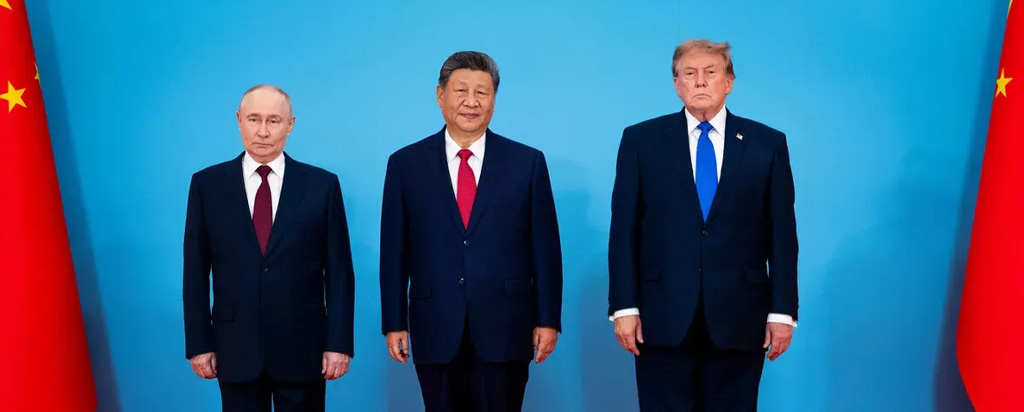
Beyond demonstrating China’s modernisation and technological prowess, the event also served as a platform for Chinese President Xi Jinping’s head-of-state diplomacy. Xi participated in nearly 20 bilateral and multilateral events, including chairing the informal leaders’ meeting and holding intensive bilateral meetings on the sidelines with APEC countries.[iii] However, amid the flurry of head-of-state diplomatic activities, the highlight of his engagement was the trilateral summit between the US, China and Russia on 19 November.
The three powers met for the first time, which some international observers termed Yalta 2.0. The Chinese media hailed the trilateral summit as a success of Xi Jinping’s consistent strategic engagement with major powers and his diplomatic philosophy of “building a new type of major country relationship”.[iv] However, broader questions remain: what did China actually gain at the table, and to what extent will Xi Jinping’s head-of-state diplomacy be able to steer major-power relations in the future?
Beijing has designated head-of-state diplomacy as the “highest form of Chinese diplomacy” and its guiding principle.[v] Projected as unique to Xi Jinping’s style, it was upheld as the central pillar of China’s approach to global diplomacy during the 2023 Central Conference on Work Relating to Foreign Affairs.[vi] Accordingly, official discourse frequently cites the head of state diplomacy as providing ‘strategic guidance’ to China’s overall foreign policy.
More importantly, the head of state diplomacy is touted as crucial for building what China views as “new type of major power relations”.[vii] Echoing this view, Chinese Foreign Minister Wang Yi, in March 2026, during a press briefing on the sidelines of the fourth session of the 14th National People’s Congress, hailed Xi’s head of state diplomacy as the anchor of Chinese diplomacy, promoting new trends of dialogue and cooperation between major powers.[viii]
In the Chinese view, head-of-state diplomacy builds ‘strategic communication’ at the highest level and puts a ‘safety valve’ on bilateral ties, preventing escalation through ‘loss of control’.[ix] Further, it provides concrete guarantees at the highest level, facilitating practical cooperation between major powers. In reality, Beijing seeks to promote highly leader-centric engagement between China and major powers like the US, Russia and the EU.
By seeking to steer bilateral ties at the highest level, China largely aims to work around the institutional complexities and domestic checks and balances of its counterparts.[x] High-level understandings carry political weight and create a top-down direction that binds lower-level agencies and departments to action.[xi] While shaping China’s relations with major powers remains the priority for head-of-state diplomacy, in recent years, China has also promoted the same approach with its neighbourhood and Global South countries.
Around the trilateral summit, Chinese commentators credited Xi’s consistent head-of-state engagement with the US and Russia with laying the groundwork for the meeting.[xii] The meeting itself was hailed as vindication of China’s diplomatic approach of managing differences between major powers through dialogue and direct communication between heads of state.
Against the backdrop of current geopolitical turmoil and heightened major-power rivalry, the China–US–Russia meeting was indeed significant. Three major nuclear powers convening at the negotiating table to discuss issues ranging from nuclear security, regional hotspots, trade and energy flows is likely to have a significant impact on many of the global challenges facing the international community. Nonetheless, subsequent progress will depend heavily on the extent of interest convergence and the concessions the three powers are prepared to make to each other.
For China, the trilateral summit gave Beijing a significant platform to enhance its global diplomatic standing further. In recent years, the Chinese leadership has striven to position itself as a global mediator and a promoter of world peace. Setting aside its previous reluctance to undertake mediation efforts abroad, China under Xi has, by contrast, been active on this front, pursuing high-profile mediation, making top-level visits, and proposing peace plans.[xiii]
In this context, the meeting allowed Beijing to project its role as a mediator between two major powers and, as a party to the trilateral deliberation, to portray itself as an architect of international peace. Alongside discussions on international issues, President Xi Jinping also advanced potential measures for managing major-power relations to maintain global peace and stability.
Although neither the US nor Russia endorsed these measures, Beijing prioritised narrative-building. By setting out these principles at the trilateral discussion, China can now claim to offer a solution to major-power rivalry as a responsible stakeholder in the international system. Despite the symbolic value of China’s engagement in the trilateral summit, questions remain about the substantive gains China made for its core foreign policy interests.
Head-of-state diplomacy, with Xi Jinping at the forefront of personalised, direct engagement, has a mixed record. It has not consistently translated into favourable outcomes for China, either in the neighbourhood or with major powers. In its immediate periphery, while economic integration has continued to expand, strategic trust remains low, and flashpoints persist.
For instance, in South-east Asia, which has been the focus of Xi’s head-of-state diplomacy in recent years, leadership-level talks have failed to sway ASEAN leaders to take a position aligned with China on US tariffs or alter their policy of strategic neutrality amid Sino-US rivalry.[xiv] Similarly, negotiations over the Code of Conduct in the South China Sea remain strained.
As for major powers, China’s relations with the US and EU remain tense over human rights, China’s overcapacity, sanctions and tariffs. Likewise, with Russia, although economic and military relations have deepened, Beijing’s influence on Moscow’s conduct in the Ukraine war, as well as its increasing engagement with North Korea, remains limited.
Around this time, the Peace Declaration released at the end of the trilateral summit also highlighted the limits of leadership-level engagement, as direct communication and talks did not lead to accommodation of each other’s strategic interests and concerns. The four-point brief addressed UN reform, energy supply, international law and nuclear risks but left out issues like tech and trade restrictions, critical minerals, supply chain security and regional flashpoints, which have been major points of contention between the three powers.[xv]
Therefore, even if Xi’s diplomatic endeavours brought the three powers to the same table, his personal intervention or dynamics with either the Russian or the US President is unlikely to facilitate consensus building, especially when high stakes are involved. Notably, days before the trilateral summit, the US moved to prevent Chinese companies’ remote access to most advanced chips through third-country data centres.[xvi] On the other hand, following the talks, President Putin vowed a more significant response to Ukraine’s attack on the Crimean bridge and, reportedly, Beijing has been delaying firm orders on the much-publicised 200 Boeing purchase that was agreed during Trump’s visit to China in May 2026.[xvii]
In an era defined by increasing major-power competition, China portrays its head of state diplomacy as pivotal to building major-power relations and shaping global governance. However, the trilateral summit and its aftermath indicate otherwise. Major power interactions are still largely determined by entrenched interests in maximising security and power, and by broader structural constraints. Accordingly, the underlying distribution of power and competing coalitions will shape global governance, with leadership-level diplomacy playing a supportive role. Personal relationships and direct communication can help manage unintended escalation. Still, they are unlikely to overcome the protracted rivalry, deep mistrust, and competing visions of the world order that define major power relations.
Views expressed are of the author and do not necessarily reflect the views of the Manohar Parrikar IDSA or of the Government of India.
[i] Wataru Suzuki and Pak Yiu, “China Shows Vision of Future in Shenzhen with Plenty of Red Tape”, Nikkei Asia, 18 November, 2026.
[ii] “China’s Advanced AI, Intangible Cultural Heritage Featured in APEC Leaders’ Lounge”, YouTube, 20 November 2026.
[iii] “Wang Yi Introduced the Outcomes of the 33rd APEC Informal Leaders’ Meeting and Related Activities”, Ministry of Foreign Affairs of People’s Republic of China, 20 November 2026.
[iv] “For the First Time! The Trilateral Meeting between China, Russia, and the United States Carries Fourfold Significance”, Chuan Guan News, 17 November 2026.
[v] “Head-of-State Diplomacy Opens Up a New Realm of Major-Country Diplomacy with Chinese Characteristics”, People’s Daily, 11 September 2026.
[vi] “The Central Conference on Work Relating to Foreign Affairs was Held in Beijing Xi Jinping Delivered an Important Address at the Conference”, The Commissioner’s Office of China’s Foreign Ministry in the Hong Kong S.A.R, 28 December 2023.
[vii] “Head-of-State Diplomacy Opens Up a New Realm of Major-Country Diplomacy with Chinese Characteristics”, no. 5.
[viii] “Wang Yi Hails Head-of-State Diplomacy as Anchor of Chinese Diplomacy”, CGTN, 8 March 2026.
[ix] “Heads of State Diplomacy Lead China-U.S. Relations”, Xinhua News Agency, 18 May 2026.
[x] Sense Hofstede, “China’s Major-Country Diplomacy Leaves No Room for European Characteristics”, China Observers in Central and Eastern Europe (CHOICE), 30 March 2026.
[xi] Ibid.
[xii] “China-Russia US Summit ‘Recorded in History’; Experts Say Provides a Clear Path for New Major Power Relations”, The Paper, 20 November 2026.
[xiii] “China’s Role as a Conflict Mediator is Growing Fast. Here’s Why”, World Economic Forum, 4 October 2018.
[xiv] Li Mingjiang, Le Hong Hiep, Ngeow Chow Bing and Neak Chandarith, “How Southeast Asia Sees Xi Jinping’s Regional Push Amid U.S.-China Tensions”, Carnegie China, 22 April 2025.
[xv] “U.S.-Russia-China Heads of State Declaration toward Peace”, The White House, 19 November 2026.
[xvi] “US-China Relations in the Trump 2.0 Era: A Timeline”, China Briefing, 20 November 2026.
[xvii] Laura Gozzi, “Putin Vows ‘far more painful’ Response to Ukraine’s Strikes on Crimean Bridge”, BBC, 20 November 2026; “‘Nothing Came Through’: Why Boeing Failed to Land Firm Orders during Trump’s Shenzhen Trip”, South China Morning Post (SCMP), 23 November 2026.