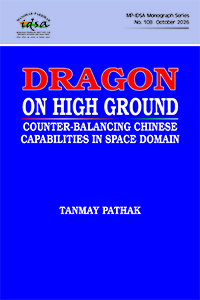
Dragon on High Ground Counter-Balancing Chinese Capabilities in Space Domain
- 2026 |
- Monograph
About the Monograph
China’s civil-military fused space expansion has transformed orbit into a contested strategic theater, presenting a structural rather than a purely technological challenge in the region. This monograph attempts to map all civil and military Chinese space capabilities and examines how it has operationalised space as a warfighting domain leveraging Military Civil Fusion. By fielding a comprehensive counterspace arsenal and deploying highly integrated dual-use system including BeiDou navigation, pervasive ISR constellations, and the Tiangong space station, Beijing has managed to obfuscate the boundary between civilian and military space tracks. Analysing a mix of indigenous and global space sources, various western intelligence assessments from 2015–2025, the research details India’s vulnerabilities in Space Domain Awareness (SDA), PNT resilience, and industrial capacity. For India an integrated counter-strategy addressing electronic/cyber hardening, deterrence mechanisms, legal-diplomatic frameworks, and industrial self-reliance is critical including a Space Activities Act, autonomous PNT, and a declared space deterrence doctrine. A dominating presence in Space domain is critical for future growth of India and hence India should focus on denying China a decisive operational advantage rather than engaging in a satellite-for-satellite arms race.
About the Author
Brig Tanmay Pathak is a serving Indian Army Officer from Infantry. He has extensive operational experience in High Altitude along Line of Control, Line of Actual Control, Deserts and Counter Terrorism Operations, as well as in training appointments. He has worked as a Research Fellow at Manohar Parrikar Institute for Defence Studies and Analyses (MP-IDSA) during 2025 and 2026. He is currently posted in J&K. Brig Tanmay Pathak holds a M.Sc. degree in Defence and Strategic Studies from Madras University and M.Phil from Punjab University, Chandigarh.
Keywords: China, Civil-Military Relations