Vietnam’s Pragmatic Foreign Policy Shift
- June 10, 2026 |
- Issue Brief
Summary
Vietnam is departing from its reticence and caution to a pragmatic foreign policy focused on balancing global and regional powers. This strategic evolution is being driven by its national priorities and the dynamic regional security situation.
Introduction
At the 23rd Shangri-La Dialogue, General Secretary of the Communist Party of Vietnam and President To Lam, while delivering the keynote address on 29 May 2026, highlighted three foundational crises—a crisis in the international order, a crisis of the development model, and a crisis of strategic trust. The specific risks he mentioned included technology and defence industry norms, AI governance, undersea cable and critical infrastructure resilience, information environment cooperation, human security and societal resilience, and preventive diplomacy capacity.
While warning against uncontrolled competition, To Lam urged nations to work together to achieve peace, trust and development.[1] Emphasis on “constructivism” during his remarks also reflects a shift in mindset from passively monitoring the actions of major powers to proactive engagement by Vietnam and other regional countries towards building inclusive security structures.[2]
This was the first time that the Vietnamese party chief participated in Asia’s premier security forum—a platform traditionally dominated by defence ministers and officials. It also indicates a shift in Vietnam’s diplomatic and strategic evolution.[3] To Lam retained his position as the Secretary General of the CPV during the 14th National Party Congress in January 2026, and later assumed the state presidency in April.
The consolidation of power in Vietnam’s top leadership marks a major departure from the past, which centred on collective leadership.[4] This shift could also enable faster decision-making and a more flexible posture for a nation once seen as diplomatically reticent and cautious, given its collective leadership.[5] As Vietnam enters a new developmental phase, its new leadership faces challenges amidst a perilous international environment that could undermine its national goals. The brief analyses Hanoi’s emerging priorities through which it seeks to shape the broader strategic discourse.
Shifts in Vietnam’s Diplomatic Approach
‘Bamboo diplomacy’ reflects Vietnam’s longstanding foreign policy approach, rooted in its strategic doctrine emphasising flexibility, resilience and balance. This doctrine, which centres on pragmatism, ensures strategic autonomy, based on ‘Four Nos’—‘No military alliances’; ‘No foreign bases’; ‘No siding with one power against another’; and ‘No use or threat of force’. Over the past decade, Vietnam has steadily expanded its diplomatic engagement, strengthened strategic partnerships with multiple actors, and enhanced its visibility within multilateral institutions. As of 2025, Vietnam has signed strategic partnerships with over 30 nations, including 12 comprehensive strategic partnerships.[6]
The second decade of the 21st century continues to be shaped by new opportunities for deeper international cooperation. However, it also faces numerous new challenges stemming from intensifying great power competition, a global economic crisis and regional instability. Alongside these, the rapid advancement of science and technology has generated new momentum for growth and digital transformation.
In this context, more than two decades of implementing the Doi Moi reforms, which had enhanced Vietnam’s geopolitical and geostrategic stature, have necessitated significant shifts in its foreign policy thinking and strategies. The 11th Party Congress of the CPV held in January 2011 introduced significant changes in Vietnam’s foreign policy approach; moving from ‘Vietnam as a friend and reliable partner to countries, striving for peace, stability, and development’ to ‘Vietnam as a friend, reliable partner, and active, responsible member of the international community’.[7]
By the 12th Party Congress held in January 2016, the CPV further specified that the objective of Vietnam’s foreign policy activities was to ‘safeguard the supreme interests of the nation and its people, based on the fundamental principles of international law, equality, and mutual benefit’. The foreign policy shifts introduced at the 11th Party Congress, which focused on deepening Vietnam’s international relations, achieving comprehensive international integration, and advancing multilateral diplomacy, were further refined at the 12th, 13th and 14th Party Congresses.[8] The 13th Party Congress, held in January 2021, prioritised multilateral diplomacy to establish a peaceful and stable international environment, which was much needed in an era of great power competition. To further strengthen its external outreach, Vietnam adopted the policy of ‘building a comprehensive and modern diplomatic framework with three pillars: Party diplomacy, state diplomacy, and people-to-people diplomacy’.[9]
About Vietnam’s approach to its foreign policy under its new leadership, we get a broad understanding through an article titled “Promotion of Comprehensive Foreign Affairs at New Height” written by To Lam on 18 February 2026. In the article, To Lam talked about how the world is undergoing significant transformations characterised by interconnectedness and competition. This, according to To Lam, presents opportunities alongside risks for development. He further adds that, as the multilateral international system is increasingly shaped by political and economic competition, it is becoming ineffective at addressing emerging security challenges. In this emerging scenario, To Lam calls for a new, comprehensive foreign policy. The aim is to safeguard Vietnam’s national interests while prioritising peace, independence, self-reliance and the welfare of its people.[10]
During his keynote address at the Shangri-La Dialogue, To Lam, reiterating ASEAN principles of strategic autonomy, peaceful dispute resolution, freedom of navigation and opposition to bloc confrontation, called for “reinforcing international law, setting up inclusive and sustainable growth drivers, as well as initiating dialogue and transparency…”.[11] The need to manage its relations with the great powers has necessitated Hanoi to adopt a realistic diplomatic approach. This pragmatic approach enables it to maintain its strategic autonomy and safeguard its interests. This is prompting Vietnam to reiterate its long-term commitment to multilateralism and its active role in ASEAN. This helps shape regional discourse through a collaborative approach in areas such as maritime security, economics and supply chain resilience, integrating digital technologies and the digital revolution. The ongoing shifts in the international environment, characterised by uncertainty and risk, have further reaffirmed Vietnam’s commitments to ensuring regional stability and growth.[12]
Prioritising High Economic Growth
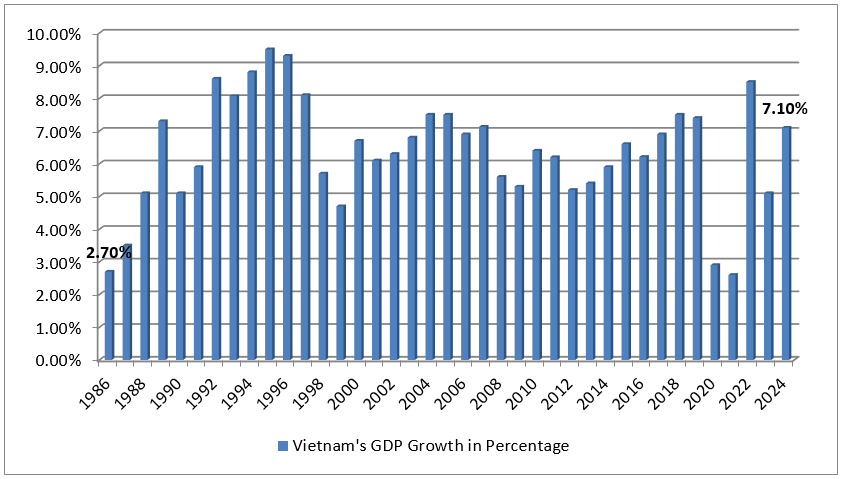
Since the introduction of the Doi Moi initiative in 1986, Vietnam’s economy has been on an upward growth trajectory. As indicated in Figure 1, Vietnam’s GDP in 1986 was 2.7 per cent, which increased to 7.1 per cent in 2024. Over the decades, the overall GDP grew at an average rate of 6 to 7 per cent despite major economic shocks, including the 1998 Asian financial crisis and the 2020 pandemic. Strong gains in services and construction, and strong integration into global supply chains, have helped Vietnam attract significant foreign investment. This has resulted in sustained economic growth despite external shocks, making it one of the world’s most robust economies today. According to data released by Vietnam’s General Statistics Office (GSO), in 2025, GDP increased by 8.02 per cent, despite developments that limited global trade and commerce.[13]
Figure 1. Vietnam’s GDP Growth 1986–2024 (in %)
Source: World Bank
In 2025, the CPV Politburo issued four major resolutions outlining the country’s economic roadmap. To make Vietnam a high-income country by 2045, a target of double-digit GDP growth and the implementation of a US$ 570 billion infrastructure development programme have been announced. In this regard, Vietnam has set a sustained 10 per cent GDP growth target starting this year, along with steps to integrate science, technology and digital transformation effectively.[14]
The Party Congress of the CPV is held once every five years, during which it sets Vietnam’s political direction and economic targets. The 14th Party Congress, held in January 2026, set a target for GDP per capita to reach around US$ 8,500 by 2030. To achieve this GDP per capita target by 2030, the government realised the need to address structural challenges and transition from a labour-based growth model to one driven by productivity. General Secretary To Lam has already laid out Vietnam’s Pro Growth Agenda based on 3 Core Pillars, as per which the private sector would be the primary growth driver.[15]
This has been clearly stated in Resolution 68, a policy adopted by the Politburo in April 2025. It aims to make the country’s homegrown private companies the key driving force of the economy by 2035, while also focusing on ‘high-tech industries such as artificial intelligence, semiconductors and digital technology…’.[16] The other two pillars include ‘…enhancing infrastructural development; and reducing red tape to help speed up the process of investment approval and execution…’.[17]
The ongoing reformative measures would help elevate Vietnam’s growth model, enhancing productivity while also enabling it to integrate further into global supply and value chains. Despite this initiative, Vietnam’s future growth trajectory remains exposed to the ongoing external developments and uncertainties in the multilateral trading regime. For instance, Vietnam’s economy remains deeply reliant on trade, with the US accounting for nearly one-third of its exports.[18]
In 2026, global economic uncertainties have emerged due to US trade policies and the ongoing war in West Asia. The US ran a trade deficit of US$ 123.5 billion with Vietnam, prompting Trump’s 46 per cent tariff, which fell to 20 per cent in July 2025 following a framework trade deal,[19] then fell further after the US Supreme Court ruling against the unilateral tariffs in February 2026.
Apart from the US tariff policies, the conflict in West Asia could also undermine Vietnam’s set growth target. The war in West Asia is causing a major energy crisis and is already driving up manufacturing costs. Given the multifaceted nature of the conflict, the economic fallout, including reduced foreign investment flows and inflationary pressures, could become more difficult to manage. Vietnam had recently established a “Comprehensive Economic Partnership Agreement” (CEPA) with the United Arab Emirates. The CEPA presented a significant opportunity for Vietnam to diversify its trade and investments further. However, as the conflict in West Asia continues to widen and intensify, implementing and maximising the agreement’s benefits could become more challenging.[20]
Prioritising Military Diplomacy
Vietnam increasingly embodies what many middle powers aspire towards: strong economic growth combined with relatively independent diplomacy.[21] Since 1986, Vietnam’s foreign policy has evolved from economic integration to a strategic shift which prioritised deeper international integration. Through expanding its military engagement, Vietnam wants to enhance its global standing and influence. Presenting his report at the 14th Party Congress in January 2026, General Phan Van Giang, Minister of National Defence, “emphasised the goal of building a revolutionary, regular, elite and modern People’s Army…”. As per General Giang, “… the strategic goals laid out in the 13th Party Congress regarding the military’s development have been implemented decisively and effectively…”.[22]
In the last five years, Vietnam has been undertaking major military reforms geared towards building a revolutionary, regular, elite and modern army. The military has completed the restructuring of over 5,000 units, with personnel prioritised for combat-readiness missions, especially along border areas and on islands. Vietnam also plans to accelerate the development of its defence industry, focusing on autonomy, self-reliance, dual-use capabilities and cutting-edge technologies.[23] Through its defence cooperation with its strategic partners, Vietnam seeks to strengthen its capabilities in the production of high-tech arms and equipment, which are much needed for its military modernisation.
Therefore, it is evident today that Vietnam is deepening its international integration through its defence diplomacy. This includes increasing its participation in various bilateral and multilateral military exercises and training. To date, Vietnam has established bilateral defence ties with more than 100 countries, including all the permanent five members of the United Nations Security Council. It has also established defence cooperation with major powers, including India. Vietnam sees its international integration through its military diplomacy as a significant step towards establishing strategic trust and cooperation.
Vietnam has also been proactively participating in regional and international multilateral forums, including the ASEAN Defence Ministers’ Meeting (ADMM), ADMM Plus, the Shangri-La Dialogue, the Moscow International Security Conference, and the Xiangshan Forum. Vietnam sees this as essential to establishing and maintaining a peaceful and favourable environment for its national construction and development.[24] Therefore, going forward, Vietnam would prioritise broader collaborative engagement, including creating a favourable international environment and ensuring peace and stability by resolving conflicts peacefully in accordance with international law.
Conclusion
Vietnam’s past and historical experiences have enabled it to develop a pragmatic strategy. This has become its major foreign policy approach towards balancing against competing global powers. This is quite evident when we examine Vietnam’s management of its relations with China while also looking to the US for a more meaningful partnership. Despite ongoing bilateral differences in the South China Sea—which directly threaten Vietnam’s economic lifelines and sovereignty—it continues to maintain robust economic ties with Beijing while also looking to the United States to strengthen its capabilities. However, as the US–China rivalry continues to intensify, it would have implications for Vietnam. Therefore, for Vietnam to achieve its priorities, Hanoi must also focus elsewhere.
Under To Lam’s “pragmatic nationalism”, Vietnam is likely to become even more firm in extracting the maximum benefits from its partnerships to achieve its strategic goals, while committing to none of them. The shifts in its foreign policy since the second decade of the 21st century reflect a strategy centred on its long-term goal and new developmental phase. This shift, based on its internal and external priorities, is reshaping its external engagements, characterised by a diversification of partnerships to limit reliance on a single power. This, in turn, would ensure it is less exposed to external shocks resulting from the ongoing power rivalry.
An uncertain international environment, slower global demand, trade pressure from Washington, and ongoing conflicts, especially in West Asia, have fuelled the need for greater international integration. The pragmatic shift in Vietnam’s foreign policy, which recognises the tactical importance of economic diversification and defence ties, would further strengthen collaboration with regional powers such as India.
Views expressed are of the author and do not necessarily reflect the views of the Manohar Parrikar IDSA or of the Government of India.
[1]“Keynote Address by General Secretary and President To Lam at Shangri-la Dialogue 2026”, Government News: Socialist Republic of Viet Nam, 29 May 2026.
[2] Nguyen Thanh Trung, “Shangri-La Dialogue: The Role of Middle Powers”, Tuoi tre, 31 May 2026.
[3] Jacopo Romanelli, “2026 Shangri-La Dialogue: Vietnam Steps Onto a Larger Strategic Stage”, The Vietnamese, 25 May 2026.
[4] Son Nguyen, “Tô Lâm’s Presidency: Việt Nam’s Strongman Era?”, The Vietnamese, 28 May 2026.
[5] Greg Torode, “Exclusive: Better China Ties Can Help Regional Peace, Security, Vietnam’s Top Leader Says”, Reuters, 30 May 2026.
[6] Jacopo Romanelli, “2026 Shangri-La Dialogue: Vietnam Steps Onto a Larger Strategic Stage”, The Vietnamese, 25 May 2026.
[7] “11th Party Central Committee’s Report on Congress Documents”, Vietnam Plus, 28 January 2016.
[8] Đỗ Thanh Hà and Trần Nam Tiến, “Vietnam’s Foreign Policy Reform (1986-2025): From Breaking Isolation to International Integration and the Era of the Nation’s Rise”, International Journal on Culture, History, and Religion, Vol. 7, Special Issue 2, 8 October 2025.
[9] “The 13th National Party Congress Resolution”, Tap Chi Cong San, 25 August 2021.
[10] “Promoting Comprehensive Foreign Affairs at New Height: Party Chief”, Viet Nam News, 18 February 2026.
[11] “Keynote Address by General Secretary and President To Lam at Shangri-la Dialogue 2026”, no. 1.
[12] Nguyen Thi Thuy Ngan, Asrinaldi and Indah Adi Putri, “Vietnam’s Foreign Policy in the 21st Century: Balancing Global Powers”, International Journal on Political Science and Governance, Vol. 7, No. 6, Part B, 2025.
[13] “Socio-economic Situation in the Fourth Quarter and 2025”, National Statistic Office, Vietnam.
[14] “Vietnam’s Economy Accelerates Despite Global Uncertainties: French Report”, Vietnam Net Global, 3 June 2026.
[15] Nguyen Khac Giang, “How To Lam Can Unleash Vietnam’s Private Sector”, Fulcrum, 29 April 2025.
[16] “Resolution 68: Private Economic Sector Affirms Principal Driver of Growth, Innovation”, Vietnam Law & Legal Forum, 26 January 2026.
[17] Hoang Thi Ha and Dien Nguyen An Luong, “Vietnam’s Trump Card: Navigating Growth, Politics, and US Relations”, Fulcrum, 3 June 2025.
[18] “Vietnam’s Economy Accelerates Despite Global Uncertainties: French Report”, no. 14.
[19] Anisha Sharma, “Vietnam-US Trade and Investment Relations: Updated to November 2025”, Vietnam Briefing, 25 November 2025.
[20] Tien Phong, “Middle East Conflict: What is the Biggest Pressure on Vietnam’s Economy?”, Vietnam Net Global, 3 March 2026.
[21] Ei Sun Oh, “Tô Lâm’s Regional Visits to Reflect Vietnam’s Rising Role”, The Manila Times, 27 May 2026.
[22] Tran Thuong and Huong Quynh, “General Phan Van Giang: Military Reorganization Near Completion”, Vietnam Net Global, 22 January 2026.
[23] “Building a Modern Vietnam People’s Army in the New Revolutionary Period”, National Defence Journal, 11 December 2025.
[24] Hoang Xuan Chien, “Vietnam’s Defence Cooperation and International Integration in an Era of the Nation’s Rise”, Tap Chi Cong San: Communist Review, 23 December 2025.