Corridors of Growth: India–Bhutan Rail Connectivity and Economic Transformation
- May 15, 2026 |
- Issue Brief
Summary
The India–Bhutan rail connectivity initiative will improve trade logistics and facilitate Bhutan’s economic diversification and access to new markets. Concurrently, it drives development in India’s Northeast. It is therefore a pivotal project for bilateral cooperation and regional integration.
Railways function not merely as a mode of transport but as a critical infrastructure that underpins economic linkages within and across national boundaries. They have long served as the backbone of economic integration by facilitating the efficient movement of goods, people, and ideas across regions. Its ability to reduce transportation costs, compress distances, and connect production centres with markets has made it central to processes of industrialisation and regional development.
Over the last few decades, the Indian Railways has placed greater emphasis on building rail connectivity across South Asia. Cross-border railway projects are increasingly seen as practical tools to deepen economic ties, streamline trade, and reinforce regional linkages. Converting metre gauge to broad gauge in Bangladesh and building rail connectivity with Nepal illustrate this shift, where operational train services and new infrastructure are gradually knitting together markets and border regions.[1] Within this evolving regional approach, Bhutan has also come into focus as the next step in expanding rail-based connectivity.
On 13 March 2026, Prime Minister Narendra Modi virtually inaugurated a set of infrastructure projects in Kokrajhar, Assam, including the proposed rail link with Bhutan.[2] The planned corridor comprises two routes connecting Assam and West Bengal to Gelephu and Samtse in Bhutan, respectively. Construction of both links is scheduled to begin in the first quarter of 2027, with a combined estimated cost of Rs 4,033 crores, fully financed by the Government of India.[3] These initiatives fall under India’s Rs 10,000-crore development assistance commitment to Bhutan’s 13th Five-Year Plan (2024–2029). Beyond its infrastructural scope, the project carries clear strategic and developmental significance for both countries.
Existing Connectivity Framework and Structural Constraints
The contemporary partnership between India and Bhutan is defined by deep economic interdependence, shaped as much by geography as by policy choice. As a landlocked country, its access to external markets is structurally contingent on transit through India, resulting in a highly asymmetrical yet mutually reinforcing economic relationship. India’s share in Bhutan’s total trade increased from 79.17 per cent in 2023 to 79.88 per cent in 2024. In absolute terms, bilateral trade between India and Bhutan reached Rs 12,669 crore in 2024, with India’s exports accounting for Rs 9,538 crore and imports from Bhutan at Rs 3,131 crore.[4] Most of these products are essential commodities. Additionally, to facilitate the movement of people, including third-country nationals, an Immigration Check Post was inaugurated in Darranga, Assam, on 7 November 2024. The Jogigopha Inland Waterway Terminal, inaugurated in January 2025, will further enhance regional trade connectivity. India accounts for the overwhelming share of Bhutan’s trade and functions as its principal gateway for third-country commerce.
Despite this level of integration, the physical infrastructure underpinning bilateral trade remains limited in scope. Connectivity is overwhelmingly road-based, routed mainly through Assam and West Bengal via Guwahati–Samdrup Jongkar, Jaigaon–Phuentsholing, and Bongaigaon–Gelephu.[5] While these corridors facilitate routine cross-border movement, they are constrained by higher logistics costs, lower carrying capacity, and vulnerability to seasonal and terrain-related disruptions.
These constraints are most pronounced in Bhutan’s southern belt, where key nodes such as Gelephu, Phuentsholing and Samtse serve as primary gateways for cross-border exchange. Their geographic proximity to India positions them as natural transit hubs; however, their current role remains limited by the absence of multimodal infrastructure. Importantly, the lack of rail connectivity is a significant gap. Early momentum towards establishing rail links took shape in the mid-2000s, when the governments of India and Bhutan commissioned joint feasibility studies that identified five potential corridors, as outlined in Table 1.
Table 1. Potential Railway Links Proposed between India and Bhutan in 2005
| S. No. | Station in India | Station in Bhutan | Length (Approx.) |
| 1. | Hasimara (West Bengal) | Phuentsholing | 18 kms |
| 2. | Kokrajhar (Assam) | Gelephu | 57 kms |
| 3. | Pathsala (Assam) | Nanglam | 51 Kms |
| 4. | Rangjya (Assam) | Samdrup Jongkhar via Darranga | 48 kms |
| 5. | Banarhat (West Bengal) | Samste | 23 kms |
Source: South Asia Subregional Economic Cooperation (SASEC)
The projects acquired clearer shape in the 2020s, when India advanced plans for two cross-border rail links: Kokrajhar–Gelephu and Banarhat–Samtse. The foundations for this cooperation were laid during PM Modi’s visit to Bhutan in March 2024, and a decisive breakthrough came in September 2025, when the two sides formally agreed to develop the two-rail links.[6] More recently, the initiative has entered the implementation stage, with the Government of India approving the projects mentioned in Table 2. The Kokrajhar–Gelephu line, in particular, has been designated a priority project, reflecting both its developmental value for the Northeast and its strategic importance in deepening India–Bhutan ties.[7]
Table 2. Finalised Railways Links between India and Bhutan
| S. No. | Rail Lines | Length | Investment | Project Timeline (Starting 2027) |
| 1. | Kokrajhar – Gelephu | 69kms | ₹ 3456 Cr | 4 years |
| 2. | Banarhat – Samste | 20 kms | ₹ 577 Cr | 3 years |
| Total | 89 kms | ₹ 4033 Cr |
Source: Compiled by the author based on MEA’s Special Briefing on the subject.
Significance of the Project for Bhutan
For Bhutan, this project addresses various structural constraints linked to its landlocked geography. First, it helps Bhutan transition from road-dependent logistics to a high-capacity, multi-modal connectivity framework. Historically, Bhutan’s landlocked geography has necessitated a near-total reliance on road-based transit, a model prone to high operational costs, seasonal disruptions, and scalability limits. The establishment of these rail links introduces Bhutan’s first-ever rail network, integrates the nation into the Indian Railways’ broad-gauge network of 150,000 km, and connects it directly to major industrial hubs such as Bongaigaon.[8] By facilitating the efficient movement of bulk cargo, this shift mitigates chronic logistical bottlenecks caused by congestion at key border gateways, such as Phuentsholing.
Second, both Gelephu and Samste are undergoing policy-driven transformation as two important industrial nodes. These rail projects serve as the physical foundation for Bhutan’s 13th Five-Year Plan[9] and the visionary Gelephu Mindfulness City (GMC). The Kokrajhar–Gelephu link constitutes the core connectivity for the proposed 2,600 sq km Special Administrative Region, enabling the high-capacity logistics required to position it as a global technology hub, in line with the vision of Jigme Khesar Namgyel Wangchuck. This project serves as the essential logistical backbone for the GMC, providing the large-scale transit capacity necessary to transform this strategic border zone into a global investment and innovation hub.[10]
Similarly, the 16-km stretch connecting the industrial city of Samtse will streamline the bulk import of goods such as dolomite, ferro-silicon, quartzite, and stone chips from Bhutan.[11] It will also address structural limitations in western Bhutan by complementing projects like the Norbugang–Dhamdum highway and positioning Samtse as an economic powerhouse.[12] Together, these links enable the southern districts to attract significant investment and stimulate agro-based and domestic growth. Moreover, this infrastructure will optimise logistics, stimulate industrial and tourism growth, and strengthen bilateral socio-economic integration between India and Bhutan.
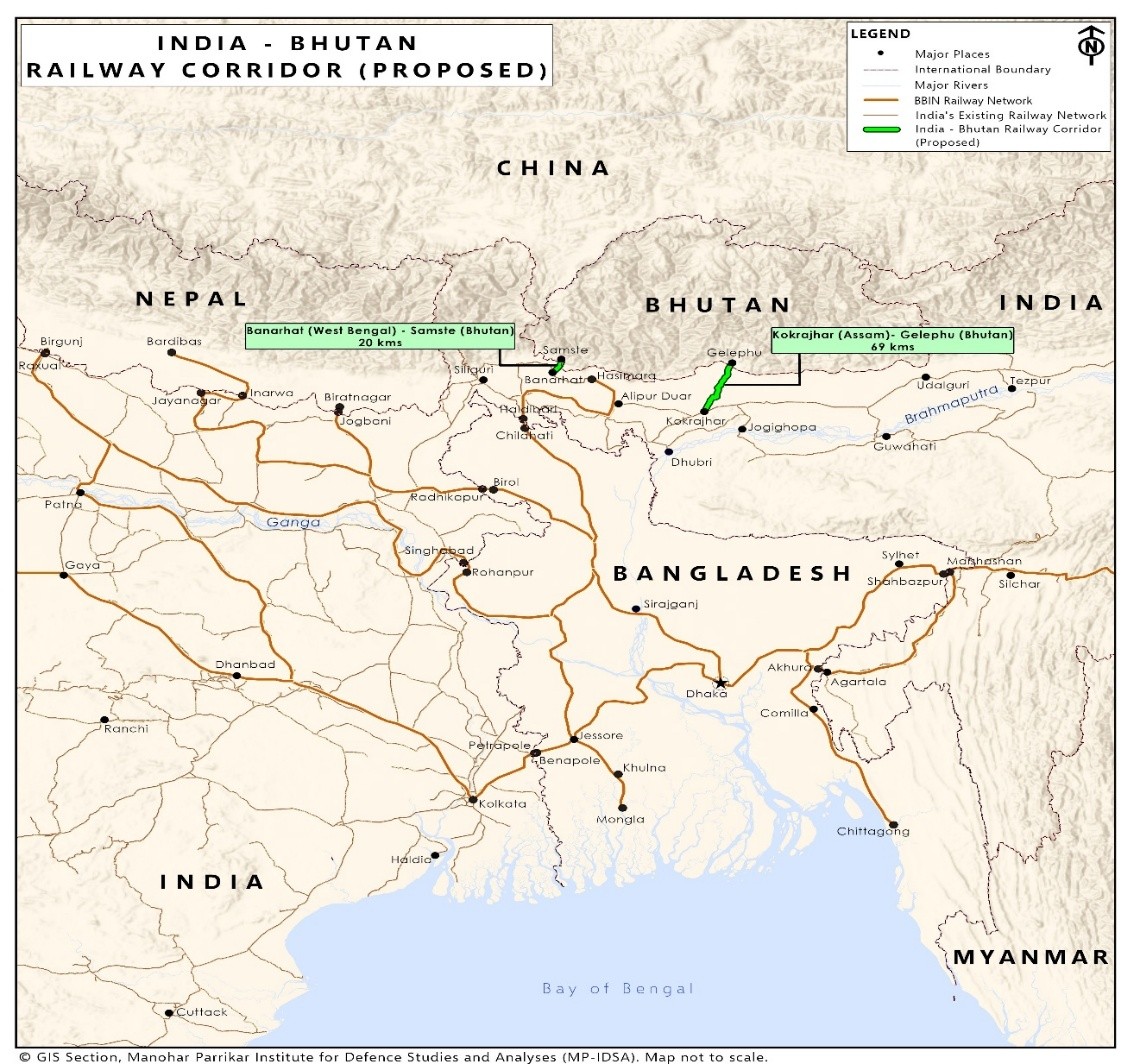
Third, it enables integration into regional supply chains through a land-linked framework. It may also be extended into the BBIN (Bangladesh–Bhutan–India–Nepal) growth quadrangle, securing vital access to maritime outlets via the ports of Chittagong and Mongla in Bangladesh, as illustrated in Figure 1. This reduces Bhutan’s logistical constraints and dependence on a single market, enabling more competitive exports of hydropower-based industrial goods such as ferroalloys and niche agro-products, including organic produce and processed foods. Improved connectivity reduces transit times and costs, making Bhutanese exports more viable in Bangladesh and beyond, while also supporting gradual industrial diversification necessitated by its graduation as a least developed country (LDC) in 2023.
Figure 1. India–Bhutan Railway Corridor (Proposed)
Therefore, enhanced connectivity can stimulate economic activity in southern districts, attract investment, and strengthen emerging growth centres such as Gelephu Mindfulness City. Over time, it provides the infrastructural base necessary for deeper integration into regional supply chains while remaining consistent with Bhutan’s broader development framework.
Strategic Significance for India
For India, improving railway connectivity is a testament to the evolving geopolitical landscape, strategic ambitions, and developmental imperatives. Improved connectivity through Assam and West Bengal can stimulate local economies, improve market access, and strengthen logistics networks in the northeast. At a broader level, the project deepens India–Bhutan economic interdependence while reinforcing India’s role as a regional integrator.
The project acts as an effective fiscal multiplier, accelerating the developmental transformation of India’s Northeast. As emphasised by Union Railway Minister Ashwini Vaishnaw, these rail links are a major developmental catalyst for India’s Northeast Region (NER), supported by a record Rs 11,486 crore budgetary allocation for regional rail expansion in 2026.[13] The resulting infrastructure catalyses the emergence of vibrant Border Economic Zones. It secures specialised markets for Indian industrial outputs, including refined petroleum and consumer commodities, while providing Bhutan with the logistical backbone necessary for its own industrial expansion. By integrating the Northeast into a broader transnational network, the project fosters long-term economic resilience. It ensures that the region becomes a central gateway for India’s broader engagement with the South Asian and Southeast Asian economic spheres.
Moreover, these railway links carry strategic weight as instruments to sustain stability in the Himalayan region and further bolster India’s ‘Neighbourhood First’ policy, with Bhutan serving as a key component of India’s northern security framework. The establishment of high-capacity railway infrastructure within the immediate vicinity of the Siliguri Corridor provides vital strategic depth and logistical difficulties for a region traditionally defined by the geographic vulnerabilities of the Chicken’s Neck. It may facilitate rapid mobilisation for both humanitarian and defence exigencies and serve as a decisive deterrent against regional instability, thereby consolidating Bhutan’s long-term security alignment with India.
Furthermore, these links serve as catalysts for wider regional integration within the BBIN initiative (as indicated in Figure 1 in dark brown), while reinforcing India’s central role in shaping and sustaining this connectivity architecture. The project also incorporates advanced technical safeguards, such as AI-based Intrusion Detection Systems (IDS) to protect elephant corridors, demonstrating a sophisticated model of developmental partnership from the Indian side.[14]
Potential Challenges and the Road Ahead
Despite the current momentum, Indo-Bhutan railway projects have historically faced significant structural and socio-technical hurdles that have prevented them from taking off for several years. While the initiative has benefitted from persistent political will, stagnation has been largely driven by complex environmental issues encountered during the initial survey stages and recurring technical hurdles. Presently, while the Kokrajhar to Gelephu alignment has advanced, the Banarhat to Samtse route remains sensitive due to land acquisition problems in West Bengal. The proposed trajectory intersects with tea plantations and private landholdings in the Samtse district.[15]
The complex topography of the Himalayan foothills also dictates the engineering requirements. The project must contend with an undulating, seismically active landscape and the hydrological volatility of mountain-fed rivers, which necessitates a dense network of bridges, viaducts and culverts. This technical complexity exposes the initiative to the risk of optimism bias in delivery schedules, necessitating rigorous contract enforcement and consistent public oversight to mitigate the regulatory uncertainty inherent in cross-border megaprojects.
Simultaneously, there is a need to harmonise large-scale industrial infrastructure with Bhutan’s developmental philosophy and its commitment to carbon neutrality. The historical delay in project commencement underscores the difficulty of aligning large-scale engineering with these environmental mandates. The project must implement stringent safeguards to prevent ecological disruption within the transboundary biosphere, specifically across the forested corridors of Assam and southern Bhutan. Failure to adhere to these standards could elicit domestic resistance, given that ecological preservation is a constitutional imperative in Bhutan.[16]
Advancing this project also requires an emphasis on institutional resilience. The establishment of India–Bhutan Rail Cooperation Committees provides a critical mechanism for joint monitoring and expedited dispute resolution, ensuring that the high levels of political commitment are translated into operational success. Overall, the success of this initiative requires a whole-of-region strategy that reconciles India’s strategic security objectives with Bhutan’s pursuit of a sustainable, land-linked future.
Conclusion
The successful implementation of these two rail corridors signifies a pivotal shift in South Asian connectivity, transforming bilateral engagement from a traditional development model to one of calibrated infrastructure development with economic and strategic synergy. These proposals align with India’s ‘Neighbourhood First’ approach, which emphasises cross-border infrastructure as a tool for regional integration and borderland development. They reinforce India’s central role in shaping connectivity in the eastern Himalayan region. It will provide Bhutan with strategic diversification without undermining its external balancing, and operationalise sub-regional frameworks such as the BBIN Initiative. Ultimately, their success will depend on whether physical infrastructure is matched by institutional coordination, environmental sensitivity, and sustained economic use.
[1] “Prime Ministers of India and Bangladesh to Jointly Inaugurate Three Development Projects on 1st November”, Ministry of External Affairs, Government of India, 31 October 2023.
[2] “PM Modi Virtually Unveils Projects Worth ₹4,570 Crore in Assam’s Kokrajhar”, The Hindu, 13 March 2026.
[3] “Construction of Gelephu- Kokrajhar Railway to Begin Next Year”, Kuensel Online, 4 February 2026.
[4] “India-Bhutan Bilateral Relations; Annual Reports & Press Briefings”, Ministry of External Affairs, Government of India, 14 March 2024.
[5] “Land Ports Authority of India”, Ministry of Home Affairs, Government of India.
[6] “Joint Press Release on the State Visit to Bhutan by Prime Minister of India”, Ministry of External Affairs, Government of India, 12 November 2025.
[7] “Kokrajhar-Gelephu Rail Link Likely in Three Years, Assam Project Fast-tracked”, India Today, 3 February 2026.
[8] “Transcript of Special Briefing on New Railway Projects Between India and Bhutan”, Ministry of External Affairs, Government of India, 29 September 2025.
[9] “Thirteenth Five Year Plan- Prime Minister’s Office”, Office of the Cabinet Affairs and Strategic Coordination, Royal Government of Bhutan, 17 December 2023.
[10] Namgay Zam, “Gelephu: The World’s First Mindfulness City is in Bhutan”, The Diplomat, 23 January 2024.
[11] “Transcript of Special Briefing on New Railway Projects Between India and Bhutan”, no. 8.
[12] Tenzing Lamsang, “Samste to be an Economic Powerhouse with Norbugang, Dham Dhum Highway and Possible Airport”, The Bhutanese, 18 January 2025; Dorji Choden, “Samste to be an Industrial Hub”, The Bhutanese, 30 March 2024.
[13] “India Funds Kokrajhar-Gelephu Line Bringing Bhutan onto National Railway Network”, The Assam Tribune, 29 September 2025.
[14] “Transcript of Special Briefing on New Railway Projects Between India and Bhutan”, no. 8.
[15] “Bhutan Rail Link via Assam to be Ready in Three Years: NFR”, News Arena India, 2 February 2026.
[16] “The Constitution of the Kingdom of Bhutan”, Royal Government of Bhutan, 2008.