

Conflict Dynamics in Mozambique and India’s LNG Investments
- April 16, 2026 |
- Issue Brief
Summary
Mozambique’s LNG future faces uncertainty as Rwanda signals a potential troop withdrawal from Cabo Delgado, exposing the fragility of externally supported security arrangements in a conflict-prone region. This development carries broader strategic consequences, including implications for India’s investments in the regional energy infrastructure.
Introduction
On 14 March 2026, Rwanda warned that it may withdraw its troops from northern Mozambique if external funding, particularly from the European Union (EU), is not sustained.[i] This development follows reports that EU financial support for Rwanda’s counter-insurgency operations in Cabo Delgado may not be extended beyond May.[ii] In a recent interview, President Paul Kagame said that the possible withdrawal of Rwandan troops is not a threat but a practical issue. He explained that Rwanda’s intervention has helped improve security in Cabo Delgado, but most of the costs are being paid by Rwanda itself. The EU’s contribution of about US$ 23 million covers only a small part of the total expenses needed to maintain a force of around 5,000 troops. Kagame pointed out that this funding is meant to support Mozambique and the international energy stakeholders operating there, not Rwanda. He made it clear that if security is important, it must be properly funded; Rwanda cannot continue its deployment.[iii]
Rwanda’s potential withdrawal raises critical concerns regarding the sustainability of externally funded stabilisation efforts in conflict-affected regions. More importantly, it highlights the fragility of the security architecture underpinning Mozambique’s resource-rich Cabo Delgado province, an area central not only to regional stability but also to global energy investments. For India, the stakes are particularly significant. Mozambique has emerged as a key partner in India’s energy diplomacy, especially in the liquefied natural gas (LNG) sector, with major investments by Indian public sector undertakings in offshore gas projects.[iv]
Cabo Delgado’s Fragile Security Architecture
Cabo Delgado, located in northern Mozambique, has emerged as a critical theatre of conflict since 2017, driven by a combination of Islamist insurgency and deep-rooted socio-economic grievances. The region’s vast natural gas reserves and mineral wealth have elevated its strategic importance, attracted major international investments, while simultaneously making it vulnerable to violent contestation. The insurgency, initially spearheaded by Ahlu Sunna Wal Jamaah and later aligned with the Islamic State, has resulted in the displacement of a significant portion of the province’s population. Beyond its humanitarian toll, the conflict has disrupted global energy projects, particularly LNG operations, thereby linking Cabo Delgado’s instability to broader geopolitical and economic dynamics. As a result, the crisis represents not merely a domestic security challenge for Mozambique but a complex intersection of local grievances, terrorism and resource-driven politics.[v]
In response, Cabo Delgado has witnessed overlapping interventions: Rwanda’s deployment, the Southern African Development Community (SADC) Mission in Mozambique (SAMIM), and the African Union’s (AU) political engagement. Rwanda intervened rapidly through a direct agreement with Mozambique, focusing on securing strategic zones and demonstrating high operational effectiveness. In contrast, SAMIM represented a regional effort under SADC, deploying multinational forces with a broader mandate but facing challenges related to coordination, logistics and strategic coherence. The AU, while not directly operational, provided political endorsement and normative legitimacy to these efforts, reflecting its role within Africa’s broader peace and security architecture.[vi]
Notably, these interventions operated simultaneously without a unified command structure, illustrating a fragmented yet adaptive security environment characterised by overlapping mandates and partial coordination. However, in comparative terms, Rwanda’s intervention has been relatively more effective and positively perceived, achieving faster stabilisation of key areas and demonstrating greater operational coherence than the SADC- and AU-led efforts, which were constrained by institutional and logistical limitations. Rwanda has effectively become the backbone of counter-insurgency efforts, and any sudden withdrawal could reverse the progress achieved on the ground.
Mozambique’s own limitations further complicate the situation. Its armed forces lack the operational capacity, coordination and logistical strength required to manage the insurgency independently. Regional efforts, particularly those led by the Southern African Development Community, have also faced challenges such as slow deployment, limited resources and weak coordination. As a result, Mozambique remains heavily dependent on Rwanda for internal security, which raises concerns about its long-term stability.[vii]
External support has played an important role in sustaining Rwanda’s deployment. Financial and logistical assistance, especially through mechanisms such as the European Peace Facility, has helped cover key operational costs, including troop transport, equipment and logistics.[viii] Daniel Chapo, who took office in January 2025, has reaffirmed that foreign troops will continue to remain in Mozambique as long as the terrorist threat persists. He highlighted that Rwanda’s presence plays a crucial role in providing a basic level of security, especially for multinational companies involved in the LNG sector, allowing their operations to continue without further delays. According to Chapo, despite the ongoing insurgency, the agreement between Mozambique and Rwanda ensures sufficient security for activities to return to normal gradually.[ix]
This improving security environment is reflected in the revival of Mozambique’s LNG sector. On 29 January 2026, Mozambique and TotalEnergies agreed to restart the US$ 20 billion LNG project in Afungi, which had been suspended since 2021 due to insurgent attacks in Cabo Delgado. The decision signals growing confidence in security conditions, supported by the presence of Rwandan forces. Despite ongoing cost negotiations, both sides have stressed that these will not delay progress. President Daniel Chapo has reaffirmed that the restart is already underway, noting that current security conditions are sufficient for operations to proceed. The project is expected to significantly boost Mozambique’s economy and position it as a major LNG exporter.[x]
At the same time, Mozambique has sought to reinforce these gains through deeper engagement with the European Union. Daniel Chapo’s visit to Brussels from 14 March to 18 March 2026 underscored Mozambique’s efforts to deepen its strategic partnership with the European Union, highlighting new opportunities for cooperation and reaffirming the EU’s role in the country’s economic and social development. This outreach occurred at a critical juncture, ahead of the anticipated expiry of EU financial support for Rwanda’s deployment and the conclusion of the EU military assistance mission in May and June 2026, respectively. However, Chapo noted that there was no official confirmation regarding the termination of these arrangements, stressing that both missions remain operational, thereby signalling an intent to manage uncertainty and maintain confidence in Mozambique’s existing security framework.[xi] In this context, Rwanda’s role stands out as a more flexible and dependable security partner, shaping the evolving dynamics of intervention in Cabo Delgado.
Rwanda’s Security Statecraft
Rwanda has increasingly positioned itself as a proactive and capable security actor in Africa, marking a significant shift in the continent’s security landscape. Unlike traditional peacekeeping contributors, Kigali has transitioned from multilateral frameworks, particularly United Nations missions, to more flexible bilateral security engagements. In Mozambique, Rwanda undertook its intervention through a direct bilateral arrangement with the host government, effectively bypassing regional frameworks such as the SADC, whose mission is the SAMIM.[xii]
Rwanda’s model emphasises rapid deployment, operational autonomy, and political flexibility, allowing it to respond effectively to crises while maintaining strategic leverage. The effectiveness of this approach has been particularly evident in Cabo Delgado. The Rwanda Defence Force (RDF), known for its discipline and cohesion, played a decisive role in recapturing key strategic towns, including Mocímboa da Praia, and stabilising insurgency-affected areas.[xiii] This stands in contrast to the relatively limited success of other actors, including regional forces and private military contractors like the Russian Wagner Group and the South African Dyck Advisory Group.[xiv]
However, Rwanda’s engagement is not purely altruistic. Its interventions serve multiple objectives, including regime support, regional influence and economic interests.[xv] Rwanda has leveraged its external security engagement to generate notable economic gains by turning peacekeeping into a revenue stream. Deployments under the United Nations provide substantial reimbursements that significantly offset defence costs. At the same time, support from partners like the United States and institutions such as the World Bank subsidise training and DDR programmes. Combined with sustained donor inflows enabled by post-genocide legitimacy, Rwanda has reduced its fiscal burden while retaining policy control. Additionally, its role as a regional security provider enhances its global standing, attracting aid and investment and exerting indirect economic influence.[xvi]
Implications for Energy Security and Strategic Investments
The uncertainty in Cabo Delgado has direct implications for global energy markets and, more specifically, for India’s strategic interests. Mozambique’s offshore gas reserves, particularly in the Rovuma Basin, are among the largest in the world and have attracted significant international investment. Indian companies, including Bharat Petro Resources Ltd., Oil India Ltd., and ONGC Videsh Ltd., hold substantial stakes in these projects, making Mozambique a critical node in India’s long-term energy diversification strategy.
Figure 1. Mozambique LNG Consortium Stake Distribution
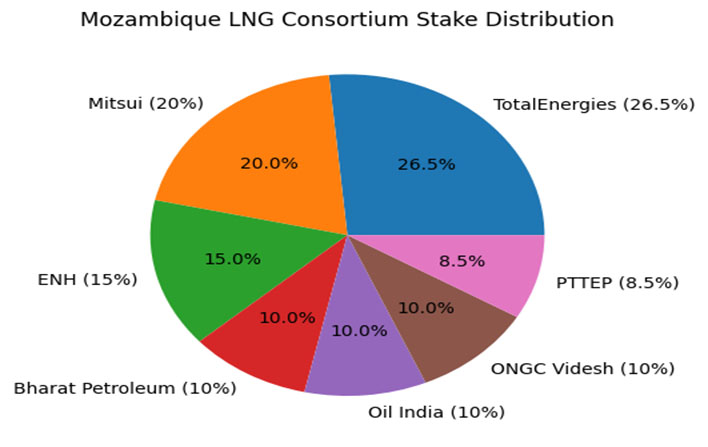
Source: Source: Compiled by the author based on Mozambique LNG Project.
However, the viability of these investments is closely tied to the security environment. The suspension of LNG projects in previous years due to escalating insurgency demonstrated the vulnerability of high-value energy infrastructure to local instability. The eventual resumption of operations was contingent upon improved security conditions, largely enabled by Rwanda’s intervention. A relapse into instability would not only delay project timelines but also generate significant financial losses.
India has emerged as the fourth-largest liquefied natural gas (LNG) importer globally, reflecting its growing reliance on external sources to meet rising energy demand amid limited domestic production. LNG imports reached around 36 bcm in 2024 and are projected to increase significantly to approximately 64 bcm by 2030, driven by rising consumption in the city gas distribution, industrial and power generation sectors. This trend underscores a structural shift in India’s energy profile, where domestic gas output, expected to grow only marginally, will be insufficient to meet demand, thereby increasing dependence on global LNG markets. While LNG enables India to diversify its energy mix and support its transition towards a gas-based economy, it also exposes the country to price volatility and supply uncertainties, particularly as the gap between contracted supply and future demand widens beyond 2028.[xvii]
LNG megaprojects are characterised by high fixed costs, long construction cycles, and complex supply chains, making them particularly sensitive to disruptions. The projected timeline for Mozambique’s LNG exports is expected to materialise closer to 2029.[xviii] Any deterioration in security conditions could further push back these timelines. Moreover, India’s 30 per cent participating interest in Area 1 represents a substantial exposure by global standards. This concentration of investment amplifies the risks associated with security uncertainties in a single region. In this context, the situation in Cabo Delgado is not merely a regional security issue but a strategic concern for India.
Assessment
Rwanda’s statements regarding a potential withdrawal from Mozambique should be approached with caution, as they appear to reflect political signalling rather than a firm policy decision. First, the messaging is likely intended to enhance Kigali’s negotiating leverage, particularly in securing greater financial support for its deployment. A complete withdrawal would impose high strategic, economic and reputational costs on Rwanda, indicating that it also has much to lose from disengagement. At the same time, the sustainability of its presence is not closely tied to external funding, especially from the European Union through instruments such as the European Peace Facility. Rwanda has claimed to bear a disproportionately high share of operational costs.
Second, the European Union may still choose to extend its support, though internal divisions among member states could complicate or delay decision-making. In the absence of a unified EU response, alternative arrangements potentially involving France and a coalition of willing states may emerge, particularly given their economic stakes in Mozambique’s energy sector, including the TotalEnergies LNG project. Importantly, the United States has also demonstrated its commitment to the project through a US$ 4.7 billion loan approved by the Export-Import Bank of the United States, which plays a critical role in de-risking investment and enabling project financing.[xix] This financial backing is significant, as it signals strong international confidence in Mozambique’s LNG potential and ties broader geopolitical and economic interests to the stability of Cabo Delgado.
Moreover, it is important to note that Cabo Delgado represents a paradox at the heart of Mozambique’s political economy: it is simultaneously the country’s most resource-rich region and one of its most impoverished and unstable. The disconnect between resource wealth and local development not only fuels grievances but also reinforces the fragility of the broader security and investment environment. Unless accompanied by inclusive development strategies, particularly improvements in agriculture, infrastructure and local employment, LNG-led growth is unlikely to deliver durable stability in the region.[xx]
At the same time, this episode highlights the risks associated with over-reliance on third-party security providers. India’s energy investments in Mozambique have been implicitly predicated on externally enabled stabilisation, with Rwanda emerging as the central security guarantor. However, Kigali’s signalling regarding the sustainability of its deployment reveals the contingent nature of such arrangements. Externalised security frameworks are subject to shifting financial contributions, geopolitical pressures, and the intervening state’s domestic considerations. For India, this underscores a critical vulnerability: security outsourcing in conflict-prone regions lacks durability and predictability, exposing long-term investments to sudden strategic shocks.
This challenge becomes more pronounced when situated within India’s broader LNG import architecture. India’s LNG supply structure remains anchored in long-term stability provided by Qatar, which accounts for approximately 45–50% of imports. This is complemented by diversification through Australia (15–20%) and the United States (10–15%), the latter offering flexibility through destination-free contracts. Russia contributes around 5–10%, largely via opportunistic spot purchases constrained by geopolitical risks, while the remaining 10–15% is sourced from suppliers such as Oman, Nigeria and the United Arab Emirates for short-term balancing. While this structure reflects a calibrated mix of stability and flexibility, India’s forward-looking strategy is increasingly shifting towards equity-based sourcing, particularly in resource-rich regions such as Africa.[xxi]
In this context, Mozambique emerges as a strategically critical pillar in India’s long-term energy security calculus. Its vast LNG potential offers a geographically diversified alternative beyond the traditional dependence on West Asia, a region persistently exposed to geopolitical volatility, conflict risks and supply disruptions. For India, investments in Mozambique, especially in Cabo Delgado, are not merely commercial ventures but strategic assets aimed at securing long-term energy flows and enhancing supply resilience. Despite the ongoing insurgency, Mozambique represents a high-risk, high-reward opportunity central to India’s efforts to build a more geographically balanced and resilient LNG import portfolio.
Finally, India should continue working with Mozambique on defence and security through training, capacity-building and maritime awareness. At the same time, it should coordinate with key partners like France, the United States and Japan, while also supporting regional organisations such as the Southern African Development Community and the African Union to strengthen stability.
Conclusion
Rwanda’s potential withdrawal highlights that security in resource-rich conflict zones like Cabo Delgado remains fragile and closely tied to geopolitical and economic interests. It exposes the limits of externally funded stabilisation and the risks of relying on ad hoc arrangements. For India, Mozambique is not just an energy partner but a key test case for managing investments in unstable regions. This calls for a more proactive and integrated approach that links energy diplomacy with security strategy. Ultimately, adapting to this evolving landscape will be essential for India to protect its investments and strengthen its role as a reliable partner in Africa.
Views expressed are of the author and do not necessarily reflect the views of the Manohar Parrikar IDSA or of the Government of India.
[i] “Rwanda Warns It May Withdraw Troops from Mozambique’s Insurgency-Hit Cabo Delgado”, Reuters, 14 March 2026.
[ii] “EU Funding for Rwanda’s Mozambique Deployment Set to End in May”, Bloomberg News, 12 March 2026.
[iii] Paul Kagame, “Do Not Expect Me to Lift Our Defensive Measures While You Let Félix Tshisekedi Do Whatever He Wants”, The Africa Report, 3 April 2026.
[iv] “Rajya Sabha Unstarred Question No. 3751: India–Africa Energy Imports and Development Cooperation”, Ministry of External Affairs, Government of India, 3 April 2025.
[v] Anne-Marie Bissada, “Mozambique: Can Cabo Delgado’s Islamist Insurgency Be Stopped?”, The Africa Report, 29 July 2020.
[vi] Maria do Céu Pinto Arena, “SADC, Rwanda, and the AU: Competing Models of Intervention in Mozambique’s Cabo Delgado”, International Peacekeeping, 2026.
[vii] Ibid.
[viii] “European Peace Facility: Council Tops Up Support to the Deployment of the Rwanda Defence Force to Fight Terrorism in Cabo Delgado”, Council of the European Union, 18 November 2024. s
[ix] Charles Mangwiro, “Rwandan and Tanzanian Forces Still Needed to Stop Terrorists in Mozambique, Says Chapo”, The Africa Report, 15 January 2026.
[x] Wendell Roelf, America Hernandez and Custodio Cossa, “Mozambique Says Total Energies-Led LNG Project to Relaunch on Thursday”, Reuters, 29 January 2026.
[xi] “Mozambique: Chapo Visit to EU Opens ‘New Opportunities’”, Club of Mozambique, 20 March 2026.
[xii]Brendon J. Cannon and Federico Donelli, “Rwanda’s Military Deployments in Sub-Saharan Africa: A Neoclassical Realist Account”, The International Spectator, 2022.
[xiii] Maria do Céu Pinto Arena, “SADC, Rwanda, and the AU: Competing Models of Intervention in Mozambique’s Cabo Delgado”, no. 6.
[xiv] Manuel Francisco Sambo, “Mozambique’s ‘War on Terror’: Why Are Regional Troops Withdrawing?”, Global Policy Journal, 15 May 2024.
[xv] “How Kagame Does Business in Africa”, The Africa Report, 10 May 2023.
[xvi] Nina Wilén, “A Hybrid Peace through Locally Owned and Externally Financed SSR–DDR in Rwanda?”, Third World Quarterly, Vol. 33, No. 7, 2012, pp. 1323–1336.
[xvii] “India Gas Market Report”, International Energy Agency, 12 February 2025.
[xviii] “Global LNG Capacity Tracker”, International Energy Agency, 17 March 2026.
[xix]Loni Prinsloo, Francois De Beaupuy and Paul Burkhardt, “US Exim Approves $4.7 Billion Loan for Total Mozambique LNG”, Bloomberg, 14 March 2025.
[xx] “Mozambique Economic Update: From Fragility to Stability – Why Fiscal Reforms Cannot Wait”, World Bank, March 2026.
[xxi] “India Gas Market Report”, no. 17.


