Ministry of Defence 2026–27 Budget Estimates: An Analysis
- February 13, 2026 |
- Issue Brief
Summary
The Ministry of Defence’s 2026–27 budget estimates will strengthen its core focus areas relating to domestic capability development, indigenous procurement, and the operational readiness requirements of the Indian armed forces.
Finance Minister Nirmala Sitharaman presented the Union Budget on 1 February 2026. The budget estimates (BE) for the Ministry of Defence (MoD) stand at Rs 784,678.3 crore, an increase of Rs 103,468.03 crore (15.2 per cent) over the 2025–26 BE.[1] Capital Outlay on Defence Services increased by Rs 39,306.7 crore (nearly 22 per cent) over the 2025–26 BE. The MoD receives the highest allocation among all central ministries, accounting for 14.7 per cent of the Central Government Expenditure (CGE) of Rs 5,347,314.81 crore, on par with its average annual share of the CGE over the past ten years. The allocations for 2026–27 BE for the MoD Capital Outlay on Defence Services, at Rs 219,306.47 crore, are nearly 18 per cent of the CGE capital expenditure (Rs 1,221,821.3 crore). Since 2017–18, MoD Capital Outlay has averaged approximately 24 per cent of CGE capital expenditure.
About 70.6 per cent of the MoD BE relates to revenue expenditure (Defence Services Revenue, Defence Pension and MoD Civil Revenue) while the capital percentage share stands at 29.4 per cent (inclusive of Capital Outlay and MoD Civil Capital). As a percentage of the Gross Domestic Product (GDP), meanwhile, in 2025–26 BE, MoD allocations were at 1.9 per cent and in 2026–27 BE, the increase in the defence budget takes it to 2 per cent of the GDP.[2] Table 1 presents the changes in value (in crores) and percentage terms for the MoD budget estimates for 2025–26 and 2026–27.
Table 1. MoD Budget Estimates 2025–26 and 2026–27 (in Crores)
| 2025–26 BE | Percentage Share of BE | 2026–27 BE | Percentage Share of BE | Change | ||
| Value | Percentage | |||||
| MoD (Civil) | 28,682.97 | 4.2 | 28,554.61 | 3.6 | -128.36 | -0.4 |
| Defence Services Revenue | 311,732.3 | 45.8 | 365,478.98 | 46.6 | 53,746.68 | 17.24 |
| Capital Outlay on Defence Services | 180,000 | 26.4 | 219,306.47 | 28 | 39,306.7 | 21.8 |
| Defence Pensions | 160,795 | 23.6 | 171,338.22 | 21.8 | 10,543.22 | 6.6 |
| Total Defence Budget | 681,210.27 | 784,678.3 | 103,468.03 | 15.2 | ||
Source: “Union Budget Documents 2026-27”, Ministry of Finance, Government of India.
The MoD’s key focus areas relating to capability development, domestic procurement and operational readiness have been strengthened in the budget estimates. The following sections highlight key details on these and related topics.
Capital Allocations
The headline-grabbing figure in the MoD budget estimates is the nearly 22 per cent growth in Capital Outlay for Defence Services. The MoD notes that out of the Rs 219,306.47 crores under this budget head, ‘Rs 1.85 lakh crore’ has been earmarked for capital acquisition. This is for the ‘forthcoming Capital Acquisition projects’ relating to ‘next-generation fighter aircraft, advanced weapons, ships and submarines, Unmanned Aerial Vehicles, Drones, etc.’.[3]
Table 2. Capital Acquisition/Modernisation Budget Estimates:
2025–26 and 2026–27 (in Crores)
| 2025–26 BE | 2026–27 BE | Change | ||
| Value | Percentage | |||
| Aircraft and Aero engines | 48,614.06 | 63,733.94 | 15,119.9 | 31.1 |
| Heavy and Medium Vehicles | 3,650.52 | 4,580.16 | 929.6 | 25.5 |
| Other Equipments | 63,099.03 | 82,217.82 | 19,118.8 | 30.3 |
| Joint Staff | 2,352.82 | 3,138.72 | 785.9 | 33.4 |
| Procurement of Rolling Stock | 500 | 450 | -50 | -10 |
| Naval Fleet | 24,390.95 | 25,023.63 | 632.7 | 2.6 |
| Naval Dockyard/Projects | 4,500 | 4,333.7 | -166.3 | -3.7 |
| Special Projects | 1,731.52 | 1989.12 | 257.6 | 14.9 |
| Total | 148,838.9 | 185,467.1 | 36,628.2 | 24.6 |
Source: “Union Budget Documents 2026-27”, Ministry of Finance, Government of India.
The capital acquisition/modernisation budget includes budget heads for Aircraft and Aero engines, Heavy and Medium Vehicles, Other Equipment, Joint Staff, Procurement of Rolling Stock, Naval Fleet, Naval Dockyard/Projects and Special Projects. As Table 2 highlights, the modernisation allocations in 2026–27 BE amount to Rs 185,467.1 crore, an increase of Rs 36,628.2 crore (24.6 per cent) over 2025–26 BE.
The capital outlay for research and development at Rs 17,250.25 crore is 15.6 per cent higher than the 2025–26 BE. The R&D capital budget is nearly 8 per cent of the total capital outlay budget in 2026–27 BE, compared with 8.3 per cent in 2025–26 BE. Moreover, the capital share of the research and development budget has been above 55 per cent in recent years (except for 2017–18 and 2020–21, when it was below 50 per cent).
Rs 7,394 crore has been allocated for the capital works of the Border Roads Organisation (BRO), compared with Rs 7,146.5 crore in the 2025–26 BE. The capital works executed by the BRO in 2024–25 (Actuals) stand at Rs 6,534.83 crore. In 2015–16, this stood at Rs 2103.75 crore. BRO capital works have grown by over 200 per cent, underscoring the government’s focus on strengthening border road infrastructure. The BE for the Coast Guard, however, has seen a 13 per cent decrease in 2026–27 BE over 2025–26 BE, at Rs 8,392.85 crore, compared with Rs 9,676.7 crore. The Coast Guard budget (Actuals) in 2024–25, at Rs 8,082.11 crore, though, has grown by 166 per cent from 2015–16.
Revenue Allocations
Defence Services (Revenue), which caters for Pay and Allowances, Operational Expenditure, Agnipath scheme allocations, among other revenue expenditures, constitutes 46.6 per cent of the total defence budget in 2026–27 BE, as against 45.8 per cent in 2025–26 BE. The budget heads that constitute the ‘operational readiness’ budget—Transportation, Stores, Works and Repairs and Refit, have been mapped as ‘Other Central Sector Expenditure’ separately but within the Defence Services (Revenue) Demand No. 20. The operational expenditure budget allocations make up 12.9 per cent of the total defence budget and 27.7 per cent of the Defence Services (Revenue) budget in 2026–27 BE, as against 14.5 per cent and 31.8 per cent respectively in 2025–26 BE.
Demand No. 22 Defence Pensions in 2026–27 BE is Rs 171,338.22 crore, an increase of Rs 10,543.22 crore (6.6 per cent) over 2025–26 BE. Defence Pensions constitute 21.8 per cent of the total defence budget in 2026–27 BE, compared with 23.6 per cent in 2025–26 BE. Pay and Allowances, as a percentage of the Services revenue budget, have declined since the introduction of the Agnipath scheme in 2022–23. Pay and Allowances (Uniformed Personnel) accounted for 61.3 per cent of the Army’s revenue budget in 2022–23, and are down to 52.9 per cent in 2026–27 BE. The corresponding percentages for the Navy are 28.4 and 25.6, and for the Air Force are 42.5 and 37.5, respectively. The allocations for Agnipath have risen accordingly. In 2026–27 BE, Agnipath allocations for the Army amount to Rs 15,173.68 crore, representing 6.8 per cent of the Army’s revenue budget. The Agnipath allocations are 2.8 per cent of the Navy’s revenue budget and 1.9 per cent of the Air Force’s revenue budget in 2026–27 BE, respectively.[4]
Assessment
The 15 per cent increase in MoD’s BE for 2026–27 BE over 2025–26 BE, as well as the more than 20 per cent growth in capital outlay budget, has to be seen in the context of the pressing security requirements in the backdrop of the ongoing Operation Sindoor as well as the challenges on the northern border. The increase in capital outlay clearly indicates the need to address the operational and modernisation requirements of the armed forces. At the same time, the MoD’s absorptive capacity to utilise the increased budgets will be in focus. In 2023–24, for instance, while the capital outlay budget estimates were Rs 162,600 crore, the MoD spent Rs 154,256 crore on capital procurement. In 2024–25, of the BE of Rs 172,700 crore, the MoD spent Rs 87,926.67 crore (April–December 2024).[5]
In December 2025, the MoD noted that the Defence Acquisition Council (DAC) had approved capital acquisition proposals worth Rs 3.84 lakh crore since January 2025.[6] During 2025–26 (till December 2025), contracts worth Rs 2.10 lakh crore were concluded.[7] In December 2024, the MoD noted that it had signed contracts worth over Rs 97,000 crore from January to December 2024, while Acceptance of Necessity (AoN) was accorded for over 40 capital acquisition proposals worth over Rs 4 lakh crore.[8] This indicates that the value of contracts signed has more than doubled from January–December 2024 to January–December 2025.
The MoD highlighted this to the Standing Committee on Defence (SCOD) in March 2025, stating that the number of contracts awarded in 2024–25 would be at least twice that of previous years. The MoD noted that this has been made possible by a series of steps to fast-track procurement timelines, including reducing delays in finalising and preparing the Request for Proposals (RfPs) and compressing field evaluation timelines, among other measures.[9] Going forward, these and related steps are likely to enable full utilisation of the increased capital outlay allocations.
Domestic procurement remains a focus for the MoD. Of the capital acquisition/modernisation budget of Rs 185,467.1 crore, Rs 139,100.3 crore (75 per cent of the total modernisation budget) is earmarked for acquisition from the domestic defence industry. In 2020–21, 40 per cent of the capital acquisition budget was earmarked for domestic procurement. This percentage has steadily and significantly increased to 58 per cent in 2021–22 BE, 68 per cent in 2022–23 BE, and 75 per cent in subsequent years, including in 2026–27 BE. Since 2020–21, over 70 per cent of the capital acquisition/modernisation budget estimates (Rs 670,319.13 crore) have been earmarked for domestic procurement.
These policy decisions have no doubt helped increase the MoD’s domestic procurement. The MoD’s foreign capital procurement in 2014–15, for instance, was nearly 35 per cent of the total capital procurement budget. It was as high as 50 per cent in 2018–19. In 2023–24, it reduced to 27 per cent.[10] In 2024–25, the domestic industry accounted for 92 per cent of defence contracts.[11] Most of the AoNs by the Defence Acquisition Council (DAC) in recent years relate to equipment being procured indigenously under the Buy (Indian-IDDM) (Indigenously Designed, Developed and Manufactured) capital procurement category of the Defence Acquisition Procedure (DAP) 2020.
In July 2025, for instance, the DAC cleared 10 capital acquisition proposals totalling Rs 1 lakh crore for the procurement of equipment such as armoured recovery vehicles, electronic warfare systems, surface-to-air missiles, mine countermeasure vessels and submersible autonomous weapons, among others. In October 2025, the DAC approved procurement proposals totalling Rs 79,000 crore for various equipment, including the indigenously developed Advanced Light Weight Torpedoes and Nag missile systems.[12]
As regards the modernisation budgets specifically, the budget head ‘Other Equipment’ has seen a significant increase of Rs 19,118.8 crore, or 30 per cent, over the 2025–26 BE. This budget head includes the budget estimates for capital procurement of ‘armaments, guns, tanks, electronics, surveillance equipment, radars and aviation equipment’, among others.[13] In comparison, Aircraft and Aero engines (a budget head primarily dominated by the Air Force) have seen an increase in allocation of Rs 15,119.9 crore (31 per cent higher) over the 2025–26 BE. Heavy and Medium Vehicles, a budget head dominated by the Army, has increased by 25.5 per cent.
As for the modernisation budget heads for the navy, the budget head ‘Joint Staff’, which is part of the Navy’s capital outlay budget estimates, has increased by Rs 786 crore, representing a 33 per cent increase. ‘Naval Fleet’ has seen a modest increase of Rs 632.7 crore or 2.6 per cent, while ‘Naval Dockyards/Projects’ has seen a negative growth of 3.7 per cent. Overall, in comparison to 2025–26 BE, the modernisation budget heads for the Navy (Joint Staff, Naval Fleet and Naval Dockyards/Projects) have seen a 4 per cent growth (Rs 32,496.1 crore as against Rs 31,243.8 crore) and these three budget heads make up 17.5 per cent of the total capital acquisition budget allocations (as against 21 per cent in 2025–26 BE).
While the growth in 2026–27 capital acquisition allocations over the previous year seems modest, from 2014–24, the Navy accounted for an average of 28 per cent of the capital outlay budget, the Air Force 39.3 per cent, and the Army 25.2 per cent. In 2020–25, the Navy accounted for 35.3 per cent of capital expenditure, compared with 23.2 per cent for the Army and 41 per cent for the Air Force.[14] In fact, the Navy accounted for the largest share of the capital outlay budget among the three services in 2022–23. On the occasion of the Navy Day in December 2025, the MoD noted that over 40 indigenous warships and submarines have been delivered since 2014, as it transitions from a ‘Buyer’s Navy’ to a ‘Builder’s Navy’.
These include the aircraft carrier INS Vikrant, commissioned in September 2022, Project 75 Kalvari-class submarines, the four Project 15B Visakhapatnam-class Destroyers, four Project 17A Nilgiri-class Stealth Frigates, three Project 15A Kolkata-class Destroyers, survey vessels (large), anti-submarine warfare shallow crafts, among others. Fifty-one large ships are currently under construction, with a value of over Rs 90,000 crore. These capabilities are being pursued under the Indian Naval Indigenisation Plan 2015–2030.[15] The capital acquisition budget heads for the Navy will reflect the production and induction timelines of these vessels, as well as the Navy’s efforts to indigenise a greater percentage of its procurement of propulsion and weapons systems (currently at 60 and 50 per cent, respectively).[16]
MoD Budget Estimates and International Trends
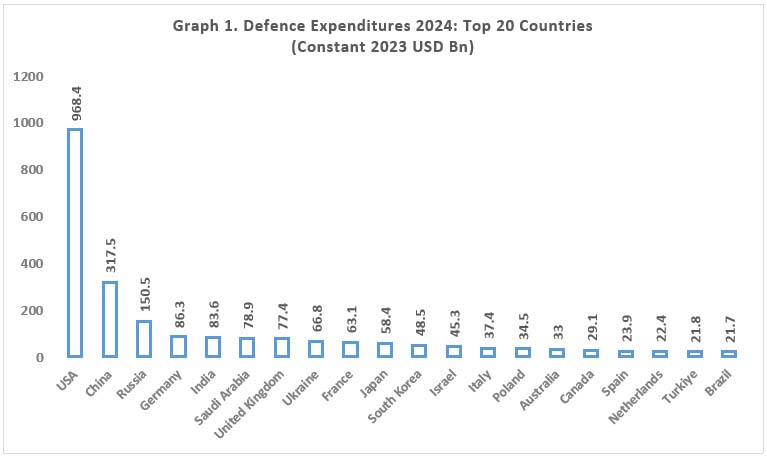
The increase in MoD budget estimates is due to modernisation, capability development and operational readiness requirements of the Indian armed forces. It is worth noting that global defence expenditures have increased among major powers. Graph 1 shows the 20 countries with the highest defence expenditures in 2024, in constant 2023 US dollars, according to the Stockholm International Peace Research Institute.[17] The United States, China, Russia, Germany and India were the top five defence spenders in 2024.
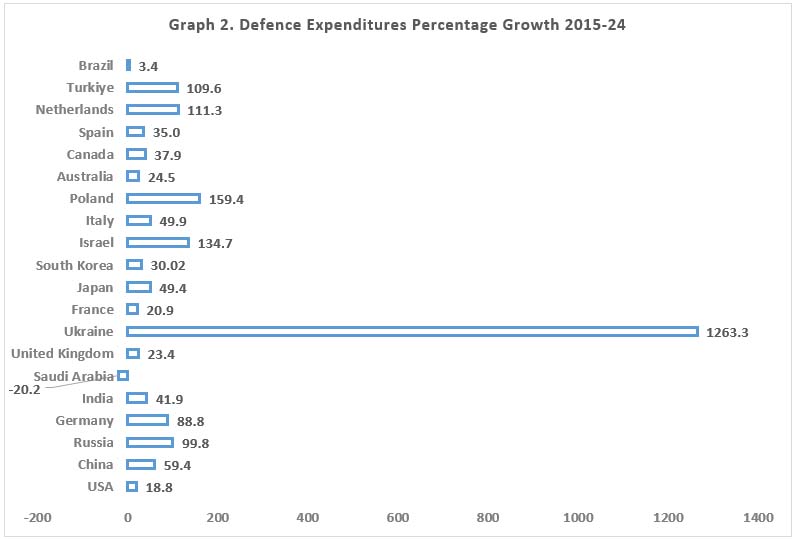
Graph 2, meanwhile, shows the percentage change in defence spending for these 20 countries from 2015 to 2024. Except Saudi Arabia, which had a negative 20 per cent growth in its defence expenditure in constant 2023 US dollars (from US$ 98.9 billion in 2015 to US$ 78.9 billion in 2024), the remaining 19 countries had a positive growth in their defence expenditures, with Ukraine registering a whopping 1263 per cent growth (from US$ 4.9 billion to US$ 66.8 billion), followed by Poland (159.4 per cent; US$ 13.3 billion to US$ 34.5 billion), Israel (134.7 per cent; US$ 19.3 billion to US$ 45.3 billion), Netherlands (111.3 per cent; US$ 10.6 billion to US$ 22.4 billion), Turkiye (109.6 per cent; US$ 10.4 billion to US$ 21.8 billion), and Russia (99.8 per cent; US$ 75.3 billion to US$ 150.5 billion).
While six countries recorded growth of at least 100 per cent, four others recorded growth of at least 50 per cent. These were Germany (88.8 per cent; US$ 45.7 billion to US$ 86.3 billion), China (59.4 per cent; US$ 199.2 billion to US$ 317.5 billion), Italy (45 per cent; US$ 25.8 billion to US$ 37.4 billion) and Japan (49.4 per cent; US$ 39.1 billion to US$ 58.4 billion). India recorded a 42 per cent increase in defence expenditure from 2015 to 2024, from US$ 58.9 billion to US$ 83.6 billion.
For the EU, Russia’s invasion of Ukraine has been a major moment of ‘geo-political awakening’. In March 2025, European Commission President Ursula von der Leyen called on Member States to increase their defence spending by an average of 1.5 per cent of GDP, which could result in an additional EUR 650 billion over four years.[18] The EU is taking a series of measures to transform itself from a ‘political’ to a ‘defence’ union. As per the October 2025 House of Commons Library publication, the United Kingdom was expected to spend 2.4 per cent of its GDP on defence in 2025. In 2025, all NATO members are expected to meet or exceed the 2 per cent of GDP defence expenditure target.[19]
In India, too, there have been calls to peg defence expenditures to a certain percentage of the GDP, including by the SCOD in 2018. The Ministry of Finance had then pointed out that ‘defence expenditure as a definite percentage of total Government Expenditure/GDP cannot be ensured because resource allocations are made on a need basis’.[20] Defence Secretary Rajesh Kumar Singh, in September 2025, meanwhile, noted that a 10–15 per cent annual increase in capital outlays would be “adequate to meet requirements”.[21]
Conclusion
Globally, due to increased defence expenditures, there is a greater focus on strategic autonomy and on strengthening domestic defence industrial bases. There is an acknowledgement that the defence sector continues to be not only an engine of economic growth but also of technological innovation. Global military powers are emphasising the importance of developing workforce skill-sets for the defence technological industrial base (DTIB). There is a focus on transforming defence procurement processes to make them more agile and better address the armed forces’ battlefield requirements.
The modernisation needs and pressing security challenges will continue to require significant allocations to the MoD in the coming years to meet the requirements of the Indian armed forces, even as the MoD is taking steps to absorb the increased financial allocations more effectively. The MoD’s 2026–27 budget estimates are expected to strengthen its core focus areas on capability development, domestic procurement and the operational readiness requirements of the Indian armed forces.
Views expressed are of the author and do not necessarily reflect the views of the Manohar Parrikar IDSA or of the Government of India.
[1] “Union Budget Documents 2026-27”, Ministry of Finance, Government of India.
[2] The GDP for FY 2026–27 is estimated at Rs 39,300,393 crore. See “Budget at a Glance”, Ministry of Finance, Government of India, p. 1.
[3] “Defence in Union Budget 2026–27”, Press Information Bureau, Government of India, 1 February 2026.
[4] These percentages are after adding the Transportation, Stores, Works, and Repairs and Refits allocations to the respective service revenue budgets.
[5] Standing Committee on Defence, Ministry of Defence, Demands for Grants (2024–25), “Capital Outlay on Defence Services, Defence Planning, Procurement Policy and Defence Pensions, Demands No 21 and 22, Ninth Report”, Eighteenth Lok Sabha, Lok Sabha Secretariat, March 2025, pp. 4–6.
[6] “Ministry of Defence Year End Review 2025”, Press Information Bureau, Ministry of Defence, Government of India, 31 December 2025.
[7] “Ministry of Defence allocated an all-time high of Rs 7.85 lakh crore in Union Budget 2026-27, 15% higher over Budgetary Estimates of FY 2025-26”, Press Information Bureau, Ministry of Defence, Government of India, 1 February 2026.
[8] “Ministry of Defence Year End Review 2024”, Press Information Bureau, Ministry of Defence, Government of India, 26 December 2024.
[9] Standing Committee on Defence, Ministry of Defence, Demands for Grants (2024–25), “Capital Outlay on Defence Services, Defence Planning, Procurement Policy and Defence Pensions, Demands No 21 and 22, Ninth Report”, no. 5, pp. 7–8.
[10] See Standing Committee on Defence, Demands for Grants (2024-25), “Capital Outlay on Defence Services, Procurement Policy, and Defence Planning”, Third Report, Eighteenth Lok Sabha, Ministry of Defence, December 2024, p. 23.
[11] “Defence Atmanirbharta: Record Production and Exports”, Backgrounder, Press Information Bureau, Government of India, 20 November 2025.
[12] Ibid.; also see “Ministry of Defence: Year End Review 2025”, Press Information Bureau, Ministry of Defence, Government of India, 31 December 2025.
[13] Standing Committee on Defence, Ministry of Defence, Demands for Grants (2024–25), “Capital Outlay on Defence Services, Defence Planning, Procurement Policy and Defence Pensions, Demands No 21 and 22, Ninth Report”, no. 5, p. 10.
[14] See Standing Committee on Defence, Ministry of Defence, Demands for Grants (2025–26), “Army, Air Force, Navy, Joint Staff, Ex-Servicemen Contributory Health Scheme and Directorate General of Armed Forces Medical Services (Demand Nos. 20 and 21), Eighth Report”, Eighteenth Lok Sabha, Lok Sabha Secretariat, March 2025.
[15] “Sailing Towards Self-Reliance: The Indian Navy’s Aatmanirbhar Bharat Journey”, Press Information Bureau, Government of India, 3 December 2025.
[16] Ibid.
[17] “SIPRI Military Expenditure Database”, Stockholm International Peace Research Institute.
[18] “Press Statement by President von der Leyen on the Defence Package”, European Commission, 4 March 2025.
[19] “UK Defence Spending”, House of Commons Library, 10 October 2025.
[20] Standing Committee on Defence, Demands for Grants (2017–18), “General Defence Budget, Border Roads Organisation, Indian Coast Guard, Military Engineer Services, Directorate General Defence Estates, Defence Public Sector Undertakings, Welfare Of Exservicemen, Defence Pensions, Ex-Servicemen Contributory Health Scheme (Demand Nos. 19 & 22)”, Fortieth Report, Lok Sabha Secretariat, March 2018, p. 16.
[21] Arzoo Yadav, “Defence Spending Should Increase to 2.5–3 Per Cent of GDP, Can Do A 10-15 Per Cent Increase in Capex Every Year: Def Secy Rajesh Kumar Singh”, Swarajya, 23 September 2025.