Fighting Asymmetrically Weak: Lessons from the West Asia War
- April 01, 2026 |
- West Asia War Analyses
Summary
Precise strikes on Iranian leadership targets by the US and Israel, launched at the very outset of the conflict, did not produce the expected collapse in Iran’s will or ability to fight. Iran has relied on the core logic of asymmetric warfare while also showing tactical innovation in sustaining retaliation against a stronger adversary.
In the current contest between the US and Israel on one side and Iran on the other, it can be safely assumed that most asymmetries are stacked against Iran. Yet, Iran has maintained a display of stiff resistance and landed a few punches above its weight against its mighty opponents.
The US Department of State defines asymmetric warfare as
warfare in which belligerents are mismatched in their military capabilities or their accustomed methods of engagement. In such a situation, the militarily disadvantaged power must press its special advantages or effectively exploit its enemy’s particular weaknesses if the disadvantaged power is to have any hope of prevailing.1
A weaker state’s first objective in war is regime survival, along with the preservation of core military assets and continuity of command. In Iran’s case, the succession of Mojtaba Khamenei after Ali Khamenei’s death underlines that regime survival remains the highest priority. Second, Iran cannot hope to defeat the US and Israel in a conventional military contest. Its aim, instead, is to deny the stronger side the achievement of its declared political and strategic objectives.
Third, the weaker side seeks to make the war militarily costly, politically unpopular, and economically disruptive for its adversaries. Fourth, in such an unequal contest, survival itself becomes a form of resistance and can be projected domestically and internationally as victory. Fifth, Iran’s strategy is to stretch time. A weaker actor often prefers a longer war if prolongation can erode the stronger side’s public support, deepen political divisions, and increase international pressure for restraint. This paper aims to dissect Iran’s actions in line with these guidelines and examine how successful it has been at this stage of the contest.
Iran’s Strengths
Fighting on Home Turf
Iran is largely a plateau outlined by mountain ranges to the North and West and interspersed with two deserts to the North and East. The mountains protect the plateau, and the deserts slow any land-based invasion. Historically, Iran has relied on its size and difficult terrain to adopt a strategic defensive mindset. The deserts make approaching the heartland of Iran a logistical nightmare, while the high mountains offer natural high ground, making the terrain a defender’s delight. Iran dominates the waterway from the Persian Gulf to the Sea via the Strait of Hormuz and the Strait of Bab el-Mandeb. Such a location provides Iran with a unique strategic position of influencing the only waterway through which 20 per cent of the world’s energy flows.
Iran also provides the only alternative land route to the standard route via the Suez Canal, connecting regions of Central Asia, South Asia, and the Middle East. This allows Iran to exert a unique influence over the region and assert itself as a regional power.[ii] Iran has long attempted to activate a land bridge to the Western Mediterranean Sea via Shia strongholds of Iraq, Syria, and Lebanon to reach the ‘rear’ of Israel.[iii] In the current war, if attacks on Israel are launched from this region, it will confirm the success of such attempts and present a unique example of ‘turning the defences’ by attacking Israel from areas in depth.
Ensuring Reliability of Critical Capabilities
The mainstay of Iran’s arsenal is an array of low-cost drones, including the Shahed-131, Shahed-136, Shahed-129, Shahed-191, and the Mohajer family of drones. Various reports indicate that Shahed drones employed in Ukraine had a very high percentage of foreign/western-manufactured components. Despite sanctions, Iran has managed to continue sourcing components and manufacturing a large number of these low-cost drones. They have spread out their sources to avoid detection and maintain redundancy.
Figure 1: Iran’s Geography
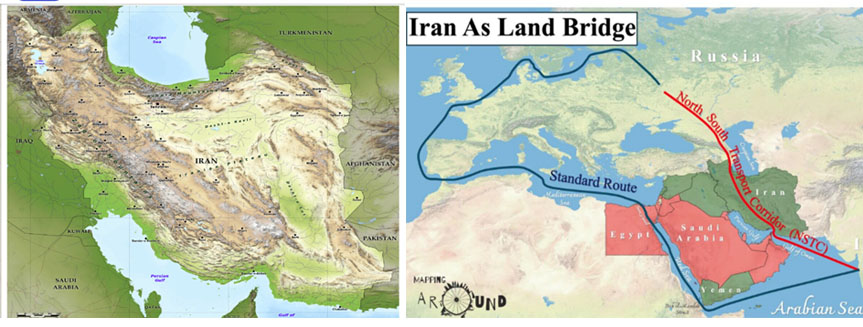
Source: Bob Stanley Gardner, “Why Iran’s Geography Shapes Its Power”, Mapping Around
Presently, Russia has a dedicated manufacturing facility for the licensed production of the Russian version, Geran-2, which can be made available to the Iranians with little effort and in considerable numbers. This would amount to reciprocation for the help Iran provided through these drones when Russia was looking for an effective response to Ukraine’s drone capabilities. Targeting a drone costing a few thousand dollars with expensive missiles has imposed a unique asymmetric cost on the US-Israeli combine. Low cost has also permitted Iran to outnumber the interceptor missiles, causing serious concerns for planners in the US-Israel combine regarding the manufacture and replacement of the interceptor missiles at the rate at which they are being expended.
Over the last two decades, Iran has also spent considerable efforts in developing a strong lineup of ballistic missiles.[iv] The indigenous component of Iranian missiles is believed to be as high as 90 per cent. The beginnings were humble in the form of replicating Russian Scud and North Korean Nodong missiles. However, dedicated expertise and experience have enabled Iran to develop a sophisticated and varied array of indigenous ballistic missile capabilities, which the US cites as one among many reasons for the current rounds of attacks. Iran has also recently released a video of their hypersonic glide missile Fattah-2. Hypersonic glide missiles have grown in popularity due to their ability to defeat the best of AD systems. The efficacy of Iran’s missiles has enabled Iran to take the war to the doorstep of Israel and target regional US assets and allies. The regimes in Syria, Iraq and Libya had not thought about developing such capabilities and paid the price for their lack of strategic foresight.
Emphasis on Grey Zone Warfare
Iran’s armed forces are organised and equipped to pursue options short of war. The use of sub-conventional tactics in the maritime domain and in the Persian Gulf region has been an abiding feature of Iran’s strategic posture. Iran’s cultivation of a wide range of proxies in the region further provides it with unprecedented flexibility in exercising the Grey Zone options with the added advantages of deniability and maintenance of strategic ambiguity. Over the decades, Iran has not only trained and armed groups such as Hezbollah, Hamas and Houthis but also raised their technological threshold to operate rockets, drones and missiles. Such capabilities are not restricted to land alone. The proxies can also deploy anti-ship missiles and Uncrewed Surface Vessels in the Strait of Hormuz, thereby greatly increasing their strategic nuisance value to the Iranians. These proxies have not yet made an impact in the current conflict. They are also under pressure from the US-Israel combine, with repeated decapitation attempts against their leadership. However, with such advanced capabilities and proven effectiveness, it remains to be seen when and how the proxies will be unleashed onto the US-Israel combine.
Creating Opportunities
Striking Enemy’s Weaknesses
The stronger belligerent cannot be strong everywhere. Iran has amply demonstrated this in their largely successful precision strikes against key AD assets of the US protecting the Gulf countries. Targets of Iran’s missile attacks include the US AN/TPY-2 radar in Jordan, AN/TPS-59 in Bahrain and AN/FPS-132 phased array radar in Qatar.[v] These radars were the eyes and ears of the US AD cover in the region. A YouTube video of uncertain origin explains how the Iranians employed classic techniques of studying US radar cover patterns, introduction of malware in the PAC-3 C2 module and overwhelmed US radars with a swarm attack of kamikaze drones to mask the tracks of 12 ballistic missiles, some of which hit the Saudi oil facility at Ghawar.[vi] Executing such strikes despite suffering heavy aerial bombing from the US-Israel combine, and the US-Israel combine’s virtual air superiority in the region, demonstrates Iran’s resolve, technical expertise, and accurate intelligence gathering capability to defeat a sophisticated AD system and strike at a superior enemy’s Achilles heel.
Exploiting Global Instability
The targeting of ships in the Straits of Hormuz by the IRGC Navy is a stated Grey Zone strategy of the IRGC Navy and proxies of Iran, such as the Houthis. The resulting rise in oil prices—which touched US$110 per barrel on 9 March 2026 and remains elevated at around US$100 per barrel—has unsettled global markets.[vii] Couple this with the rising insurance costs of shipping operating in the region. Israel’s strike on the Iranian oil storage facilities in Tehran and Alborz on 09 March 2026 has earned the wrath of the Trump administration, as expressed by a single message, “WTF”[viii]. Washington is already facing growing pressure to seek a cessation of hostilities as attacks on Iran’s energy infrastructure intensify, widening global instability. Meanwhile, U.S. allies, including Britain, France, Germany, Italy, Canada, and Japan, have supported maritime security and de-escalation, but have generally refrained from backing direct military strikes on Iran. Trump’s complaint that NATO allies were “cowards” for refusing to support the war effort around Hormuz underscores this reluctance.[ix] In this sense, despite the setbacks it has suffered, Iran continues to benefit strategically from energy instability, which enhances its capacity to impose broader economic costs.
Targeting US Bankability
Iran’s choice of striking luxury hotels in Dubai is attributed to ‘threatening the nexus of global capital would instantly send markets into a panic and coerce the UAE to pressure Washington for immediate restraint.’[x] Another observer notes that the Gulf countries’ passivity will be constrained, and they will soon be drawn into conflict, thereby shattering the oasis of peace they had created based on economic stability.[xi] The extra-regional effects of such actions are also merging. Some reports suggest that as the priority of deploying interceptors in West Asia increases, there is a fear that Ukraine will receive lower priority in a war in which the EU is deeply invested. Rising oil prices also affect the war and Europe’s participation in it. The EU has begun to seriously reconsider strategic autonomy in light of the appreciated US indifference to its strategic concerns.[xii]
Iran’s Innovative Operations
Decentralised Mosaic Defence
The Iranian leadership was acutely aware of the US-Israel’s Concept of Operations. Israel’s actions against Hamas and Hezbollah leadership over the decades, and the US’s equally stellar record in decapitating inimical governments or agencies, had allowed the Iranian leadership to predict what happened to their supreme leader. Abbas Araghchi, Iran’s Foreign Minister, labels it ‘Decentralised Mosaic Defence’.[xiii] It has been described as a system of decentralising military decision-making and capabilities to the lowest possible rung, distributing them geographically, and creating a chain of leadership in every vertical, aimed at continuing to fight despite the assassination of leaders. He explained how Iran has spent 20 years studying the US way of fighting such wars and how Iran was determined not to ‘fight the enemy’s favourite war’ and make the war long and politically exhausting for the US.[xiv]
Disperse and Dig Deep
Israel’s strikes on Iranian nuclear installations during Operation Rising Lion from 13 to 24 June 2025 were hailed by the US President as the 12 Day War that ended the war in the Middle East. The US itself joined in the bombing campaign on 22 June 2025. While claims were made that the Iranian nuclear capability was dismantled, leaked US intelligence reports suggest that Iran’s nuclear capabilities may have been set back, but were far from being dismantled.[xv] Iran’s tactics of digging its critical facilities deep into the mountains and dispersing them over its vast landmass will take much more to defeat than the US-Israel tactic of aerial bombing, as events have proven. Similarly, the Iranians have dug their drones and missile facilities deep into the mountains in ‘missile cities’ which are proving to be extremely difficult to locate and target. This allows these assets a high degree of survivability and enables the IRGC to continue targeting the assets of the US and its allies.[xvi]
Using Bitcoins to Fund War
Employing technology in war is not restricted to weapons alone. An NDTV News Desk report highlighted that Iran had permitted bitcoin mining since 2019 to develop a ‘sanctions-resistant payment system’. The Iranians are reported to profit US$71,700 per bitcoin mined, a massive margin of profit and an activity that enables them to bypass sanctions, conventional banking systems, and US Treasury enforcement.[xvii] A similar report appeared before the current crisis. In February 2026, U.S. investigators were examining whether specific crypto platforms had facilitated sanctions evasion by Iranian officials, reflecting growing concern in Washington that digital assets were being used to blunt the impact of financial isolation rather than replace conventional sources of war finance.[xviii]
Iran’s Alliances
Russia and China remain important to Iran, but in sharply different ways. Russia appears willing to assist Tehran through political backing, intelligence sharing, technology linkages and diplomatic signalling, even if it has stopped short of direct military intervention; indeed, Moscow and Beijing had earlier helped Iran build military capacity, though such support now appears capped, while western reporting cited claims that Russia was passing targeting information on U.S. assets to Iran. China’s role is more restrained and more strategic. Beijing has offered diplomatic cover, protected its economic linkages with Tehran, called for a ceasefire, insisted on respect for Iran’s sovereignty, and opposed regime change. Still, it has not crossed into military involvement. China’s shrewdness can be ascertained by how a PLA-linked AI startup called MizarVision is providing ‘high-resolution satellite imagery of every US military base, every carrier strike group, every F-22 deployment, every THAAD battery, and every Patriot missile position in the Middle East. Labelled. Geo-located. AI-annotated.’[xix] Such methods of providing tacit assistance ensure deniability and fulfil the purpose of displaying overt support.
Figure 2: Satellite Imagery of US Military Bases in the Gulf
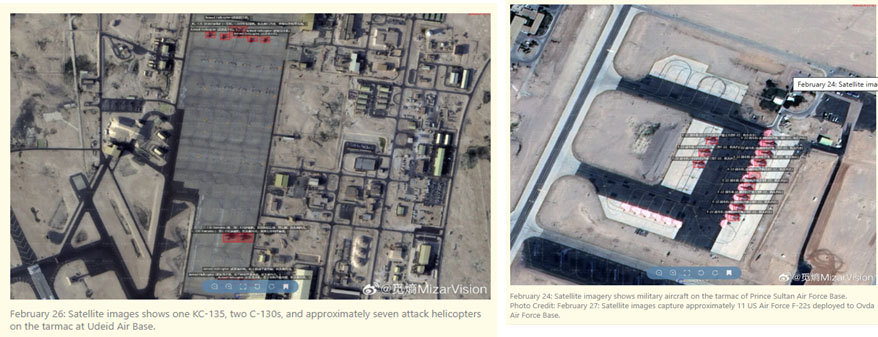
Source: Samiran Mishra, “China’s eyes in space exposed US war machine before 1st bomb fell in Iran war,” NDTV, 10 March 2026.
Role of Information Warfare
In an asymmetric war, information becomes a weapon in its own right, and Iran has sought to use civilian suffering, endurance and symbolism to shape how the conflict is understood at home and abroad. In asymmetric warfare, civilian casualties can be turned into a powerful narrative tool, not only to intensify international criticism of the stronger side, but also to portray Iran as the victim of overwhelming force and therefore as the morally superior actor. Reporting on the strike on the girls’ school in Minab, and the funerals that followed, shows how the deaths of school children quickly became a charged information battleground, with images of small flag-draped coffins serving as a potent symbol in Iran’s wartime messaging.
Ayatollah Ali Khamenei is reported to have refused to hide in a bunker and to have chosen martyrdom by remaining in his residence. Such an act has a strong potential to rally public opinion in favour of the regime.[xx] The language of shahadat (martyrdom) associated with the killing of Ayatollah Ali Khamenei allows the state to convert loss into legitimacy, sacrifice into social cohesion, and suffering into continued resolve. The message is not that the war has broken Iran, but that every loss deepens resistance; in such a framework, survival itself is projected as endurance equivalent to moral and strategic victory.
Iran’s advantage in such a conflict may lie less in conventional military parity and more in its higher tolerance for a prolonged war of attrition than America. In fact, America is poorly suited to a long war of attrition because its military campaigns are heavily constrained by domestic political pressure, sensitivity to casualties, financial costs, and the need to maintain public support. Iran’s political system has long institutionalised narratives of sacrifice, resistance, and national sovereignty – Shahadat as a Mobilising Tool – enabling the state to frame survival under external pressure as a strategic success. This produces an important form of asymmetry.[xxi] It also helps explain why Gulf countries are treading carefully and remain hesitant to participate directly in a war against Iran, as there is uncertainty over how long the US would be willing to sustain such a conflict.[xxii]
A Notion of Victory
The fact that the Iranian systems seem to be functioning in a coordinated and committed manner under the existing regime, despite the decapitation strike on their Supreme Leader, can be described as a grave miscalculation on the part of the US-Israel combine in pinning their hopes for regime change on it. This has already led to mission creep, with observers noting that a ground offensive is now imperative to enforce regime change. Tactically, Iran is currently bearing a heavy burden. Strategically, Iran seems to have consolidated into a hardened posture to retaliate against the US-Israel combine and prolong the war as long as it takes. This suits Iran well, as it is fighting this war on its own soil and is well-suited to adopt a strategic defensive posture as the weaker belligerent. The onus now lies on the US-Israel combine to define their strategic objectives clearly and achieve them early. Failing which, the Iranians can claim victory.
Conclusion
Except for the US, which enjoys the status of the sole superpower, all other nations may face the prospect of being asymmetrically weaker. Denmark and the EU recently reached this realisation following President Trump’s statements on Greenland. No state can hope to remain perpetually immune to the Volatility, Uncertainty, Complexity, and Ambiguity (VUCA)-based constant turmoil and churn experienced by the world. As strategic interests converge and collide, all responsible states must prepare for the worst-case scenario. The unique lessons that the current US-Israel versus Iran war provides to observers are vital to all states in the world. The democratisation of technology and social media allows every nation to prepare for such an eventuality in which it finds itself in an asymmetrically weaker position. While not all lessons highlighted in the paper may apply to every state, given the unique geopolitical realities of each, they inspire each state to examine its own geostrategic realities. From avoiding conflict to prolonging it, once it starts, the permutations and combinations of pursuing the most appropriate strategic choices and capabilities are vast. Every responsible state must arrive at the correct conclusions and formulate the best possible toolkit to fight its own ‘poor man’s war’.
Views expressed are of the author and do not necessarily reflect the views of the Manohar Parrikar IDSA or of the Government of India.
[i] “Glossary”, U.S. Department of State.
[ii] Bob Stanley Gardner, “Why Iran’s Geography Shapes Its Power,” Mapping Around, n.d.
[iii] T. J. Gilmore, “Iran Owns the Gray Zone,” Proceedings, March 2018.
[iv] “Missiles of Iran”, CSIS (Centre for Strategic and International Studies) Missile Defense Project
[v] Joseph Trevithick and Tyler Rogoway, “Iranian Attacks On Prized Missile Defense Radars Are A Wake-Up Call Iran’s successful targeting of critical missile defense radars in the Middle East highlights global vulnerabilities”, TWZ, 07 March 2026.
[vi] World Economy Unfold, “How 12 missiles broke a 2 Trillion Dollar Missile Shield –America shocked,” YouTube, 05 March 2026.
[vii] “Oil (Brent) Price,” Business Insider, n.d.
[viii] TOI World Desk, “Did Israel surprise US with strikes on Iran oil depots?White House reportedly sent WTF message”, Times of India, 09 March 2026.
[ix] “Trump calls NATO ‘cowards’ over lack of support in Iran war,”, 20 March 2026, Reuters 2026.
[x] Samridhhi Vij, “Why Iran Targeted Dubai: The Limits of Economic Deterrence”, ORF, 01 March 2026.
[xi] Clemens Chay, Samriddhi Vij, Akram Zaoui, and Mahdi Ghuloom, “US-Israel Strikes on Iran: Experts React to “Operation Epic Fury,” ORF, 01 March 2026.
[xii] Stuart Dowll, “EU’s strategic autonomy gap laid bare by Iran crisis” TVP World, 03 March 2026.
[xiii] Palestine Chronicle Staff, “EXPLAINER: What Is Iran’s ‘Mosaic Defense’ Strategy?”, The Palestine Chronicle, 05 March 2026.
[xiv] ibid
[xv] Matt Field, Why ‘mowing the grass’ won’t work to curtail the Iranian nuclear program”, The Bulletin of the Atomic Scientists, 26 June 2025.
[xvi] Zee Media Bureau, “Inside Iran’s ‘missile cities’: Why these secret bunkers are a strategic nightmare for US,” Zee News, 05 March 2025.
[xvii] NDTV Newsdesk report, “The Secret Loophole Helping Iran Fire Missiles At Israel And US Without Going Broke,” NDTV, 06 March 2026.
[xviii] Elizabeth Howcroft and Tommy Reggiori Wilkes, “Iran’s Surging Crypto Activity Draws US Scrutiny”, Reuters, 3 February 2026.
[xix] Shalaka Anslem Perrera, “Actuarial Warfare: How Seven Insurance Letters Closed the World’s Most Critical Chokepoint and Why Markets Are Mispricing Duration by 300%”, Substack, 09 March 2026.
[xx] Monojit Mujumdar, “Expert Explains: Islamism is dead politically…Religious vocabularies will survive in Iran, domination by clerics won’t,”, The Indian Express, 11 March 2026.
[xxi] Business Today desk, “Iranians are playing a different game’: Ex-R&AW chief Vikram Sood says Iran war likely to go on for longer than expected”, Business Today, 09 March 2025.
[xxii] Vivian Nereim and Omnia Al Desoukie, “Iran Attacks Dubai, Persian Gulf Countries Crack Their Safe Haven Image”, The New York Times, 1 March 2026.

Nestor Derrick D’Souza
He worked at Manohar Parrikar Institute for Defence Studies and...
read more +