


- This event has passed.
MP-IDSA – CAPSS Conference
Live Streaming: Day TWO
Live Streaming: Day ONE
About the Conference
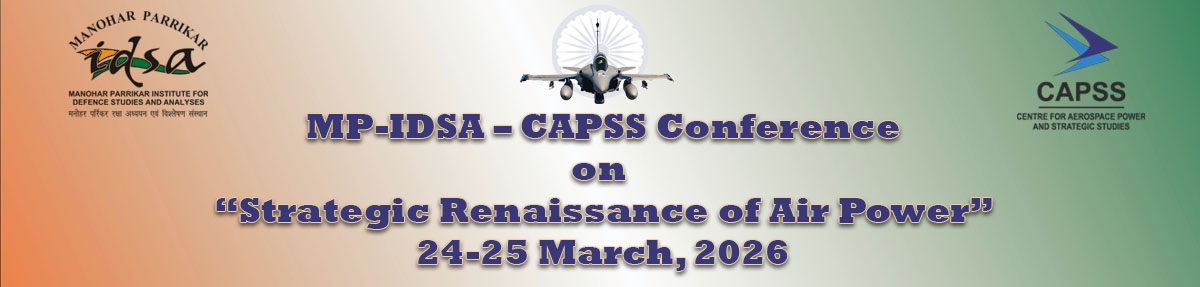
The Conference on “Strategic Renaissance of Air Power”, jointly organised by MP-IDSA and CAPSS, will be held on 24-25 March 2026 at MP-IDSA in New Delhi.
Recent conflicts, including Armenia-Azerbaijan, Russia-Ukraine, Israel-Hamas, Israel-Hezbollah, Israel-Iran, and India-Pakistan, have reinforced the centrality of aerospace power in modern warfare. In this context, the conference will bring together military professionals, policymakers, strategists, academics, and international participants to examine the evolving character and challenges of aerospace power. Structured across six sessions, it will examine critical operational, technological, and strategic dimensions.
Session I, Control of the Air, explores the growing contestation of air superiority due to the proliferation of drones, missiles, and integrated air defence systems, while highlighting the need for joint, multi-domain operations and lessons from recent conflicts.
Session II, Geo-political Shifts and Contests in Air, addresses how evolving global and regional power dynamics are fundamentally reshaping the air domain, with particular emphasis on South Asia, the Caucasus, and the Indian Ocean Region.
Session III, Future Trajectory of Aerospace Design, focuses on emerging technologies and programs such as FCAS, NGAD, and Manned-Unmanned Teaming, offering comparative insights into global aerospace innovation.
Session IV, Emerging Trends in Aerial Strike, will assess the impact of disruptive technologies, including hypersonic weapons, directed energy systems, and advanced drones, on deterrence and warfare.
Session V, Challenges of Space-Enabled Operations in Modern Conflicts, highlights the increased reliance on space-based applications like ISR, PNT, and Communications for conducting Multi-Domain Operations (MDO).
Session VI, Air Power Strategy and Doctrinal Transformation, synthesizes lessons from recent conflicts, focusing on evolving air defence challenges, doctrinal shifts, and the integration of human and algorithmic decision-making.
The conference aims to generate actionable insights to inform doctrine, capability development, and international cooperation, thereby strengthening strategic resilience and operational effectiveness in an era of intensifying multi-domain competition.
Concept Note
The recent and ongoing conflicts between Armenia-Azerbaijan, Russia-Ukraine, Israel Hamas, Israel-Hezbollah, Israel-Iran and India-Pakistan have all reinforced the salience of aerospace power. Against this backdrop, there is an imperative need for informed, multi-disciplinary dialogue amongst military professionals, policymakers, strategists, and academics. MP-IDSA in collaboration with CAPSS, is planning to host a Conference, wherein defence personnel from India and Friendly Foreign Countries (FFCs); Indian and international air power strategists, academicians and diplomats would be discussing in depth the Resurgence of Air Power and its impact on present and future conflicts. The proposed International Conference, themed “Strategic Renaissance of Air Power”, will provide a critical forum to critically examine the changing character, challenges, and opportunities of Aerospace Power in both current and future operational environments. The Conference is being planned at the MP-IDSA Conference Hall, Shankar Vihar, New Delhi, over a period of one and a half days on the 17th and 18th February 2026. The Conference would comprise of six sessions, including the Inaugral Session in which the Keynote Address is being proposed by Shri Rajnath Singh, Raksha Mantri, GoI. The Conference will unfold through synergistic sessions that chart the trajectory of Air power from its operational fundamentals to doctrinal, technological, geo-political, and space-enabled dimensions.
The topic for discussion in Session I of the Conference would be ‘Control of the Air’. The increasing salience of the air domain in the recent conflicts has further reinforced the adage, ‘Whoever controls the air generally controls the surface.’ It will investigate the technical feasibility and operational relevance of gaining air superiority, the unique challenges posed over maritime spaces, and present an Indian perspective on air control in modern conflict. The session will critically examine how the increasing proliferation of UAS, missiles, and integrated air defences have made air control even more contested. In all future conflicts, Air power would need to be increasingly used in a multi-domain environment, thereby necessitating a greater integration and jointness at the planning and execution stages of the overall plan. The lessons of Air Power from recent conflicts, especially from Op Sindoor, are extremely relevant for the Indian Air Force to evolve and make the requisite adjustments in its Tactics, Techniques, and Procedures (TTPs), thereby being better prepared for future wars.
The topic “Geo-Political Shifts and Contests in Air” for Session II addresses how evolving global and regional power dynamics are fundamentally reshaping the air domain, with particular emphasis on South Asia, the Caucasus, and the Indian Ocean Region. This session will examine the need for collaborative air domain awareness in South Asia to enhance surveillance and crisis management, assess the impact of shifting alliances and conflicts in the Caucasus on airspace control and operational strategies, and explore how intensifying competition in the Indian Ocean is influencing long-range air power projection and regional security architectures. Overall, the session aims to analyze how geopolitical developments recalibrate airspace management and strategic priorities, directly affecting the employment and effectiveness of modern air power.
Session III of the Conference will focus on the “Future Trajectory of Aerospace Design,” exploring how rapid advancements in aviation technologies, evolving doctrines, and industrial strategies are shaping the next generation of aerospace platforms. The session will examine key programs such as the European Future Combat Air System (FCAS), Indian strategy for Manned-Unmanned Teaming (MUMT), the American Next Generation Air Dominance (NGAD) initiative, and the significant innovations in aero-engines and combat aircraft development by the South Koreans. Discussions will highlight both the commonalities and differences in international approaches, offering a comparative perspective on future trends in aerospace design.
The topic for discussion in Session IV of the Conference would be “Emerging Trends in Aerial Strike.” Aerospace power, in particular, and military warfare, in general, are highly susceptible to advances in technology and have historically undergone significant transformations as a result of the technological advancements. The development of new technologies, such as Hypersonics, Directed Energy Weapons (DEWs), and quantum communications, has transformed air warfare, making aerospace power even more lethal, potent, and decisive. This session will rigorously appraise the impact of hypersonic weapons, the comparison between drones and missiles in long-range strike roles, and the specific case of aerial threats on nuclear installations. The transformative potential of emerging and disruptive technologies for deterrence, escalation, and operational impact will be at the fore.
The topic for discussion in Session V of the Conference would be ‘Challenges of Space Enabled Operations in Modern Conflicts’. The increased reliance on space-based applications like ISR, PNT and Communications for conducting Multi-Domain Operations (MDO) has made these assets attractive targets for both kinetic and non-kinetic attacks by adversaries. Space has transitioned from being the ‘ultimate high ground’ to being an operational domain where nations are fighting with each other for ‘Control of the Space’. The high costs of space assets and the increasing reliance on them for day-to-day activities mandate a coordinated and collaborative effort among like-minded nations. Given the increasing dependency on the space domain for ISR, communication, and navigation, this session will interrogate the contest for “space control.” Discussions will address space-based architectures for national ISR, the challenge of space situational awareness, and implications for international cooperation and regulation. The weaponisation of space and associated governance challenges will be explored in depth.
The topic for discussion in Session VI of the Conference would be ‘Air Power Strategy and Doctrinal Transformation’. In recent years, the number and spectrum of threats (from small UAVs, swarm drones, cruise missiles, ballistic missiles, hypersonic missiles to stealth aircraft and stealth UCAVs) to be managed by the Modern Integrated Air Defence Systems have grown exponentially and have added to the complexities and challenges of modern and futuristic IADSs. It is essential to learn the correct lessons from recent conflicts regarding air defence for successfully protecting a nation’s airspace sovereignty in the future. The culminating session will synthesise doctrinal evolution in the employment of conventional air power against nuclear weapon states, evolving doctrinal shifts in air defence with technological advancements; with specific attention to recent conflicts (such as Russia-Ukraine and Israel-Hamas), the expanded threat spectrum (UAVs, missiles, drones), and the integration of human and algorithmic decision-making. The goal would be to distil lessons for employment of conventional air power under the nuclear overhang, identify the evolving changes in air defence concepts, and the human and algorithm synchronisation for future conflicts.
The Conference aims to foster a multi-perspective understanding of the shifting dynamics of air and space power, stimulate innovation and policy development in air power employment and design and encourage actionable dialogue on enhancing operational integration and strategic resilience in South Asia and globally. The proceedings are expected to revitalise doctrine, capability development, and collaborative frameworks for a more secure and adaptive aerospace future.
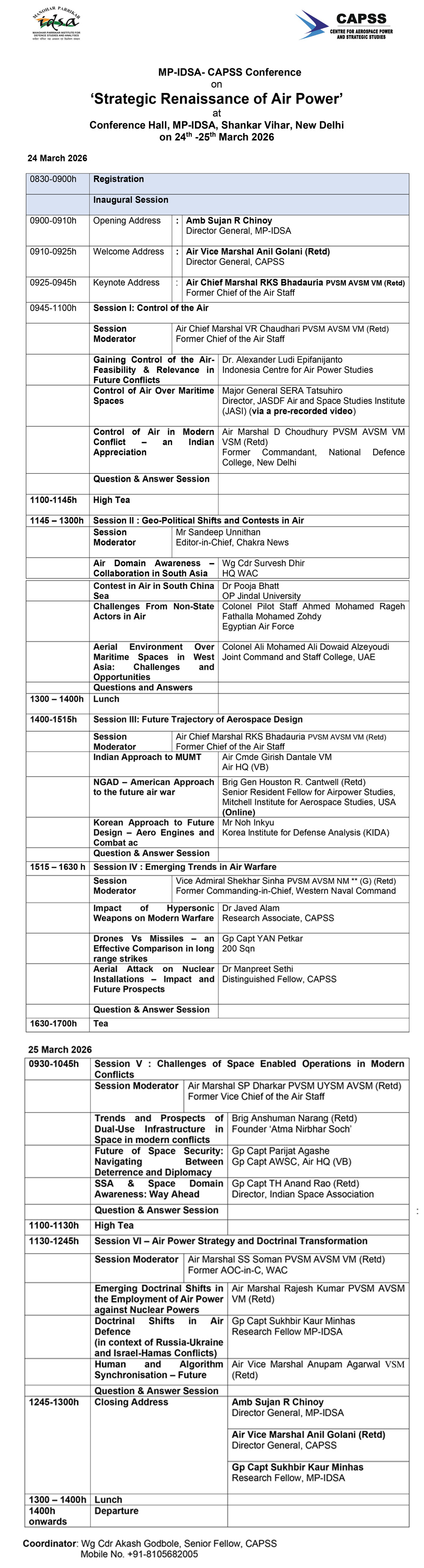
Programme
Contact Us
Conference Coordinator
Gp Capt Sukhbir Kaur Minhas, Email: rfsk.mpidsa[at]gov[dot]in
Wg Cdr Akash Godbole, Email: capsnetdroff[at]gmail[dot]com


