India–Bangladesh Land Trade: Non-Tariff Barriers
- September 17, 2026 |
- IDSA Comments
Summary
Bangladesh has near-zero tariff access to India under SAFTA. However, structural constraints such as infrastructure bottlenecks, regulatory and procedural barriers, institutional fragmentation, political-security frictions, and weak multimodal integration produce persistent non-tariff barriers that hamper bilateral trade. Addressing them will reinforce India’s connectivity in the Northeast, reduce dependence on the Siliguri Corridor, and deepen economic interdependence.
India and Bangladesh share a 4,096.7 km land border and maintain one of South Asia’s most significant bilateral relationships, underpinned by close geographic proximity, deep historical ties, and extensive economic and people-to-people linkages. With nearly 90 per cent of its land border shared with India, Bangladesh is often described as ‘India locked’,[1] making connectivity and transport cooperation mutually dependent.
Following the ouster of Prime Minister Sheikh Hasina in August 2024, India–Bangladesh relations deteriorated under the interim government, leading to the suspension or reassessment of several bilateral initiatives.[2] Internal political turbulence has since stalled connectivity projects and rendered bilateral coordination increasingly unpredictable. Further, reciprocal trade restrictions have intensified existing non-tariff barriers and increased procedural uncertainty, disrupting bilateral land trade.[3]
The Evolution of Bilateral Land Connectivity
The 1972 Trade Agreement laid the foundation for commercial cooperation between India and Bangladesh. The agreement advocates expanding economic and trade cooperation without preferential tariffs.[4] Bangladesh also enjoys zero-duty market access on most tariff lines in India under the SAFTA framework for Least Developed Countries (LDCs).[5]
India has extended Lines of Credit worth US$ 7.862 billion to Bangladesh.[6] The country is also central to India’s regional connectivity ambitions, such as the BBIN MVA and BIMSTEC. Road, rail, energy, and digital networks have deepened cross-border links in the region, with Dhaka as a key partner. Bangladesh’s close geographical proximity to India’s Northeast and the Siliguri Corridor, paired with the porous international border, makes it strategically valuable to India’s national security. As a result, deeper economic integration and interdependence can reduce interstate tensions, while a dense road network strengthens regional connectivity and border management.
Despite sustained bilateral investments in connectivity, the operational performance of India-Bangladesh land trade remains subpar. Bilateral trade has remained stable at approximately US$ 12.37 billion in 2025–26[7], yet trade flows remain heavily concentrated in a small number of crossings, with the Petrapole–Benapole corridor accounting for nearly 70 per cent of land-based trade (by value).[8] The pattern indicates that the principal problem is therefore not a lack of connectivity in absolute terms, but the limited ability of existing connectivity infrastructure to operate as an integrated trade network.
While strong economic interdependence continues to sustain cross-border trade in critical commodities, exporters remain heavily dependent on road transport as rail and other multimodal alternatives lack adequate operational and logistical integration. This suggests that the principal constraints to bilateral land trade arise primarily from structural non-tariff and trade-facilitation barriers embedded in border administration, logistics, and regulatory institutions rather than from tariff policy itself.
Structural Sources of Non-Tariff Barriers
Legacy non-tariff barriers affecting India–Bangladesh land trade fall into five mutually reinforcing categories: border infrastructure bottlenecks, regulatory and procedural barriers, institutional fragmentation, political-security frictions, and weak multimodal integration. These barriers operate at both formal and informal levels: while some arise from regulations, infrastructure and institutional design, others emerge from the behaviour of intermediaries, labour organisations, transport networks and local political actors operating around border infrastructure.
In practice, these constraints reinforce one another rather than operate independently. For example, improvements in road infrastructure along the Petrapole–Benapole corridor should reduce congestion and transit time. Yet their benefits remain limited, as some customs procedures remain unchanged.[9] Likewise, regulatory harmonisation at land ports such as Srimantapur or Sutarkandi cannot improve trade efficiency when political disruptions–including the reciprocal trade restrictions imposed in 2025–continue to disrupt supply chains. Inadequate infrastructure prolongs transit times and raises logistics costs. Table 1 depicts the status of select border trade corridors and the structural Non-Tariff Barriers affecting corridor performance in 2026.
Table 1. Status of Select Border Trade Corridors
| S. No.
|
Name of the Project | Status | Associated Non-Tariff Barrier(s) |
| 1 | Maitri Setu (Sabroom–Ramgarh Corridor) | Pre-operational.
Sabroom ICP remains underdeveloped[10]; Bangladesh’s Ramgarh facilities halted[11]; delayed after post-2024 political instability. Sabroom ICP ready; operationalisation expected after bilateral normalisation. |
Border Infrastructure; Institutional Fragmentation; Political-Security Frictions; Weak Multimodal Integration |
| 2 | Chattogram–Mongla Ports Land–Sea Corridor | Constrained/ under-utilised.
The 2018 agreement and SOP remain in force, and India continued trial/transit movements in 2025[12]; the May 2025 Indian restrictions through NE land ports materially constrained the corridor’s reverse/export flows.[13] |
Regulatory and Procedural Barriers; Political-Security Frictions; Weak Multimodal Integration |
| 3 | BBIN Motor Vehicles Agreement | Protocols finalised; not operational.
Bangladesh, India and Nepal participate; Bhutan remains an observer. IT, insurance and regulatory systems pending. |
Institutional Fragmentation; Weak Multimodal Integration |
| 4 |
Dawki–Tamabil Corridor |
Operational but constrained.
Trade and passenger movement continue; ICP under construction[14]; briefly affected by 2025 restrictions. |
Border Infrastructure; Regulatory and Procedural Barriers |
| 5 | SuTarkandi–Sheola Corridor | Operational but reduced.
Trade declined after 2025 restrictions; institutional gaps persist; Total trade fell from ₹307.16 crore in FY2024–25 to ₹242.30 crore in FY2025–26.[15] |
Border Infrastructure; Institutional Fragmentation; Regulatory and Procedural Barriers |
| 6 | SriMantapur Land Port-Bibir Bazar Corridor | Operational but restricted.
DGFT measures explicitly curtailed goods entering through ICPs/LCSs in Tripura, including Srimantapur[16]; non-restricted goods continue; temporary visa disruptions occurred in late 2024. |
Regulatory and Procedural Barriers; Political-Security Frictions |
| 7 | Petrapole–Benapole Corridor | Operational but congested.
Trade continues, but customs delays, truck congestion, and 2025 import restrictions have reduced efficiency.[17] |
Border Infrastructure; Institutional Fragmentation; Regulatory and Procedural Barriers; Weak Multimodal Integration |
| 8 | Akhaura–Agartala Rail Link | Stalled.
Political instability delayed operational protocols; infrastructure work on the Bangladesh side was delayed[18]; bilateral talks resumed in 2026, but no implementation timeline was announced. |
Border Infrastructure; Institutional Fragmentation; Political-Security Frictions; Weak Multimodal Integration |
Sources: Land Ports Authority of India; PIB; Bangladesh Land Port Authority; NEWS Media; author compilation.
Figure 1. India–Bangladesh Cross-Border Trade Infrastructure and Connectivity Network
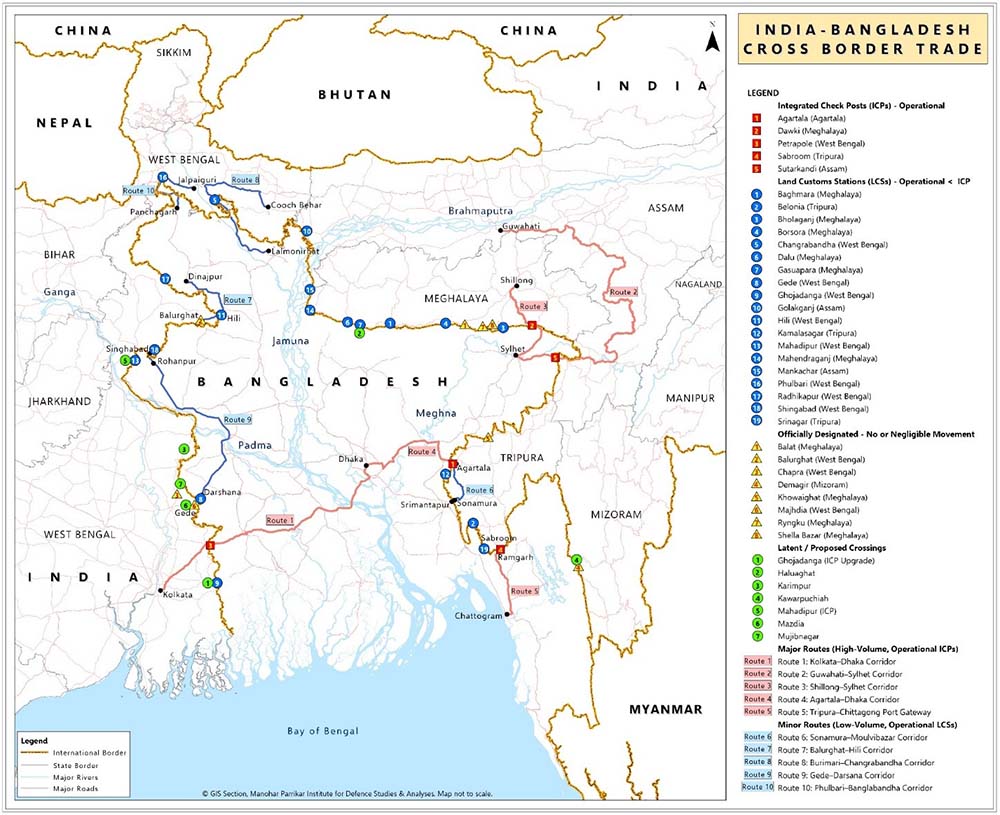
Sources: Land Ports Authority of India; High Commission of India, Dhaka; Bangladesh Land Port Authority; OpenStreetMap; author’s compilation.
Table 1 and Figure 1 map the principal freight corridors and border crossings underpinning India-Bangladesh land trade. It separates Integrated Check Posts (ICPs), operational Land Customs Stations (LCSs), and the major road, rail, and port-linked multimodal corridors discussed throughout this paper. Together with Table 1, the map illustrates the geographical concentration of trade flows and highlights the infrastructure and connectivity constraints that shape the non-tariff barriers analysed in the following sections.
Non-Tariff Barriers
Border Infrastructure and Interoperability Bottlenecks
Figure 1 and Table 1 show how land trade between India and Bangladesh suffers from inadequate border infrastructure, weak transport integration and slow ICP development, which impede transit and make trade time-consuming. It also restricts Indian trucks from passing through Bangladesh to reach Northeast India, despite the 1972 bilateral transit agreement enabling it.[19]
For the Petrapole–Benapole corridor, as shown in Table 1, infrastructural deficiencies are particularly evident despite the high trade volume. Heavy congestion on arterial roads such as National Highway 19, 112, and State Highway 1 leading from Kolkata to Petrapole continues to disrupt the free flow of traffic. The routes are lined with ecologically important flora, which makes road widening difficult.[20] cargo must be transloaded, adding to trade costs and making the process 138 hours long, including 28 hours spent transloading.[21]
The 2021 ICRIER survey found that none of the assessed LCSs or ICPs possessed all 43 prescribed infrastructure facilities. Moreh, the Northeast’s best-equipped LCS, had 15, while Agartala ICP had 24.[22] Recent analysis similarly emphasises Time Release Studies (TRSs) to identify and measure border-clearance delays, suggesting that corridor performance should be assessed through cargo release time alongside infrastructure provision.[23]
Regulatory and Procedural Barriers
Recently, import trade through the Benapole–Petrapole land port was suspended after Bangladesh Customs reportedly asked Clearing and Forwarding (C&F) agents to take personal responsibility for illegal goods found in incoming Indian trucks. Following this, C&F agents stopped issuing gate passes, leaving hundreds of Indian trucks carrying import goods stranded at Petrapole.[24] Although the step was meant to enforce customs, it still halted normal trade flows, highlighting how unclear responsibility between public and private stakeholders can disrupt trade.
As shown in Table 1, these barriers have also affected projects like the Srimantapur–Comilla (Agartala–Akhaura) Corridor, Dawki–Tamabil Corridor and the Sutarkandi–Sheola Corridor. As per a 2019 report, Srimantapur and Sutarkandi face SPS and TBT barriers because inadequate testing and quarantine facilities require agricultural and food samples to be sent to Guwahati, Kolkata, or Dhaka for clearance.[25]
Sutarkandi–Sheola lacks an integrated digital ‘single-window’ customs network despite major infrastructure developments, forcing traders of fruits, silicon, and coal to rely on physical paperwork. The problem is therefore not merely digitisation but interoperability: separate customs, SPS and regulatory systems create sequential administrative checkpoints rather than a unified platform. Bangladesh is beginning to narrow this digital gap; in 2025–26, it introduced ASYCUDA-based truck tracking at Benapole and electronic invoice exchange, suggesting that the challenge is increasingly shifting from unilateral digitisation towards cross-border system interoperability.[26]
The absence of harmonised standards, Mutual Recognition Agreements (MRAs), and coordinated risk-based inspections creates procedural uncertainty, thereby limiting market access and reducing export competitiveness. Because documentation, inspection, testing, and file movement still depend on physical interaction with multiple officials and agencies, traders often rely on local clearing agents or informal intermediaries to navigate procedures and trade informally. These informal ‘fixers’ or Dalals—who are also important to the entrenched Informal Cross Border Trade—may, in turn, intervene in documentation and cargo-handling procedures, allegedly facilitating faster movement in exchange for unofficial payments.[27] These practices add another layer of transaction costs for traders dealing with formal government agencies.
Institutional Fragmentation
Institutional fragmentation manifests across projects mentioned in Table 1 along the India–Bangladesh border. In India, the construction of road or ICP infrastructure for the Maitri Bridge and border management of the Sabroom ICP is divided between the Ministry of Road Transport (via NHIDCL) and the Land Ports Authority of India (LPAI), while the Central Board of Indirect Taxes & Customs (CBIC), Border Security Force (BSF), and the Bureau of Immigration handle customs, security, and immigration.
In Bangladesh, the Bangladesh Land Port Authority (BLPA), National Board of Revenue (NBR), Roads and Highways Department (RHD), Border Guard Bangladesh (BGB), and the Dept. of Immigration and Passports perform equivalent functions. While multiple agencies can have legitimate responsibilities for customs, immigration, security, and infrastructure, the lack of institutional interoperability creates coordination costs, delays clearances, and limits corridor efficiency, so much freight still moves via the longer Kolkata–Siliguri route rather than the Sabroom–Ramgarh corridor.
While India digitised customs earlier, Bangladesh’s recent reforms are narrowing the gap; interoperability between the two systems remains the larger challenge. Fragmented governance reduces traders’ confidence, delays the operationalisation of market-access commitments, and prevents border management from evolving into an integrated framework that supports regional supply-chain resilience.
Political-Security Frictions
Political-security frictions also operate below central government trade policy. In high-volume border regions, particularly West Bengal, local political networks, transport associations, parking operators and other intermediaries can become embedded in the movement of commercial cargo. Historically, unauthorised collection points (Tolabaazi[28] and Bhaipo-tax[29]), politically connected private parking syndicates at Petrapole (Makkel Parking and Laxmi Parking), and localised extortion across borders show how domestic political economy can add a non-tariff cost to cross-border trade.[30] Digitisation measures such as the Suvidha portal in West Bengal, the Land Port Management System (LPMS) in Tripura, and the expansion of the Maitri Dwar cargo gates aim to reduce informal interventions, thereby expediting clearance and vehicle movement across various ICPs in West Bengal.
In April 2025, Bangladesh restricted imports of Indian cotton yarn through all its major land ports, citing internal security concerns[31], and terminated Indian rice imports via the Hili Land Port.[32] The disruption in the established trade pipelines forced Indian agricultural exporters to reroute yarn exports via the more expensive and time-consuming maritime route through the port of Chattogram.[33] In addition, Bangladesh imposed a transit fee on Indian cargo transiting through Bangladesh. It conducted aggressive checks on Indian trucks, restricting India’s use of land and river corridors to transport goods smoothly into its remote Northeastern states. India reciprocated by terminating trans-shipment facilities and restricting the inflow of Bangladeshi goods to the ports of Nhava Sheva and Kolkata, while limiting access through land customs stations in the Northeast states.[34]
As Table 1 shows, restrictions on imports via Northeastern land borders further impeded India, stalling projects such as the Maitri Setu (Sabroom–Ramgarh Bridge), which were already burdened by institutional fragmentation. India’s May 2026 reciprocal trade restrictions saw Bangladesh’s ready-made garment exports to India drop from US$ 279.9 million to US$ 265.8 million, disrupting operations at Srimantapur Land Port and causing job and business losses across the border.[35]
In turn, Dhaka opted to develop domestic cotton supply and diversify its supply chain by deepening economic engagement with China and the US, with China stepping up to supply a portion of Bangladesh’s total textile imports. The reciprocal trade agreement signed between Bangladesh and the USA also explicitly includes raw cotton.[36] Prime Minister Tarique Rahman then paid a state visit to Beijing, where China expressed support for advancing the proposed China–Bangladesh–Myanmar Economic Corridor (CBMEC), modelled after CPEC.[37] The geography of CBMEC is critical for India, as realising this corridor would grant China overland access to the Bay of Bengal via Myanmar and Bangladesh, thereby broadening Beijing’s footprint in India’s eastern neighbourhood.
Weak Multimodal Integration
While the renewed CEPA talks aim to improve trade flows by targeting these barriers, persistent bottlenecks are likely to re-emerge as bilateral trade normalises. Figure 1 illustrates how road, rail, inland waterway, and port connections form an integrated multimodal network, in which bottlenecks in one corridor reduce the efficiency of the wider system.
The Akhaura–Agartala Rail Link (refer to Table 1) was inaugurated in 2023 to reduce cargo distance and travel time between Northeast India and Bangladesh. However, political and operational issues have delayed regular freight operations since 2025. In addition to providing the shortest and most cost-effective land route connecting Kolkata and Agartala, the project would enable freight arriving at Chattogram Port to move through Akhaura into Agartala, avoiding the longer route through India’s Siliguri Corridor. It would also reduce the burden on the Petrapole Land Port.
Way Forward
India–Bangladesh land trade continues to underperform, constrained not by the absence of preferential market access but by deep-seated non-tariff barriers. Recent diplomatic headwinds exposed these systemic vulnerabilities, showing that isolated reforms are insufficient to close the gap between physical connectivity and operational connectivity. Addressing these barriers requires coordinated improvements in border infrastructure, regulatory procedures, institutional coordination, and multimodal connectivity. Important steps toward deeper India–Bangladesh multimodal connectivity have been taken recently–development of the Ashuganj International River Port and the construction of the four-lane Ashuganj–Agartala road–with significant potential to support bilateral and sub-regional trade.
India and Bangladesh should work bilaterally to restore trade and connectivity to pre-2024 levels. Mahfuz Kabir, Research Director at the Bangladesh Institute of International and Strategic Studies (BIISS), noted that land trade is currently hindered by inadequate infrastructure, restricted port access, India’s termination of trans-shipment facilities for Bangladesh, restrictions on goods entering the north-eastern states through land customs stations, limited on-site testing facilities, bureaucratic hurdles, and the difficulties faced by small and medium exporters in obtaining permits on time. Rather than adopting reciprocal or punitive measures, both sides should address these issues amicably to facilitate trade and strengthen bilateral ties.[38]
Bangladesh’s ongoing negotiations for a Comprehensive Economic Partnership Agreement (CEPA) with India and its preparation for LDC graduation to middle-income status make strengthening transport, logistics, investment, and people-to-people connectivity essential. Indian investment in SEZs and connectivity infrastructure should complement efforts to unlock the full benefits of CEPA. In the future, both sides could explore greater customs interoperability, mutual recognition of standards and testing, joint border procedures, and coordinated management of road, rail, and inland-waterway corridors, supported by stronger bilateral mechanisms to ensure trade continuity during periods of political friction. Phased pilot tests at major crossings and for high-volume commodities could provide a practical basis for scaling such reforms to other ports and crossings. Changing the border from a bottleneck into a resilient economic corridor is therefore a strategic imperative. Beyond commercial gains, these reforms would strengthen the India–Bangladesh partnership, enhance regional connectivity, and reinforce the resilience of South Asia’s trade architecture amid growing geopolitical competition.
Views expressed are of the author and do not necessarily reflect the views of the Manohar Parrikar IDSA or of the Government of India.
[1] Sohini Bose, “Continuity and Change in Bangladesh’s Indo-Pacific Outlook: Deliberating Post-Election Scenarios“, Observer Research Foundation, 8 January 2024.
[2] Sreeradha Datta, “Bangladesh’s Search for Partners: Strategic Autonomy and Regional Balance“, ISAS Brief, 20 May 2026.
[3] Sushovan Chakraborty and Riya Sinha, “What Future for India–Bangladesh Connectivity?“, Centre for Social and Economic Progress (CSEP), 7 August 2025.
[4] “Annual Report 2025–26”, Ministry of Commerce and Industry, Government of India, 13 April 2026, pp. 109–110.
[5] Ibid.
[6] “Lines of Credit for Development Projects”, Ministry of External Affairs, Government of India, 2026.
[7] “Total Trade 2025-2026”, Ministry of Commerce and Industry, Government of India.
[8] “India and Bangladesh Strengthen Bilateral Trade and Connectivity Cooperation“, Press Information Bureau, Ministry of Home Affairs, Government of India,26 October 2024.
[9] “Study of Trade and Transport Facilitation India-Bangladesh”, Asian Institute of Transport Development, pp. 5–6.
[10]“Sabroom Land Port at a Glance”, Land Ports Authority of India (LPAI), Ministry of Home Affairs, Government of India.
[11] “Shipping Adviser Orders Khagrachari Hill-Cutting Inquiry”, BSS NEWS, 8 January 2026.
[12] “Signed Copy of SOP On Use of Chattogram and Mongla Ports”, Ministry of Ports, Shipping, and Waterways, Government of India, 2019.
[13] Manoj Kumar and Ruma Paul, “India Withdraws Transhipment Facility for Bangladesh Exports Via Land Borders”, Reuters, 2025.
[14] “ICPs Under Development”, Land Ports Authority of India, Ministry of Home Affairs, Government of India.
[15] “Sutarkandi Land Port at a Glance”, Land Ports Authority of India, Ministry of Home Affairs, Government of India.
[16] “Port Restriction On Import of Certain Goods From Bangladesh to India”, Press Information Bureau, Ministry of Commerce & Industry, Government of India.
[17] “Over 100 Crore Worth of Betel Nut Stranded at Benapole”, The Daily Star, 8 December 2025.
[18] Tanmoy Chakraborty, “Tripura: Cross-Border Projects Worth Rs 1,300 Crore Stalled Amid Bangladesh Political Unrest”, Business Northeast, 6 January 2025.
[19] Smruti S. Pattanaik, “Consonance and Dissonance: Issues and Trends in India-Bangladesh Relations”, in Four Decades of India-Bangladesh Relations: Historical Imperatives and Future Direction, MP-IDSA, 2012.
[20] Riya Sinha, “Linking Land Borders: India’s Integrated Check Posts”, Working Paper 9, Centre for Social and Economic Progress, 2021, p. 21.
[21] Matias Herrera Dappe and Charles Kunaka et al., “Connecting to Thrive: Challenges and Opportunities of Transport Integration in Eastern South Asia”, World Bank, 2021, p. 87.
[22] Nisha Taneja et al.,, “Gap Analysis in Infrastructure at Land Custom Stations in the North Eastern Region of India”, , ICRIER Policy Brief, November 2021.
[23] Nikita Singla, “Modernising South Asia’s Borders Through Data-Driven Research“, Carnegie Endowment for International Peace, 4 March 2026.
[24] “Import Trade Halted at Benapole-Petrapole Port Over Gate Pass Dispute”, Maritime Gateway, 27 July 2026.
[25]“India-Bangladesh Agriculture Trade: Demystifying Non-Tariff Barriers to India-Bangladesh Trade in Agricultural Products and their Linkages with Food Security and Livelihood”, CUTS International, March 2019.
[26]“NBR Introduces Digital Truck Monitoring System at Land Ports“, Bangladesh Sangbad Sangstha, 18 December 2025.
[27] Alison Brown et al., “Contested Spaces of Exchange: Informal Cross-Border Trade on the India–Bangladesh Border”, Forum for Development Studies, Vol. 51, pp. 121–143, 27 November 2023.
[28] “TMC Leaders Extort Money at Malda International Land Port: Bengal Truck Owners Ahead of Mamata’s Visit”, Hindustan Times, 3 March 2020.
[29] ASRP Mukesh, “After Ousting Didi’s Govt in Bengal, BJP Ends ‘Bhaipo Tax’ on Truckers”, The Times of India, 20 May 2026.
[30] Prabir De et al., “Transit and Trade Barriers in Eastern South Asia: A Review of the Transit Regime and Performance of Strategic Border-crossings”, Asia-Pacific Research and Training Network on Trade, Working Paper Series, No. 56, June 2008.
[31] Mahfuz Kabir, Bangladesh Institute of International and Strategic Studies (BIISS), interviewed by author, 23 August 2026.
[32] Kalyan Parbat, “Bangladesh Restricts Import of Yarn from India by Land“, The Hindu, 14 April 2025; “Rice Imports Suspended at Hili Land Port“, IREF News, 3 December 2025.
[33] “Chattogram Port Sees Dramatic Surge in India Trade via Land Routes, Dry Ports“, The Business Standard, 4 September 2025.
[34] “Port Restriction on Import of Certain Goods from Bangladesh to India”, Press Information Bureau, Ministry of Commerce & Industry, Government of India, 17 May 2025.
[35] Selim Raihan, “Strained Ties, Non-Tariff Barriers and the Future of Bangladesh–India Trade Relations“, The Daily Star, 19 May 2025.
[36] Snehesh Alex Philip, “Bangladesh Strikes Trade Deal with US, Gets Exemption on Textile Exports Made with American Cotton“, The Print, 10 February 2026.
[37] Karan Manral, “China Eyes New Corridor Near India: How Bangladesh, Myanmar Fit into Beijing’s Plan“, The Times of India, 8 July 2026.
[38] Mahfuz Kabir, interview by author, no. 31.