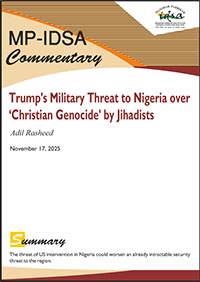
Trump’s Military Threat to Nigeria over ‘Christian Genocide’ by Jihadists
- November 17, 2025 |
- IDSA Comments
On his Truth Social platform, the US President issued a clear warning to the Nigerian government:[2]
If the Nigerian Government continues to allow the killing of Christians, the USA will immediately stop all aid and assistance to Nigeria. It may very well go into that now disgraced country, ‘guns-a-blazing,’ to completely wipe out the Islamic Terrorists who are committing these horrible atrocities. I am hereby instructing our Department of War to prepare for possible action. If we attack, it will be fast, vicious, and sweet, just like the terrorist thugs attack our CHERISHED Christians! WARNING: THE NIGERIAN GOVERNMENT BETTER MOVE FAST!
After this initial salvo, President Trump further clarified on 3 November that the US military was considering a range of actions, including airstrikes and ground incursions into Nigeria. On cue, US Secretary of State Marco Rubio and US Secretary of War Pete Hegseth endorsed the president’s directives, with the latter announcing that the US Department of War “is preparing for action: either the Nigerian government protects Christians or we will kill the Islamic terrorists who are committing these horrible atrocities”.[3]
AU, Russia, China Back Nigeria’s Rebuttal
Taking exception to the US President’s threat of military intervention, the Nigerian government said it did not “allow the killing of Christians” and stressed it does not tolerate religious persecution. At a press conference in Berlin, Nigerian Foreign Minister Yusuf Tuggar noted that as the biggest African democracy, Nigeria has a “constitutional commitment to religious freedom and rule of law”. The foreign minister emphasised that any hasty action might lead to disastrous results.[4]
The news also caused public unrest in Nigeria, with people taking to the streets in Kano, a city in northern Nigeria, to protest the US President’s threats to attack the country. Meanwhile, Daniel Bwala, an adviser to Nigerian President Bola Tinubu posted on X: “…There’s no Christian genocide happening in Nigeria. What we’re facing are criminal attacks that sadly affect everyone, no matter their religion.”[5]
The reactions from the African Union (AU), Russia and China have also been critical of US threats to invade Nigeria. On 7 November, an AU commission issued a statement criticising US statements.[6] Rejecting the charge of aversion or complicity on the part of the Nigerian government over deliberate Christian persecution, the AU objected to “narratives that oversimplify the challenges by attributing violence solely to religious motives, warning that such perspectives could destabilise communities and hinder effective solutions”.[7] The AU commission called upon all external powers, including the US, to prioritise diplomatic engagement and capacity-building initiatives, in the fight against terrorism, over making unilateral military threats.
Meanwhile, the Russian foreign ministry spokeswoman Maria Zakharova expressed concern over the unfolding situation and called on “all parties involved to comply with international legal norms strictly”.[8] For its part, the Chinese Foreign Ministry spokesperson Mao Ning obliquely called the US warning a ‘wanton threat’ and stated that Beijing opposed “any country’s interference in other countries’ internal affairs under the pretext of religion and human rights. We oppose the wanton threat of sanction and use of force”.[9]
The Question of ‘Christian Genocide’nigeria
President Trump’s threat of military action against jihadists in Nigeria comes in response to a longstanding demand by conservative legislators in his country, as well as international religious liberty activists, who have voiced concerns to Nigerian church officials that Christians have been facing extreme persecution, even genocide in Nigeria, for over a decade. They have been alleging that the Nigerian state has not only failed to stop “the genocide” but may even be tolerating extremist activities of radical Islamist groups.
It is important to note that Nigeria’s religious demography is almost evenly divided between Christians and Muslims, even though the latter is said to have a slight advantage over the former in the headcount. In a 2019 report released by the Pew Research Centre, the Muslim population accounted for 50 per cent (90 million) of the country’s total population in 2015, while the Christian population was estimated at 48.1 per cent (87 million).[10] Another notable source, The World Factbook by the CIA, estimated the demographic difference to be 53 per cent Muslim as opposed to 45.9 per cent Christian in 2018.
Some security analysts, like James Barnett of the Hudson Institute, believe that socio-political tensions and violence in Nigeria are too complicated and should not be based on purely demographic or ethno-religious lines. According to him, “the premise that Christians in Nigeria face something akin to nationwide persecution is questionable, as Christians and Muslims alike suffer from Nigeria’s rampant insecurity”.[11] For instance, he states that the jihadist group Boko Haram follows an extremely radical ideology, which targets both Christians and Muslims in large numbers. Therefore, its violence cannot be viewed as targeting Christians only.
Supporting Barnett’s analysis, a report published by the Armed Conflict Location and Event Data Project (ACLED) states that from 1 January 2020 to 30 June 2022, “Violence in which Christians have been specifically targeted in relation to their religious identity accounts for only 5% of reported civilian targeting events.” Not discounting the fact that some jihadist groups deliberately target Christians on grounds of faith, Nnamdi Obasi of the International Crisis Group states that the level of such violence does not amount to being labelled as a genocide of Christians. Thus, he points out that although the predominantly Muslim Fulani herders and militia have been attacking and killing Christian farmers in large numbers, these militias are essentially involved in banditry, and their activities are part of their land-grabbing campaign.[12]
Scholars like Mark Moritz and Mamedierra Mbacke state that even Muslim Fulani herders are often killed by Fulani extremists.[13] Thus, Obasi surmises that
Nigeria’s security threats are multi-faceted and overlapping, stemming from, among other things, religious extremism, banditry, resource competition, communal land disputes and separatist agitation.
An example of the complexity of the internal violence in the country is highlighted by the fact that in the predominantly Christian South East zone of Nigeria, factions of the ethnic Igabo Christians are killing and kidnapping fellow Christians, in the wake of worsening economic conditions.[14] Thus, it is reported that at least 1,844 people were killed between January 2021 and June 2023, with many clerics and numerous others being kidnapped. In fact, the governor of Anambra state, Chukwuma Soludo, in July, said that: “99.99 per cent” of the criminals responsible for killings and kidnappings were Christians and not Islamists.
The Trump administration’s narrowly focused narrative on the “genocide of Christians” fails to appreciate that, despite the present state of violence, Nigeria has also achieved a high level of inter-faith tolerance, particularly in its urban centres. Obasi notes
For the most part, Nigerians of all faiths live, trade and work together peacefully. … Notably, while (President) Tinubu is a Muslim, his wife is not only a Christian, but also a pastor in one of Nigeria’s largest Pentecostal churches, the Redeemed Christian Church of God.[15]
Threat of US Military Intervention ‘Counter-Productive’
By casting aspersions on the political will of the Nigerian government in combating terrorism and by looking at the terrorist threat solely from the communal lens, many security analysts fear that the US plans to conduct military strikes against terrorist targets would complicate the already fraught inter-religious relations within Nigerian society and exacerbate the scourge of jihadism, currently ravaging the region. James Barnett notes that US military operations in Nigeria could “recklessly destabilise Africa’s most populous country”.[16]
In addition, the embarrassing ceasefire deal that the US forged with the Houthis in Yemen in May this year hardly presents a positive precedent on the effectiveness of US military intervention in fighting jihadist groups in recent times. Even if President Trump withdraws from his present maximalist position and settles for bilateral security cooperation, the current strain in US–Nigeria relations might take time to heal fully.
Some security experts even fear that the US’ ongoing security support to Nigeria, which includes military training, counterterrorism assistance, and limited arms sales to fight Boko Haram, the Islamic State West Africa Province (ISWAP) and combating piracy in the Gulf of Guinea, may be affected in the wake of the ongoing tensions between the two states.[17] Analysts like Obasi aver that Trump’s rhetoric might be directed to strengthen his own domestic MAGA base in the US, which includes a significant number of evangelical Christians.[18] The move might also be partly in response to Democratic victories in four recent elections: the New York City mayoral race, the governor’s races in New Jersey and Virginia and Prop 50, California’s redistricting ballot measure.
Nigeria Needs to Get Its Act Together
Notwithstanding the US’s bellicose rhetoric, there is no denying that the Nigerian government needs to develop a strong and resolute political will to make its counter-terrorism policies and actions more effective. Along with international partners, the country needs to urgently develop and marshal its resources and plug the shortfalls in the inadequate strength of its armed forces and police, which has led to a dramatic rise in the number of vigilante groups in the country, thriving on the pretext of safeguarding certain regions and ethno-religious groups.[19]
International organisations and nation states objecting to US plans to intervene militarily in Nigeria would also have to play a constructive role in building Nigeria’s capacities and intelligence-sharing to combat the menace of terrorism, curb socio-economic inequalities, and promote development in Africa’s biggest democracy. Meanwhile, major powers need to refrain from instrumentalising so-called reports on religious and minority rights as a pretext for militarily intervening in terror-afflicted countries and instead focus more on developing capacities. Proper diagnosis of the prevailing malaise, along with a well-planned and calibrated approach that engages regional governments and institutions to combat terrorism, might yield desirable outcomes. By blaming Abuja for the supposed genocide, the threat of US intervention in Nigeria might worsen an already intractable security menace for the region.
Views expressed are of the author and do not necessarily reflect the views of the Manohar Parrikar IDSA or of the Government of India.
[1] “Countries of Particular Concern, Special Watch List Countries, Entities of Particular Concern”, Office of International Religious Freedom, US Department of State, 31 October 2025; “Naming of Nigeria as a Country of Particular Concern is an Important Step to Advance Religious Freedom”, United States Commission—Internal Religious Freedom, 3 November 2025.
[2] Donald J. Trump, “If the Nigerian Government continues to allow the killing of Christians, the U.S.A. will immediately stop…”, Truth Social, 2 November 2025.
[3] Joseph Winter, “Trump Tells Military to Prepare for ‘Action’ Against Islamist Militants in Nigeria”, BBC , 3 November 2025.
[4] “Nigeria Rebuffs Trump’s ‘Christian Persecution’ Claim, Warns Against Sudan-style Division”, TRT Afrika, 4 November 2025.
[5] Micah McCartney, “China Responds to US ‘Wanton Threat’ to Nigeria”, Newsweek, 5 November 2025.
[6] Ayomikunle Daramola, “AU to US: Respect Nigeria’s Sovereignty — No Need for Unilateral Military Threat”, TheCable, 8 November 2025.
[7] Ibid.
[8] “Russia ‘Closely Monitoring’ Trump’s Threat to Attack Nigeria”, TRT Afrika, 7 November 2025.
[9] Micah McCartney, “China Responds to US ‘Wanton Threat’ to Nigeria”, no. 5.
[10] Jeff Diamant, “The Countries with the 10 Largest Christian Populations and the 10 Largest Muslim Populations”, Pew Research Center, 1 April 2019.
[11] James Barnett, “A Better Understanding of Nigeria’s Problems”, Hudson Institute, November 2025.
[12] Alexander Okere, “Benue: We’re Facing Calculated Genocidal Invasion by Herder Terrorists, Tor Tiv Tells Tinubu”, Channels Television, 18 June 2025.
[13] Mark Moritz and Mamediarra Mbacke, “The Danger of a Single Story about Fulani Pastoralists”, Pastoralism, Vol. 12, No. 1, March 2022, p. 14.
[14] Claire Mom, “Christians Killing Christians in South-east—It’s Not About Religion Says Soludu on Genocide Claims”, Channels Television, 18 June 2025.
[15]Nnamdi Obasi, “Why is President Trump Threatening a Humanitarian Intervention in Nigeria?”, International Crisis Group, 7 November 2025.
[16] James Barnett, “A Better Understanding of Nigeria’s Problems”, Hudson Institute, November 2025.
[17] Ohimai Amaize, “With Trump’s Threat of Military Intervention in Nigeria, Tinubu Faces a Delicate Balancing Act”, Atlantic Council, 5 November 2025.
[18] Nnamdi Obasi, “Why is President Trump Threatening a Humanitarian Intervention in Nigeria?”, no. 15.
[19] Ibid.
Keywords : Nigeria, Nigeria-US Relations