
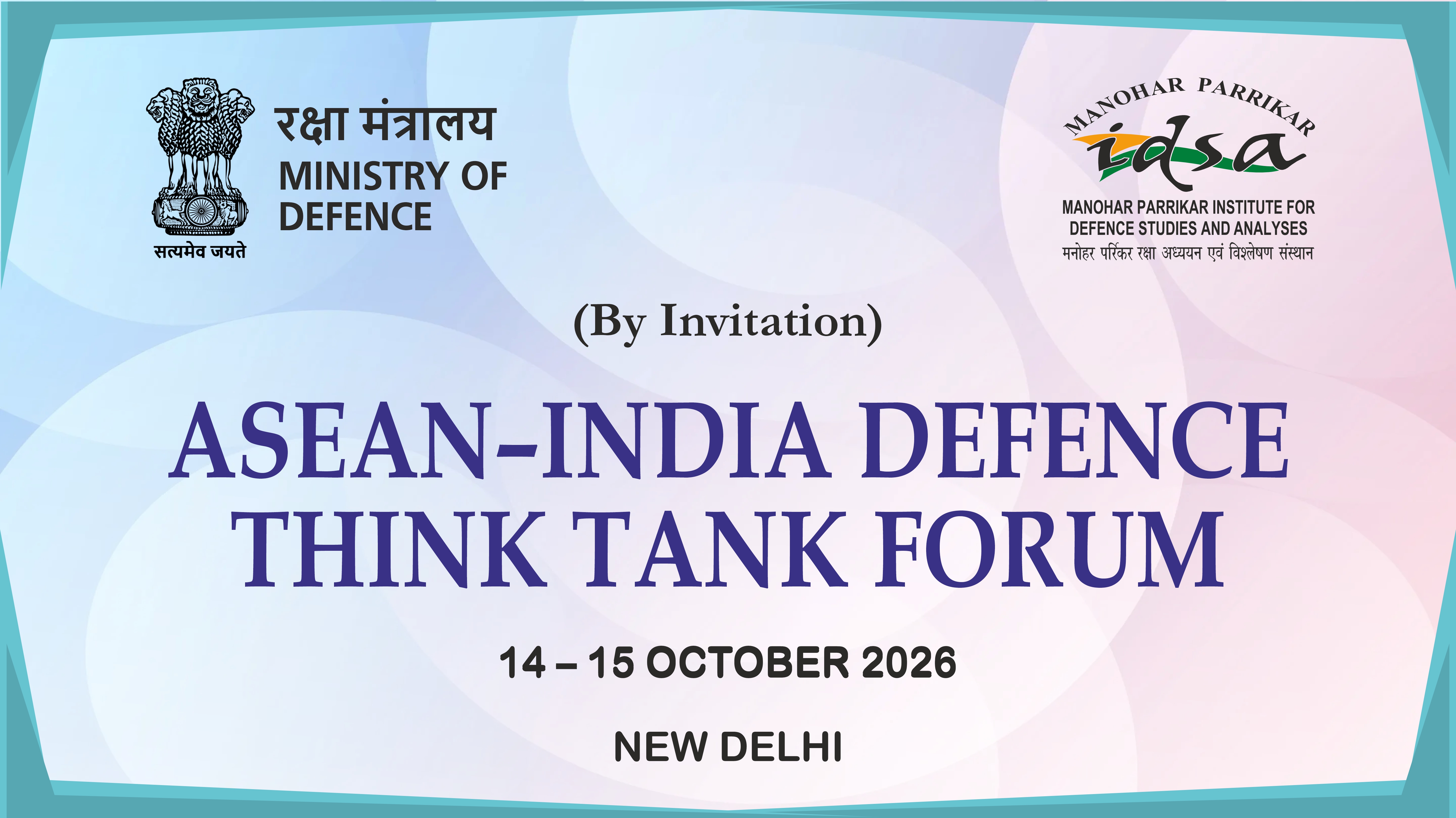
ASEAN–India Defence Think Tank Forum 2026
About the Conference
The maiden ASEAN–India Defence Think Tank Forum, being held at the Manohar Parrikar Institute for Defence Studies and Analyses (MP-IDSA), marks an important institutional step in strengthening intellectual and policy-level engagement between India and ASEAN member states in the field of defence and security. The initiative follows the announcement made by Raksha Mantri Shri Rajnath Singh during the second ASEAN–India Defence Ministers’ Informal Meeting in Kuala Lumpur on 31 October 2025, on the sidelines of the 12th ADMM-Plus. The initiative was envisaged as a platform to deepen defence and security cooperation and advance India’s Act East Policy.
The inaugural Forum brings together representatives from all 11 ASEAN Member States and India. This includes policymakers, representatives of the armed forces, heads of leading think tanks and subject experts. It provides a platform for meaningful exchange of perspectives on key issues concerning regional security and defence cooperation, defence technology and innovation, maritime security, and the evolving strategic environment in the Indo-Pacific. The discussions seek to strengthen mutual understanding and identify avenues for greater cooperation while placing ASEAN centrality at the heart of the India–ASEAN security partnership. The Forum also reflects India’s continued commitment to a free, open, inclusive and rules-based Indo-Pacific and to deepening its strategic engagement with ASEAN through sustained policy dialogue and institutionalised defence cooperation.
Concept Note
The ASEAN–India Defence Think Tank Forum is proposed as a Track-1.5/2.0 platform connecting strategic research communities with defence policymakers and practitioners from ASEAN member states and India. The forum will foster joint analysis and produce implementable recommendations to strengthen cooperation across contiguous maritime and technological theatres of the Indo-Pacific. ASEAN and India represent pivotal anchors of the Global South whose traditions emphasise multipolarity, non-interference, and inclusive regionalism. Intensifying major-power competition, grey-zone coercion, and the militarisation of emerging domains are compressing the autonomy of middle powers. In this context, sustained intellectual partnership between ASEAN and India is essential to reinforce ASEAN centrality, lend analytical depth to India’s Act East policy, and safeguard a rules-based order from polarisation.
The forum will:
- Assess the strategic trajectory of ASEAN–India defence cooperation.
- Identify practical collaboration in maritime domain awareness (MDA), naval cooperation and interoperability, and protection of sea lanes linking the Indian Ocean with Southeast Asian waters.
- Promote cooperation in defence technology and innovation: AI, cyber defence, unmanned systems, space-based ISR, supported by resilient supply chains.
- Examine India’s emergence as a credible defence export and MRO partner for Southeast Asia.
Session Outlay and Panel Questions
Session 1: Strategic Stability and Regional Geopolitics
Context: The Indo-Pacific is witnessing a reassertion of power balancing alongside coercive activities below the threshold of war. ASEAN’s Outlook on the Indo-Pacific seeks to maintain unity and its convening role; India’s Act East policy and SAGAR and MAHASAGAR vision advocate open, multipolar cooperation. Aligning these approaches through ASEAN-led mechanisms: ADMM-Plus, EAS, ARF, with IORA, BIMSTEC interface is critical to preserve strategic space for middle powers.
Panel Questions
- How do ASEAN and India assess the strategic landscape of the current fractured global order? What are the convergences and divergences in threat perception?
- How do both sides look at the future of the Indo Pacific and the role of external powers in an era of poly-crises?
- India’s Act East policy and Indo Pacific vision complement ASEAN’s Outlook on the Indo-Pacific, what areas need prioritisation?
- What mechanisms can ensure inclusive and balanced regional security frameworks?
Objective: develop coordinated assessments and habits of consultation on regional architecture and grey-zone challenges.
Session 2: India ASEAN Maritime Cooperation amidst Grey Zone Challenges
Context: The maritime domain is increasingly shaped by grey zone coercion —actions below armed conflict that gradually shift the strategic balance. These include maritime militias, coercive law enforcement, illegal resource exploitation, and information operations, often overlapping with piracy, trafficking, and illegal fishing. For India and ASEAN, this presents both challenges and opportunities. It underscores the need to deepen maritime cooperation through regional platforms, joint exercises, and initiatives like the Indo-Pacific Oceans Initiative (IPOI). Strengthening Maritime Domain Awareness, interoperability, and collaboration in areas such as disaster response and underwater awareness will be key to ensuring a stable, rules-based maritime order.
Panel Questions:
- How should India and ASEAN conceptualize grey zone coercion in the maritime domain, and how does it intersect with non-traditional maritime threats?
- What are the key operational, legal, and capacity-related challenges in detecting, attributing, and responding to grey zone activities in the Indo Pacific?
- To what extent are current regional mechanisms and platforms sufficient in addressing these challenges, and where do critical gaps remain?
- What practical measures can India and ASEAN adopt to enhance maritime cooperation—particularly in areas such as domain awareness, interoperability, joint exercises, and emerging security sectors?
- How can India and ASEAN deepen collaboration to counter grey zone coercion while preserving regional stability, ASEAN centrality, and a rules-based maritime order?
Objective: identify interoperable MDA, capacity building, and critical-infrastructure protection.
Session 3: HADR Cooperation in the Maritime Domain
>
Context: As ASEAN and India deepen their Comprehensive Strategic Partnership, climate change is emerging as a critical dimension of maritime cooperation. With extensive coastlines and shared dependence on the Indo-Pacific’s maritime domain, both face growing risks from sea-level rise, extreme weather events, and climate-induced disruptions to infrastructure, livelihoods, and maritime boundaries. These challenges are no longer environmental alone—they are increasingly linked to maritime security, humanitarian response, and regional stability. Existing mechanisms such as defence dialogues, maritime exercises, and ASEAN-led platforms provide a strong foundation to integrate climate considerations into security frameworks.
Panel Questions:
- How is climate change reshaping maritime security dynamics for ASEAN and India, and what are the most pressing shared risks?
- How can ASEAN–India maritime cooperation evolve to better integrate climate action, including resilience-building, disaster response, and sustainable maritime practices?
- How can current mechanisms—such as ASEAN-led platforms, joint exercises, and defence cooperation—be adapted to incorporate climate-related priorities more effectively?
- What concrete steps can be taken to improve climate intelligence sharing, joint preparedness, infrastructure resilience, and capacity building in the maritime domain?
- How can ASEAN and India institutionalise climate cooperation in the maritime domain to strengthen long-term regional stability and support a sustainable Indo-Pacific?
Objective: propose frameworks for capacity building, and coordinated resilience.
Session 4 – Preparing for disruption: Defence Technology & Innovation Cooperation Context: The landscape of modern conflict is being radically transformed by the integration of AI-enabled decision tools, cyber operations, autonomous platforms, and space-based ISR. Recent theatres of conflict in Eastern Europe and West Asia have provided sobering lessons on the limitations of traditional, high-cost air defence systems when faced with massed, low-cost saturation attacks. The proliferation of loitering munitions and FPV (First Person View) drones has shifted the focus toward asymmetric innovation, where the "cost-exchange ratio" often changes battle outcomes. For India and ASEAN, this underscores an urgent need for collaborative R&D in Counter Unmanned Aerial Systems (C-UAS), electronic warfare, and directed-energy weapons to safeguard sovereign assets against evolving grey-zone threats. To address these evolving threats, involving agile, private-sector-led ecosystems could be the way forward. India’s iDEX model and Make in India reforms offer a template for engaging start-ups and MSMEs in rapid prototyping and localizing high-tech defence solutions. Establishing a collaborative "innovation-first" framework between India and ASEAN can foster joint R&D and secure supply chains for emerging technologies.
Panel Questions:
- How have the lessons from Ukraine and West Asia regarding saturation attacks and the vulnerabilities of traditional air defence systems altered regional threat perceptions in India and ASEAN?
- Given the high cost of interceptors versus the low cost of drones, what innovative anti-drone (C-UAS) technologies should India and ASEAN prioritize for joint development?
- How can the iDEX model of challenge-based innovation be adapted to create a cross-border ecosystem for Indian and ASEAN start-ups?
- What role can private-sector start-ups play in accelerating the "lab-to-field" transition for dual-use technologies like AI and space-based ISR?
- How can the India-ASEAN innovation ecosystem foster agile manufacturing of ‘attritable’ (low-cost, expendable) systems to ensure resilient defence in a protracted conflict?
- What specific mechanisms can be established to ensure secure technology transfer and protect the intellectual property of niche innovations in the cyber and space domains?
Objective: Explore possible models for secure technology transfer and innovation cooperation.
Session 5 – India-ASEAN Defence Industry Collaboration: The Way Forward
Context: Strengthening regional security requires a move toward diversified, resilient, and reliable defence supply chains. Within this framework, India’s Atmanirbhar Bharat (self-reliant India) initiative has catalysed its emergence as a credible partner for the supply and maintenance of advanced platforms, including patrol vessels, air-defence systems, helicopters, and radars. For ASEAN, these developments offer opportunities for procurement that is customised to littoral missions and supported by local MRO (Maintenance, Repair, and Overhaul) ecosystems. Deepening this industrial link through co-production and joint ventures is a critical step toward enhancing regional interoperability and strategic trust.
Panel Questions:
- What frameworks or joint venture models are most effective for facilitating sustainable co-production and long-term industrial collaboration?
- In the context of the Atmanirbhar Bharat initiative, what are the primary comparative advantages of the Indian defence industry for ASEAN regarding cost, reliability, and strategic alignment?
- How can Indian defence exports and industry partnerships best complement ASEAN’s existing procurement roadmaps and supply chain diversification?
- To what extent can deepened industrial trade and localised maintenance support enhance the practical interoperability of regional naval and air forces?
- How can policy frameworks facilitate sustainable defence trade?
Objective: To develop user-driven pathways for long-term industry cooperation, co-production, and sustainable defence trade.
Programme
08:30 – 09:30 hrs: Registration
09:30 – 10:15 hrs
Inaugural Session
Welcome Remarks: Amb. Sujan R Chinoy, Director General, MP-IDSA, New Delhi, India
Inaugural Address: Shri Rajnath Singh, Hon’ble Raksha Mantri, Government of India and President, MP-IDSA, New Delhi, India
Vote of Thanks: Dr. Temjenmeren Ao, Associate Fellow, MP-IDSA, New Delhi, India
10:15 – 11:00 hrs
High Tea
Group Photo of Raksha Mantri with Speakers
11:00 – 13:00 hrs
Session 1 – Strategic Stability and Regional Geopolitics
Chair:Amb. Gurjit Singh, Former Ambassador of India to ASEAN and Indonesia
Speakers:
1. Strategic landscape of the Current Fractured Global Order: Convergences and Divergences in Threat Perception
Vice Admiral. Datuk Yusne bin Hj Mokhtar, Chief Executive, Malaysian Institute for Defence and Security (MiDAS), Malaysia
2. Future of the Indo Pacific and the Role of External Powers
Dr. Bradley Jensen Murg, Senior Advisor, Cambodian Institute for Cooperation and Peace (CICP), Cambodia
3. Mechanisms for an Inclusive and Balanced Regional Security Frameworks
Ms. Joanne Lin Weiling, Senior Fellow, Coordinator, ASEAN Studies Centre, ISEAS, Yusof Ishak Institute, Singapore
4. ASEAN’s Outlook on the Indo-Pacific and the Emerging Security Framework
Mr. Kantabhon Sukkaew, Plan and Policy Analyst (Professional level), National Security Council, Bangkok, Thailand
5. ASEAN’s Outlook on the Indo-Pacific complementing India’s Act East Policy & Indo Pacific Vision: Prioritising New Areas for Cooperation
Dr. Somdeth Bodhisane, Director, Institute for Industry, Commerce and Energy (IICE), Ministry of Industry and Commerce, Laos PDR
Discussion
13:00 – 14:00 hrs: Lunch
14:00 – 14:30 hrs
Special Session
Chair: Amb. Sujan R Chinoy, Director General, MP-IDSA, New Delhi, India
1. India-ASEAN Relations: A MoD Perspective
Mr Amitabh Prasad, Joint Secretary, International Cooperation, Ministry of Defence, Government of India
2. India-ASEAN Relations: A Former Defence Attaché’s Reflection
Lt. Gen. Anil Ahuja (Retd.), PVSM, UYSM, AVSM, SM, VSM & Bar, Distinguished Fellow, Vivekanand International Foundation, New Delhi
14:30-16:00 hrs
Session 2 – India-ASEAN Maritime Cooperation amidst Grey Zone Challenges
Chair:Vice Admiral Shekhar Sinha, PVSM, AVSM, NM & Bar, ADC (Retd.), Member, Governing Council, Indian Council of World Affairs (ICWA), New Delhi
Speakers:
1. Grey zone coercion in the Maritime Domain
Dr. Vu Hai Dang, Acting Director, Centre for Maritime Diplomacy, East Sea Institute, Diplomatic Academy of Vietnam (DAV), Vietnam
2. Grey Zone Activities in the Indo Pacific: Current Regional Mechanisms and Platforms
Mr. Neil Silva, Lecturer, UP College of Law, University of the Philippines (Online)
3. Maritime Cooperation; Responding to Grey zone Activities in the Indo Pacific
Dr. Vannak Ro, Research Fellow, Cambodian Institute for Cooperation and Peace (CICP), Cambodia
4. India and ASEAN Deepen Collaboration and Preserving Regional Stability
Capt. Sarabjeet S Parmar (Retd), Distinguish Fellow, Australia-India Institute
Discussion
16:00 – 16:15 hrs: Tea Break
16:15 – 17:45 hrs
Session 3 – HADR Cooperation in the Maritime Domain
Chair:Admiral Dinesh Kumar Tripathi, PVSM, AVSM, NM (Retd), Former Chief of Naval Staff, Chairman, National Maritime Foundation, New Delhi
Speakers:
1. Maritime Security Dynamics for ASEAN and India
Mr. Umair Akmal, Research Officer, Sultan Haji Hassanal Bolkiah Institute of Defence and Strategic Studies (SHHBIDSS), Brunei Darussalam
2. ASEAN-led Platforms and the incorporation of Climate-related Priorities
Dr. Don McLain Gill, Lecturer, Department of International Studies, De La Salle University (DLSU), Manila, Philippines
3. ASEAN and India Cooperation in Maritime Domain: For long-term Regional Stability and Support Sustainable Indo-Pacific
Captain Jamalul Shafri bin Mohd Shukor RMN, Director of Maritime Security Division, MiDAS, Malaysia
4. ASEAN-India Comprehensive Strategic Partnership: Humanitarian Response & Regional Stability
Air Marshal (Dr.) Rajeev Sachdeva, AVSM (Retd)
Discussion
18:30 hrs: Dinner hosted by DG, MP-IDSA
09:30 – 10:00 hrs
Special Session
Chair: Amb. Sujan R Chinoy, Director General, MP-IDSA, New Delhi, India
Special Address: H.E. Mr. Karlito Nunes, Ambassador, Democratic Republic of Timor-Leste
10:00-11:30 hrs
Session 4 –Preparing for disruption: Defence Technology & Innovation Cooperation
Chair: Mr. Atul Kumar, Director – Government Initiatives & Global Trade, Data Security Council of India (DSCI)
Speakers:
1. Changing Landscape of Modern Conflict: Integration of AI, Cyber & and Space-based ISR
Air Vice Marshal Chaiya Okdaeng, Director, Strategic Studies Center, National Defence Studies Institute, Bangkok, Thailand
2. ASEAN-India Cooperation for an Innovation Ecosystem and Agile Manufacturing
Mr. Andi Widjajanto, Senior Advisor, Laboratorium Indonesia 2045 (LAB 45), Indonesia
3. ASEAN-India Collaborative R&D against Evolving Grey-zone Threats
Major Thanva Sonesoulivanh, ASEAN Political- Security and Multilateral Cooperation Division, Ministry of National Defence, Lao PDR
4. ASEAN-India Prioritize Joint Development for Resilient Defence amidst Protracted Conflict
Mr. Prasanna Karthik, Vice President, Adani Defence & Aerospace
Discussion
11:30 – 11:45 hrs Tea Break
11:45 – 13:00 hrs
Session 5 – India-ASEAN Defence Industry Collaboration: The Way Forward
Chair: Amb. Rajiv Bhatia, Distinguished Fellow, Gateway House and former Ambassador to Myanmar
Speakers:
1. Strengthening Regional Security through Diversifying, Resilient, and Reliable Defence Supply Chains
Dr. Naing Swe Oo, Senior Advisor, Myanmar Institute of Strategic and International Studies (MISIS), Myanmar
2. Pathways for ASEAN-India Long-term Industry Cooperation, Co-production, and Sustainable Defence Trade
Dr. Evan A. Laksmana, Shangri-La Dialogue Senior Fellow for Southeast Asian Security and Defence, International Institute for Strategic Studies (IISS), Singapore
3. Policy Frameworks to facilitate Sustainable ASEAN-India Defence Trade
Dr. S Samuel C Rajiv, Research Fellow, MP-IDSA, New Delhi
Discussion
Vote of Thanks
Ms. Simran Walia, Research Analyst, MP-IDSA, New Delhi
13:00 hrs: Lunch followed by Departure
Core Team

Temjenmeren Ao
Associate Fellow

Om Prakash Das
Research Fellow

Simran Walia
Research Analyst