Turkish Defence Exports to the GCC States
- July 22, 2026 |
- IDSA Comments
Türkiye has emerged as one of the world’s fastest-growing defence exporters and transformed its indigenous defence industry into a key instrument of foreign policy and regional influence. This transformation has been driven by the Presidency of Defence Industries (SSB), which coordinates export strategy, alongside firms such as Baykar, Roketsan, Otokar, and Nurol, whose platforms account for the bulk of Turkish deliveries to the Gulf states.[1] According to the latest Stockholm International Peace Research Institute (SIPRI) report, Türkiye accounted for 1.8 per cent of global exports of major arms during 2021–25, up from 0.9 per cent in 2016–20, making it the world’s 11th largest arms exporter.[2] Notably, the volume of Turkish arms exports increased by 122 per cent from 2016–20 to 2021–25, reflecting the rapid expansion of its indigenous defence industry and growing international demand for its combat-proven military systems.
The SIPRI Trend Indicator Value (TIV) is a metric used to measure the volume of international transfers of major conventional weapons, reflecting the military capability and quantity of weapons transferred. It does not reflect the actual financial value of arms transfers. SIPRI TIV data for 2000–2025 indicate that the Gulf has remained a major market for conventional arms imports, with Saudi Arabia recording the highest cumulative import volume (40,237 million TIV), followed by the United Arab Emirates (25,560 million TIV) and Qatar (16,183 million TIV).[3] Although import levels have fluctuated over time, Gulf States have consistently relied heavily on external suppliers for major defence acquisitions.
Figure 1 demonstrates the growing regional orientation of Türkiye’s defence exports, with the United Arab Emirates (20.52 per cent) and Saudi Arabia (12.12 per cent) emerging as its largest export destinations. Together with exports to Qatar, Bahrain and Iraq, nearly half of Türkiye’s total arms exports are directed to West Asia, including the Gulf region.
Figure 1. Türkiye’s Arms Export Destinations and Shares (2000–2025)
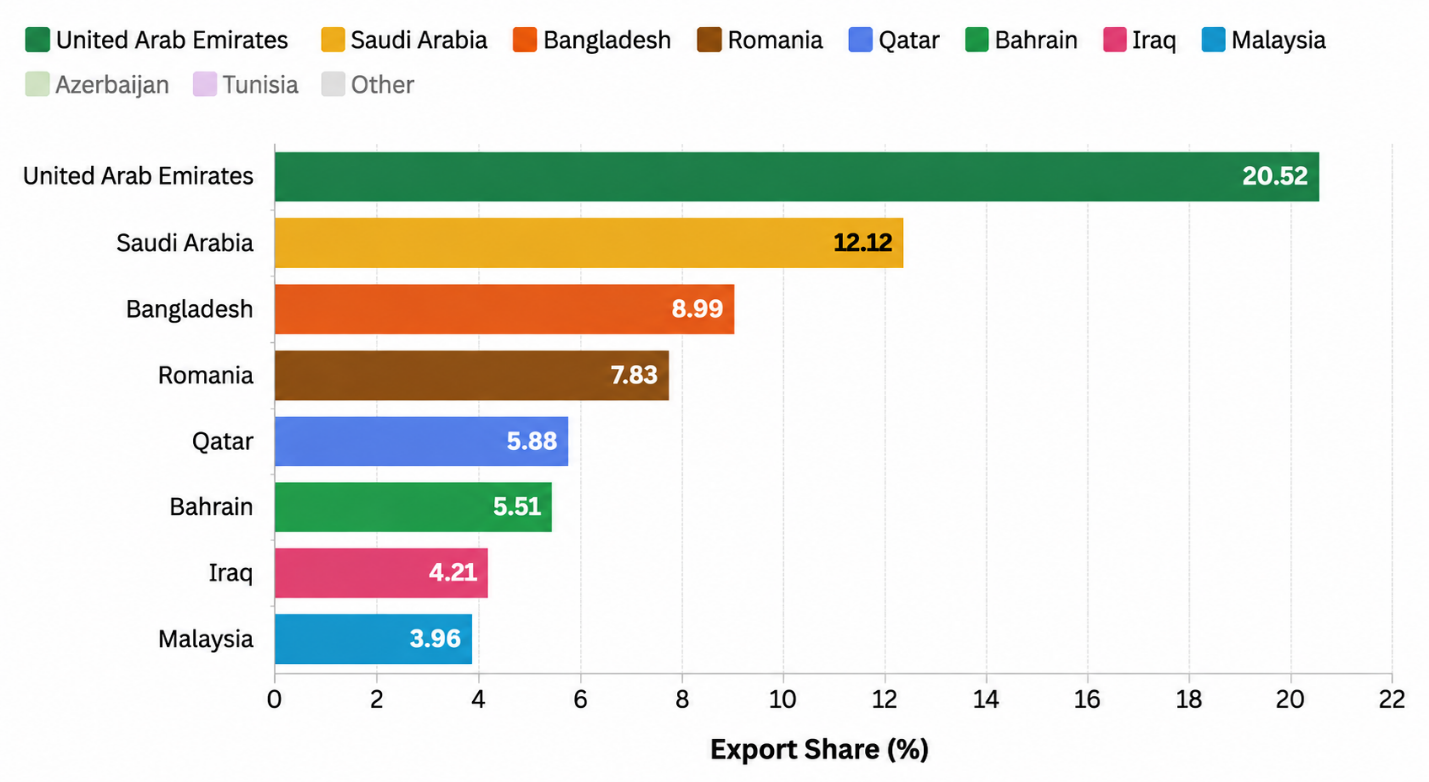
Source: Adapted from “The Gulf’s Need for Arms in the Shadow of War and Türkiye’s Rising Defense Industry”, Foundation for Political, Economic and Social Research (SETA), 29 April 2026. Based on cumulative 2000–2025 data.
Türkiye’s Defence Exports to Individual GCC States
Türkiye’s defence engagement with the Gulf has expanded across all six Gulf Cooperation Council (GCC) States, although the scope and depth of cooperation vary considerably. While the UAE, Saudi Arabia and Qatar have emerged as the principal destinations for Turkish defence exports, Bahrain, Oman and Kuwait have also strengthened defence ties through selective acquisitions. Together, these partnerships illustrate the expanding geographical reach and growing strategic significance of Türkiye’s defence-industrial engagement across the Gulf.
United Arab Emirates
Turkish defence exports to the UAE began with the delivery of 136 AIFV Armoured Personnel Carriers (APCs) in 2000, followed by 14 Cobra APCs in 2005. Defence cooperation subsequently expanded to include artillery systems, including 48 T-122 multiple rocket launchers delivered in 2008, three T-300 multiple rocket launchers in 2010, and eight Canavar multiple rocket launchers in 2012, as well as 2,000 CIRIT air-to-surface missiles delivered in 2015. The partnership entered a new phase with the delivery of 193 Kirpi mine-resistant armoured vehicles in 2022 and 400 Rabdan infantry fighting vehicles (through a joint UAE–Türkiye co-development) in 2023. More recently, 20 Bayraktar TB2 armed drones were delivered in 2023 under a 2022 contract.[4] In addition, a further order for 60 Bayraktar TB2s in 2022 has yet to be delivered.
Türkiye–UAE defence-industrial cooperation has continued to deepen through expanded collaboration between Baykar and the UAE’s EDGE Group (a state-owned defence conglomerate). On 8 May 2026, the two companies signed agreements to integrate EDGE’s AL TARIQ family of precision-guided munitions with the Bayraktar AKINCI unmanned combat aerial vehicle (UCAV). They established a commercial framework to jointly market each other’s defence products in international markets.[5] These agreements build on their earlier collaboration to integrate the DESERT STING 16 guided-glide weapon onto the Bayraktar TB2,[6] and demonstrate a shift from conventional defence exports towards integrated capability development, technological collaboration, and joint market expansion, thereby strengthening the long-term strategic defence partnership between Türkiye and the UAE.
Qatar
Turkish defence exports to Qatar have expanded steadily across armoured vehicles, naval platforms, unmanned systems and missiles. The partnership initially focused on armoured vehicles, with Qatar receiving 100 NMS APCs and six Bayraktar TB2 armed drones in 2019. The same year also saw the delivery of 50 Kirpi APCs. Cooperation subsequently broadened to include naval platforms, with four MRTP-24 patrol boats delivered in 2021, followed by two Al Doha training ships, two Ishat landing craft, and one Fuwairit landing ship in 2022. In the land systems domain, 32 Ejder Yalçın armoured tactical vehicles were delivered in 2021, while deliveries of 310 Ejder Yalçın APCs (ordered in 2016) and an additional 50 vehicles (ordered in 2020) were completed in 2022. Moreover, Qatar placed orders in 2023 for the Sungur portable surface-to-air missile system, two Fast Attack Craft (FAC-50) missile boats, and 15 Çakır multi-role missiles,[7] with deliveries yet to commence, reflecting the continued diversification of bilateral defence cooperation.
Saudi Arabia
Turkish defence exports to Saudi Arabia initially centred on armoured vehicles, beginning with the delivery of 98 Cobra APCs in 2004. This was followed by 64 M-113A300 APCs in 2006; 10 ACV-S APCs and an additional 64 M-113A300 APCs in 2007; 300 M-113A300 APCs in 2010; 312 M-113A300 APCs in 2013; 320 M-113A300 APCs in 2015; and a further 350 M-113A300 APCs in 2017. Bilateral defence cooperation later expanded into the unmanned aerial systems domain with the delivery of three Karayel armed drones in 2020. More recently, Türkiye delivered 146 Cobra-2 APCs in 2024 under a 2023 contract.[8]
A notable milestone was reached in July 2023 when Saudi Arabia signed contracts with Baykar to procure the Bayraktar Akıncı UCAV, marking what Baykar described as the largest defence and aviation export agreement in Türkiye’s history.[9] Alongside the acquisition, the agreement included military and defence cooperation, technology transfer, joint production, training, technical support and logistics services, reflecting a shift from a buyer–seller relationship towards collaborative defence-industrial development. The deal also underscored Saudi Arabia’s objective of strengthening indigenous defence manufacturing capabilities while reinforcing Türkiye’s position as an emerging defence partner in the Gulf.
Bahrain
Turkish defence exports to Bahrain have been concentrated in the armoured vehicle sector, beginning with the delivery of 21 Cobra APCs in 2005, followed by 15 additional Cobra vehicles in 2008. Defence cooperation subsequently expanded with the delivery of 13 Arma 6×6 APCs in 2011 and a further 60 vehicles in 2012. More recently, Türkiye delivered 397 ZPT APCs and 216 CIRIT air-to-surface missiles in 2020, followed by 35 Cobra-2 APCs in 2022.[10] These procurements indicate the gradual expansion of Turkish defence exports to Bahrain from conventional land systems to include precision-guided missile capabilities.
Oman
Turkish defence exports to Oman have been limited but significant in the armoured vehicle sector. The partnership began with a 2015 contract for 27 Pars APCs, which were delivered in 2019. This was followed by the delivery of 145 Pars infantry fighting vehicles in 2020 under the same procurement programme.[11] Since then, no major additional Turkish defence exports to Oman have been recorded, indicating that bilateral defence cooperation has remained focused on land systems and has not yet expanded into other defence domains.
Kuwait
Turkish defence exports to Kuwait have so far been limited to the unmanned aerial systems domain. In 2023, Kuwait ordered 18 Bayraktar TB2 armed drones, with deliveries completed in 2025.[12] The acquisition marked Kuwait’s first major procurement of Turkish defence equipment and signalled the expansion of bilateral defence cooperation into advanced unmanned aerial capabilities.
Strategic Convergence
Türkiye is set to receive used Eurofighter Typhoons from the Gulf, marking the first time it has purchased combat aircraft from the Gulf States. In 2025, Türkiye ordered 24 second-hand Eurofighter Typhoon Tranche-3 fighter/ground-attack aircraft, with 12 each from Qatar and Oman, as an interim capability to strengthen its air force until the indigenous KAAN fifth-generation fighter enters service.[13] Deliveries have yet to commence. Once completed, these acquisitions are expected to strengthen the Turkish Air Force’s combat capabilities.
The 2021 Al-Ula Declaration[14] paved the way for Gulf reconciliation and created a favourable regional climate, allowing Türkiye, which had backed Qatar during the blockade, to repair its own ties with Riyadh and Abu Dhabi, among others. The subsequent improvement in political ties created a more favourable environment for defence-industrial cooperation, enabling Türkiye to expand strategic partnerships with key Gulf States.
Evidently, Türkiye is deepening cooperation with the Gulf States, particularly in defence, security and trade, reinforcing its role as an emerging actor in the Gulf’s evolving regional security architecture. Growing strategic convergence with Qatar and Saudi Arabia is seen as creating opportunities for closer policy coordination, while improving ties with the UAE, despite persistent differences on some regional issues, offers scope for expanded economic and security engagement. At the same time, heightened regional insecurity, uncertainty over traditional security partners, and the pursuit of more autonomous foreign policies by Gulf States are expected to encourage countries such as Oman and Kuwait to strengthen cooperation with Türkiye, especially in strategic sectors such as defence and the military industry.[15]
Conclusion
Türkiye’s expanding defence exports to the Gulf reflect more than commercial success; they underscore the growing strategic convergence between Ankara and the GCC states. The normalisation of regional relations following the 2021 Al-Ula Declaration, combined with Gulf States’ efforts to diversify their security partnerships and strengthen indigenous defence industries, has created favourable conditions for deeper defence-industrial cooperation. While the UAE, Saudi Arabia and Qatar have emerged as Türkiye’s principal defence partners, the gradual expansion of exports to Bahrain, Oman and Kuwait demonstrates Ankara’s broadening strategic footprint across the Gulf. Increasingly, Turkish defence cooperation has evolved beyond conventional arms sales to encompass technology transfer, joint production, training, and long-term industrial collaboration.
In the future, Türkiye is well-positioned to consolidate its role as an important defence partner in the Gulf, particularly as regional states seek greater strategic autonomy amid an evolving security environment. However, sustaining this momentum will depend on Ankara’s ability to maintain political stability in its relations with Gulf partners, deliver advanced indigenous defence platforms on schedule, and compete with established suppliers such as the United States, France, South Korea, and increasingly China. Türkiye’s relative advantage has rested on faster delivery timelines and fewer end-use restrictions than Western suppliers typically impose. However, this edge could narrow if Gulf States continue to hedge across multiple suppliers rather than consolidate around any single partner, or if reliance on Western-sourced components exposes Turkish platforms to third-party export controls. If these conditions are met, defence exports are likely to remain a key instrument of Türkiye’s regional influence, strengthening both its strategic partnerships and its position within the Gulf’s evolving security architecture.
Views expressed are of the author and do not necessarily reflect the views of the Manohar Parrikar IDSA or of the Government of India.
[1] “About Us: Secretariat of Defence Industries”, Secretariat of Defence Industries (SSB), Presidency of the Republic of Türkiye, 2026.
[2] Mathew George, Katarina Djokic, Zain Hussain, Pieter D. Wezeman and Siemon T. Wezeman, “Trends In International Arms Transfers, 2025”, Stockholm International Peace Research Institute (SIPRI), March 2026.
[3] “The Gulf’s Need for Arms in the Shadow of War and Türkiye’s Rising Defense Industry”, Foundation for Political, Economic and Social Research (SETA), 29 April 2026.
[4] “Arms Transfers Database”, SIPRI, 9 March 2026.
[5] “EDGE, Baykar Sign Contract to Arm AKINCI with AL TARIQ Precision-Guided Munitions”, Press Release, EDGE, 8 May 2026.
[6] Jeremy Binnie, “Baykar Confirms Akinci Deliveries to UAE”, Janes, 2 January 2025.
[7] Cem Devrim Yaylali, “Dearsan Launches Second Qatari Fast Attack Craft”, Janes, 18 February 2026; “Arms Transfers Database”, no. 4.
[8] “Arms Transfers Database”, no. 4.
[9] Gareth Jennings and Lale Sariibrahimoglu, “Update: Saudi Arabia Signs for Akinci UAVs in Record Deal with Turkey”, Janes, 20 July 2023; Ragip Soylu, “Saudi Arabia Signs Drone Deals with Turkey’s Baykar”, Middle East Eye, 18 July 2023.
[10] “Arms Transfers Database”, no. 4.
[11] Ibid.
[12] Ibid.
[13] “Turkey in Talks with Qatar and Oman to Buy Used Eurofighter Jets, Erdogan Says”, The Associated Press, 24 October 2025; “Arms Transfers Database”, no. 4; “Türkiye to Acquire 12 Eurofighter Typhoons Each From Qatar And Oman”, Türkiye Today, 12 December 2025.
[14] “Al-Ula Declaration: Bahrain, Egypt, Kuwait, Oman, Qatar, Saudi Arabia and United Arab Emirates”, United Nations Treaty Collection, 5 January 2021.
[15] İsmail Numan Telci, “The Gulf: Redefining the Security Paradigm”, in ‘SETA Security Radar, Türkiye’s Geopolitical Landscape in 2026’, Foundation for Political, Economic and Social Research (SETA), 21 January 2026.