

Delhi Defence Dialogue 2026
DAYS
HOURS
MINUTES
SECONDS
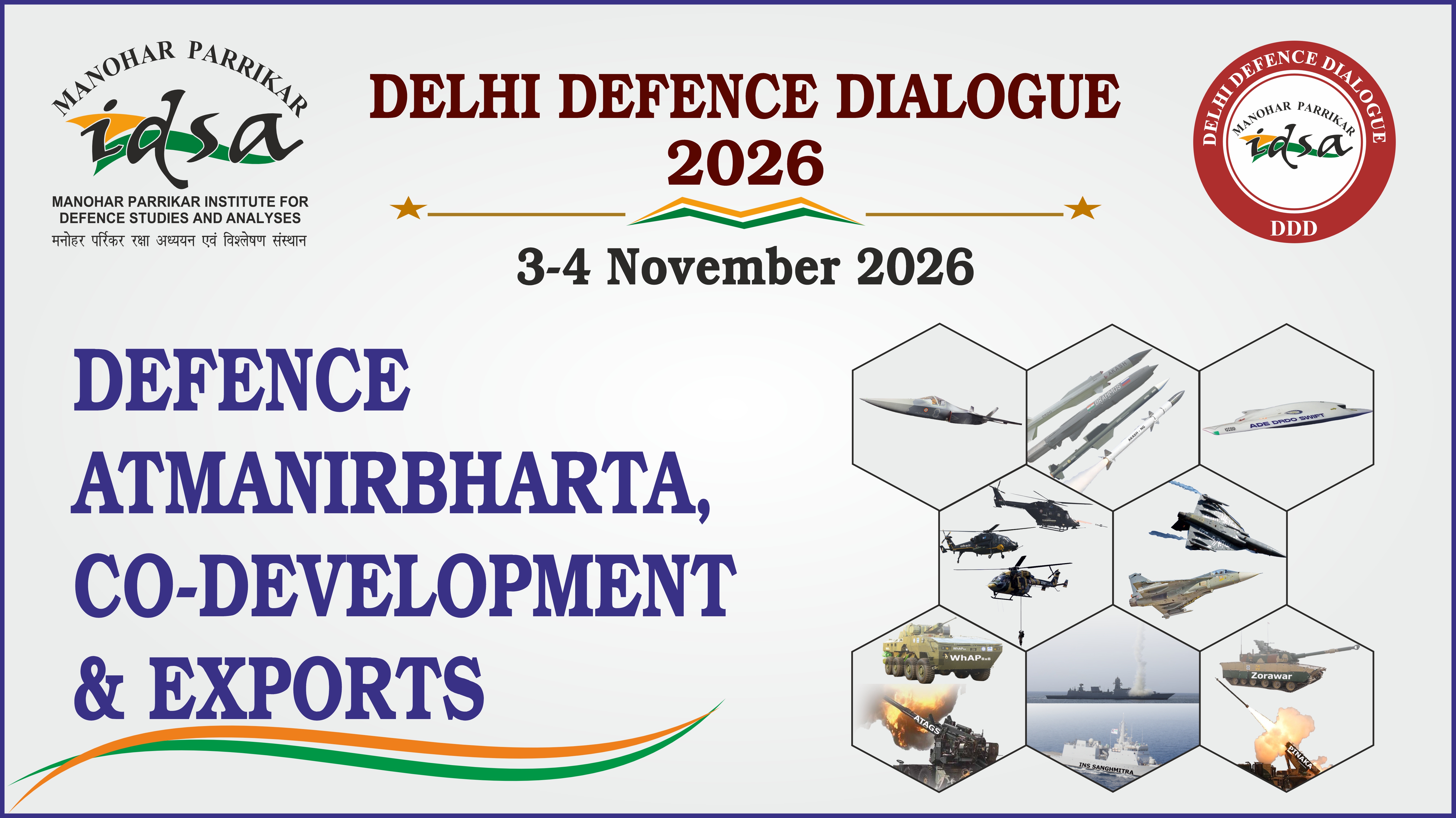
About Delhi Defence Dialogue (DDD) 2026
Welcome to the Delhi Defence Dialogue 2026. Organised by the Manohar Parrikar Institute for Defence Studies and Analyses (MP-IDSA), this flagship forum brings together global defense strategists, industry leaders, and policy makers to map out structural frameworks regarding defense manufacturing ecosystem expansion.
Conference Team
- Group Captain (Dr.) Rajiv Kumar Narang, Senior Fellow (Conference Coordinator)
- Dr Bipandeep Sharma, Associate Fellow
- Meghna Pradhan, Research Analyst
- Ms Khyati Singh, Research Analyst
- Mr Vivek Reshi, Research Analyst
Concept Note
The Manohar Parrikar Institute for Defence Studies and Analyses (MP-IDSA) is organising the third Delhi Defence Dialogue 2026 (DDG 2026) on the theme “Defence Atmanirbharta (self-reliance), Collaborations and Exports” on 3-4 November 2026, at New Delhi. The complex security challenges, hostile neighbours, challenges posed by emerging technologies, their adoption by terror elements, fragility of security umbrellas and unreliability of supply chains necessitate a review of approach to capability development, especially within context of long and complex wars.
The Indian government has set the goal of an Atmanirbhar Viksit Bharat (self-reliant developed India), including in the defence technologies, on completion of 100 years of independence, i.e. by 2047. India is pursuing a multi-pronged approach in capability development involving self-reliance in defence technologies, co-development collaborations and increasing defence exports. However, achieving this goal would require structural, policy and ecosystem reforms and reorientation of approach to partnerships .
Defence Atmanirbharta (Self-Reliance)
The emerging technologies are changing the dynamics of warfare as well as providing opportunities to find innovative ways to neutralise emerging aerospace threats. India is making efforts to develop and leverage capabilities of Artificial Intelligence (AI), Quantum, Blockchain and other innovative technologies for countering the emerging threats. Missiles and emerging technologies are becoming critical elements of war fighting. The wide spectrum of threats posed by hypersonic, ballistic and cruise missiles, loitering and swarm drones, and manned aircraft has increased the challenges of aerospace defence. The targeting of civil, energy and critical economic targets in recent wars has further expanded the scope and span of air defence. The neutralisation of wide spectrum of aerial threats will require adoption of multiple emerging technologies and their fusion for building robust aerospace defence systems.
Self-reliance in naval, land, aerospace and missile defence systems will be one of the key focus areas of deliberations. India has made significant progress in the development of defence equipment and efforts are being made to reduce import dependencies on the advanced weapons, propulsion systems, sensors and weapon technologies. In the naval systems, India has developed ships of different sizes and capabilities, submarines, aircraft carriers, naval fighter aircraft prototype, sensors and weapons. Indian naval shipyards are catering to global shipbuilding orders. In the land domain, India has indigenously designed, developed and manufactured advanced artillery guns, tanks including light tanks, Infantry Combat Vehicles, long range rockets and ammunitions. In the military aircraft segment, India has developed and manufactured helicopters, fighter, transport and trainer aircraft of different sizes and capabilities. Some of its indigenous development programs such as the advanced Jet Trainer, advanced fighter aircraft, aero engines, Unmanned Aerial Systems (UAVs), Unmanned Combat Aerial Vehicle (UCAV) and Light Transport Aircraft, are in various stages of development. In the missile segment, India has developed Akash, Quick Range Surface to Air Missile (QRSAM) and other air defence systems.
India despite above developments remains dependent of several critical systems, sub-system, components, materials, sensors and payloads. Therefore, there is a need to deliberate on the trajectory, identify challenges and articulate a roadmap to make India self-reliant in land, aerospace, naval, missile and space technologies by 2047. In order to achieve this, the Indian defence forces, as key stakeholders, need to evolve from ‘facilitators’ to ‘development partner’ in indigenous development. This in turn may require creation of integral R&D organisations in the Indian defence forces and the Department of Military Affairs (DMA) akin to the integral defence forces R&D organisations of the US defence forces; and equivalent defence forces R&D organisations of leading defence manufacturing countries such as Russia, France, China, UK, Israel, etc.
The success of India’s self-reliance mission would also depend upon its ability to identify factors contributing to delays, indecision and closure of indigenous development projects and instituting course corrections. In addition, measures such as review of Allocation of Business (AoB) rules for enhancing ownership and accountability, creation of Research and Development (R&D) structures in the defence forces, and upgradation of defence testing infrastructure need due consideration.
Defence Co-Development Collaborations, and Export
India’s trajectory of defence collaborations was predominantly tilted towards ‘license manufacturing and Transfer of Technology (ToT). It now aims to transform the trajectory of defence collaboration from ‘license manufacturing and ToT’, to ‘co-development’ of defence technologies in order to meet its emerging challenges. The leveraging of co-development collaborations with global partners is part of India’s endeavours towards self-reliance and building a robust globally competitive defence industry. It is making earnest endeavours to establish co-development collaborations for building complex and critical technologies. Complex high value defence systems such as advanced land, aerospace and naval propulsion systems and medium to large civil-military transport aircraft, are being given special emphasis for potential partnerships. Aspects such as reasonable work share of Indian entities, IPR sharing and production of critical systems in India are central to such collaboration. India’s large market, and significant design development and manufacturing capabilities provide an enabling environment for establishing co-development collaborations.
India’s dynamic public and private domestic industry provides multiple options for establishing co-development collaboration. The co-development collaboration could be established between Indian public and private entities, amongst Indian private entities and between Indian and global Original Equipment Manufacturers (OEMs) in mutually beneficial areas. Therefore, deliberation on “Co-development Collaboration” will be focused on identifying potential areas of co-development, policy, regulatory, technology, certification, IPR or other challenges and the learnings would be leveraged to articulate the way forward.
Propulsion Systems: Atmanirbharta and Co-development
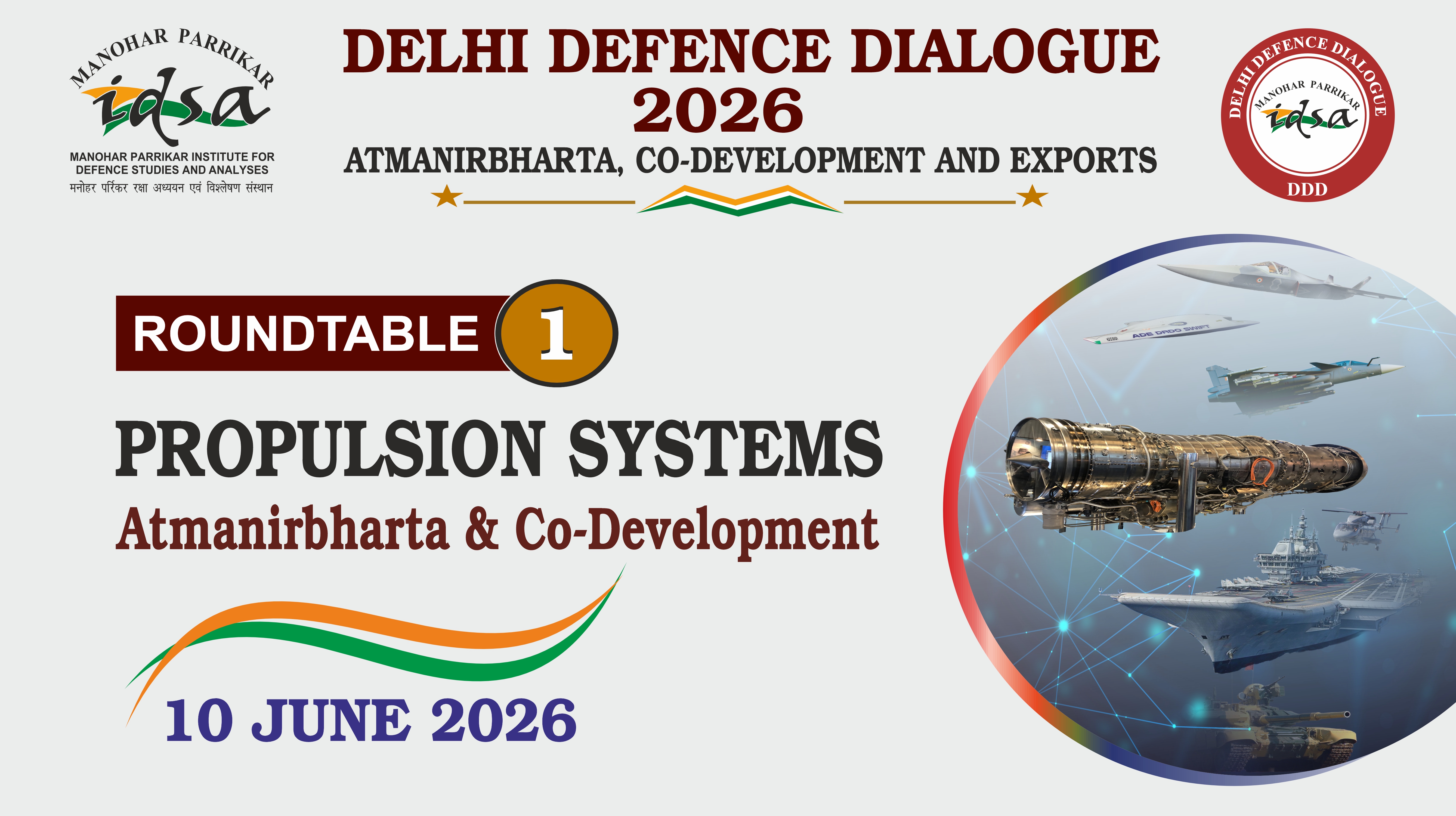
Propulsion Technology sits at the very heart of modern warfare and military systems. India’s journey towards Atmanirbharta (self-reliance) in defence has gathered significant momentum, but propulsion systems continue to be one of the highly demanded, yet less indigenised assets within the Indian defence ecosystem. The indigenous land, aerospace and naval propulsion systems development programs have achieved low to moderate success. Prime Minister Modi, in his Independence Day speech on 15 August 2025, called for self-reliance in jet engines, which has been a critical challenge for its aeronautics industry. Furthermore, India is in discussion with global aero-engine manufacturers for co-development of an aero-engine for its Advanced Medium Combat Aircraft (AMCA). The deliberations are underway on the quantum of work share of Indian partner, control over Intellectual Property Rights (IPRs) and other aspects of co-development and production; and, creation of enabling aero-engine testing ecosystem. The concurrent development of indigenous aero-engines to replace imported engines of Light Combat Aircraft aircraft, is also being explored. The discussions regarding ‘Propulsion Systems Atmanirbharta and Collaborations’ will, therefore, examine the policy, design, development, testing, funding, IPR, and other challenges and leverage learnings to examine the way forward for indigenous development and co-development of naval, aerial and land propulsion systems, including with global partners.
Defence Innovation Collaborations
The defence innovation organisations are created to harness the innovative potential of starts ups and existing capabilities of the civil industry to build military technologies and reduce the development timelines. India has signed Memoranda of Understanding (MoU) with friendly foreign countries to establish innovation collaborations that enable innovators from both sides to work together and solve common problems or build complementary capabilities. Therefore, an effort would be made to understand innovation organisations and initiatives, opportunities, challenges and way forward for optimally leveraging and expanding innovation collaborations with friendly foreign countries.
Stimulating Defence Exports
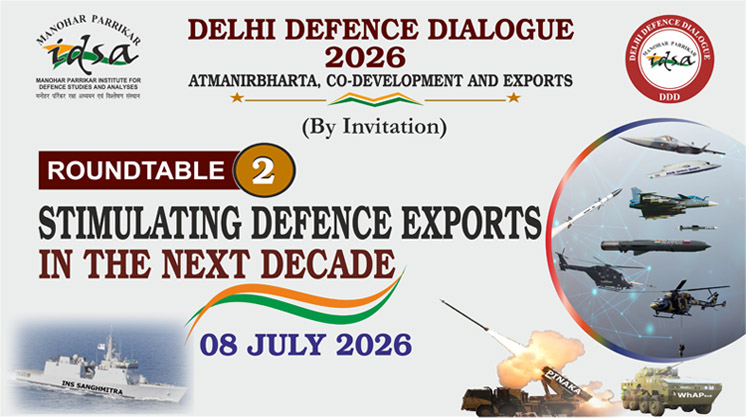
Indian defence industry, after decades of inward looking policies, has been opened up for export to friendly countries. It has the potential to design, develop, manufacture and scale up production of niche and innovative defence technologies not only for Indian defence forces but also for friendly countries. Indian industry could prove to be an able partner for friendly countries in West Asia, South Asia, Africa, Latin America, Europe and other parts of the world.
Indian public and private sector companies have developed a unique relationship of cooperation and competition, which is helping India in producing high quality defence products to meet the requirements of the domestic as well as international customers. Indian government has instituted policy reforms to encourage Indian industry to build quality products for the global market and stimulate export. Therefore, there is a need to engage with global partners to understand opportunities and challenges of defence exports. Therefore, deliberations on “Stimulating Defence Exports” aim to examine defence equipment requirements, import policies, procurement procedures, taxation, certification and other mechanisms of friendly countries; and challenges and opportunities for defence exports.
The DDD2026 provides an opportunity to engage with stakeholders from defence Ministries, defence forces, industry, policy and domain experts, academia and other from India and friendly foreign countries. The dialogue would provide a platform to deliberate on wide ranging issues of mutual importance. Some of the key issues for the discussion during the DDD2026 include the following:
(a) What are the envisaged requirements and roadmaps for building indigenous naval land, aerospace, missile and emerging defence technologies to become self-reliant?
(b) What are the challenges and way forward in the design, development, manufacturing, certification, operationalisation and induction of naval, land, aerospace and missile defence systems?
(c) What are the defence forces R&D organisations of the leading defence manufacturing countries and what is their contribution in technology development?
(d) What are the potential areas, challenges and way forward for co-development of complex defence technologies such as propulsions systems, military transport aircraft with friendly foreign countries?
(e) What are the potential, challenges and way forward for leveraging consortium approach between Indian industry or between Indian industry in collaboration with international partners to developing complex system?
(f) What are the requirements of defence equipment of friendly foreign countries and their policies on defence equipment import, taxation, acquisition, certification and related aspects?
(g) What are the defence export, taxation, testing, standards, certification and other policy reforms required in India to stimulate defence exports?
(h) What is the opportunities, challenges and way forward for establishing innovation collaborations with friendly foreign countries?
(i) What are the policy, structural, ecosystem, technology development and other reforms required to make India Atmanirbhar (self-reliant) and exporter of defence technologies by 2047?
The deliberations on Atmanirbharta (self-reliance) in land, naval and missile/ aerospace defence systems, development of propulsion systems, establishing co-development collaborations, understanding integral defence forces R&D organisations and identifying course corrections for stimulating defence exports will be leveraged to articulate a way forward for building a self-reliant export oriented defence industry.
Programme
To be updated
Roundtables
Rountable ONE
Rountable TWO
Speakers
Social Media Posts
|
|
Gallery
Publications
BOOK: ADAPTIVE DEFENCE: Navigating The Changing Landscape of Modern Warfare
Editors: Amb. Sujan R. Chinoy and Rajneesh Singh
Previous Conferences
- DDD 2025 : Harnessing New Age Technology for Defence Capability Development
- DDD 2024 : ADAPTIVE DEFENCE: Navigating The Changing Landscape of Modern Warfare


