Warfare

Lest We Forgot: The Battle of Rezang La

While recalling the 1962 conflict we often refer to India’s ‘humiliating defeat’ at Chinese hands and forget that the Jawan of the Indian Army invariably fought with exceptional bravery and valour in the most trying conditions often without winter clothing and in some cases even without adequate ammunition.

Trends in Thinking about Warfare

Militaries the world over need to study and understand lessons from the ongoing military operations in Afghanistan, Iraq, and Lebanon, and the new knowledge needs to be placed in context. Neglected military history itself provides enduring lessons. This article attempts to capture the trends and debates in the understanding of current warfare and outlines how lessons of war are interpreted with a focus on future trends in war-fighting. The article concludes with some policy suggestions and areas for further inquiry.

Network Centric Warfare in the Context of ‘Operation Iraqi Freedom’

The Revolution in Military Affairs (RMA) moves on the wheels of Technology, Doctrine and Organisation; however, the main support structure, which gives it the predominant strength, is undoubtedly the technology. The changing concepts of warfare are driven by the available technology of the times. While sophisticated weapons and sensors have greatly enhanced combat efficiency, developments in Information and Communication Technology (ICT) have enabled greater connectivity and information sharing among widely spread force components.

Conceptualisations of Guerrilla Warfare

Guerrilla warfare is not a new phenomenon and history is witness to its repeated occurrence. In the modern era, it acquired prominence during the Napoleonic Wars which led to an examination of its role by leading nineteenth-century thinkers including Clausewitz, Jomini, Marx and Engels. Over the course of the subsequent century, the concept and practice of guerrilla warfare was integrated within social, economic and political programmes that aimed to overthrow established authority and transform society through an armed struggle.

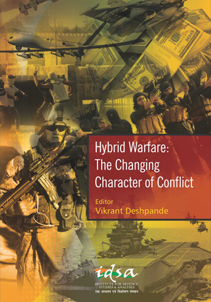
Hybrid Warfare: The Changing Character of Conflict

  • Publisher: Pentagon Press
A scan of recent conflicts indicates blurring lines between war and peace, state and non-state, regular and irregular and conventional and unconventional. The prevailing security environment is radically different from what it was even a decade ago. The probability of conventional conflict between states or groups of states has been steadily declining while, at the same time, sub-conventional conflict is gaining prominence. These small wars, or niggling wars as some have called it, have also been called hybrid, non-linear, gray zone, unrestricted and a plethora of such names. The ontological and epistemological enquiry of these terms is essential to understand if they allude to the same phenomenon through different frames. Are they the convention or an aberration? The book tries to fill this crucial research gap related to the changing character of conflicts in the strategic discourse in India.
  • ISBN: 978-93-86618-35-1,
  • Price: ?.995/- $32.95/-
  • E-copy available