To gain the trust of Seoul and Beijing, the DPJ government plans to present a bill in the Diet for granting the right of franchise to foreign nationals registered as permanent residents, a majority of whom are South Korean and Chinese.
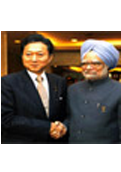
The Joint Statement catapulted India-Japan strategic and global partnership to a “New Stage” in which the bilateral relationship is going to be deepened on all fronts, embracing regional, global and economic issues.
To assuage fears, Japan might see merit to take India on board in the form of a naval cooperation framework to secure peace at sea. Developments in the past 4-5 years in India-Japan relations point towards that direction.
After Yukio Hatoyama assumed the office of Prime Minister, Japan’s foreign policy has begun to look different with an element of assertiveness and a greater focus towards Asia.
Notwithstanding the community formation ideas in different shapes coming from Japan and Australia, the EAS came out with as many as 42 deals on issues ranging from outstanding trade and economic matters to the launch of a human rights commission.
In the aftermath of North Korea's second nuclear test and the launch of three short-range missiles on May 25, 2009, followed by the launch of seven ballistic missiles into the Sea of Japan on July 4, there has been widespread speculation on Japan's principled position on non-proliferation and disarmament and whether it will abandon its nuclear abstinence and acquire nuclear capability. This possibility has been echoed recently by the US Secretary of State Hillary Clinton and Defense Secretary Robert Gates.
The appropriate option for the Hatoyama government would be to take incremental steps aimed at building greater confidence and trust amongst Asian nations across a number of policy fronts rather than indulge in advancing grand ideas which appear at the moment unachievable.
The Futenma issue is therefore unlikely to be allowed to derail the decades-old alliance relationship, irrespective of the fact that there is now a government in Japan headed by the DPJ, which was in the opposition since World War II.
Japan is seeking to forge an East Asian Community inline with the European Union. But the optimism that East Asia will realize the goal of European Union (EU) type integration does not seem realistic since historical issues still impede normal diplomatic relations.