Indus Water Treaty

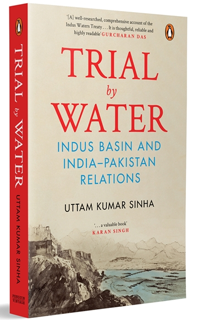
Trial by Water: Indus Basin and India-Pakistan Relations

  • Publisher: Penguin Random House India
In 1947, the Indian subcontinent was partitioned, and Pakistan was born. A shared heritage, a composite culture and centuries-old bonds between people, all seemed to vanish overnight. Nowhere was this rupture more profound than in the Indus Basin—once a unified lifeline of the region, now fragmented by sovereign borders, its rivers flowing through two nations immediately at odds with each other. The Indus Waters Treaty was signed in 1960, proving that even bitter adversaries could cooperate over shared resources. Yet, it never brought lasting peace. The treaty was suspended by India in April 2025 as a punitive measure in the wake of the Pahalgam terror attack, and its future remains shrouded in uncertainty. Can it still endure and adapt? Perhaps the time has come for a new arrangement—one that is not just inevitable but essential. This book traces the turbulent history of the Indus Basin and examines how the Indus Waters Treaty has been shaped by the region’s ever-evolving political dynamics. It explores the role of key leaders on both sides, as well as external pressures, in shaping and reshaping one of the world’s most critical transboundary water agreements. The Indus Basin has been a witness to conflict, compromise and survival. And if you seek to understand the true nature of India–Pakistan relations, start with the rivers that bind them. Trial by Water leads us in that direction.
  • ISBN: 9780143471028,
  • Price: ₹ 599/-
  • E-copy available

Uttam Kumar Sinha | July 17, 2025 | Book

Water Security for India: The External Dynamics

  • Publisher: Institute for Defence Studies and Analyses

India is facing a serious water resource problem and as trends suggest, it is expected to become 'water stressed' by 2025 and 'water scarce' by 2050. Premised on this, this IDSA Report raises fundamental questions about the forces driving water demand and the political dynamics of riparian relations, both in terms of hindrances and opportunities, amongst states in the subcontinent.

  • ISBN 81-86019-83-9 ,
  • Price: ₹ 350/-
  • E-copy available

| Book

Riverine Neighbourhood: Hydro-politics in South Asia

  • Publisher: Pentagon Press

Rivers are the most visible form of fresh water. Rivers are ancient and older than civilizations a ‘mini cosmos’ spawning history, tales, spirituality, and technological incursions. Flowing rivers are the largest renewable water resource as well as a crucible for both humans and aquatic ecosystem.

  • ISBN 978-81-8274-914-6,
  • Price: ₹ 895
  • E-copy available

Will the Indus Water Treaty Survive?

The Indus Water Treaty (IWT) is the most significant confidence-building measure between India and Pakistan. Despite the wars and hostilities, the IWT has functioned well since it was signed in 1960. However, one cannot ignore the challenges of future supplies of fresh water between the two countries. The article delves into a historical account of how the treaty came about, the salient features of the treaty and examines whether ‘water rationality’ will continue to govern the riparian relationship or whether ‘water sharing’ will open up a new front of contentious politics.

50 Years of the Indus Water Treaty: An Evaluation

Rivers are more than what Samuel T. Coleridge poetically expressed in Kubla Khan: ‘meandering with mazy motion’ and falling into the ‘sunless sea’. Rivers are life-givers, carrying a mystic and sacred quality about them. That they are oft described as being ‘mighty’—the mighty Amazon; the mighty Nile; the mighty Brahamaputra; the mighty Murray; the mighty Mississippi and Missouri—is hardly mystifying. Civilizations have grown around it and flourished. In contemporary politics the salience of rivers cannot be overlooked both in terms of being drivers of cooperation and conflict.

China Builds Dam on Indus near Ladakh

The tail-end of Indus receives so little water that today Sindh's agriculture faces extinction. Further reduction of water will increase salinity, land erosion and sea-flooding that will severely damage the Indus delta. As a consequence, rise in water table may flood cities like Karachi and Thattha. The impact of water shortage on aquatic wildlife will be detrimental.