Indian Air Force

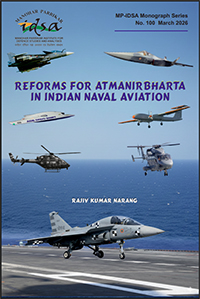
Reforms for Atmanirbharta in Indian Naval Aviation

This monograph deliberates on reforms for achieving self-reliance in naval aviation. Indian Navy (IN) is at the cusp of transforming from a ‘buyers navy’ to a ‘builder navy’ in ship and submarine building; however, self-reliance in aviation remains a missing link. IN’s withdrawal from LCA Mk-1 (Navy), LCA Mk-2 (Navy), non-approval of TEDBF and lack of participation of IN in Naval AMCA has brought its Carrier Based Fighter (CBF) program to a stalemate. The incoherences in the self-reliance trajectory of CBF extends to Maritime Reconnaissance (MR), Airborne Early Warning (AEW) aircraft, helicopters and UAVs. The structures, policies and initiatives need re-orientation/ reforms for naval aviation self-reliance. The proposed apex level structural and execution level policy reforms are aimed at bringing synergy, accountability and expediting decision making. Also, elevating naval aviation self-reliance trajectory from subsystems level to platform and systems level development initiatives can be a stimulant for change. In addition, measures for mitigating aero engine vulnerabilities, scientific mechanism for Indigenous Content (IC) validation, factoring impact of ToT and imports, and spiral development approach are essential prerequisites for Atmanirbharta in Indian Naval Aviation.

Multi-Domain Operations: Air Force as the Central Node

The modern battlespace is heavily influenced by technology and it has forced modern militaries to reflect on the question, ‘What comes after Joint.’1 There is growing recognition that in the contemporary operational environment, focus on ‘joint’ is no longer sufficient. The character of warfare has undergone a profound transformation; the modern battlespace has become an intricate, multifaceted environment where success is contingent upon the harmonious orchestration of capabilities spanning diverse operational domains.2 While the term ‘joint’ usually signifies integration at the operational level, ‘multidomain’ aims to achieve integration across all levels—from strategic to tactical.3 Multi-Domain Operations (MDOs) have evolved as a method to integrate and synchronise activities across land, sea, air, space, cyber and information domains to achieve strategic objectives. The ability to seamlessly operate across these domains is crucial for military success in any contemporary and future conflict. This commentary argues that air forces are best suited to play the predominant role in these operations due to their advanced technological capabilities, strategic flexibility, robust command and control structures, and a culture of innovation. The commentary will dwell on these attributes and their implications for MDOs, drawing on historical evidences and will also carry out a comparative analysis with other military branches—namely the army and navy—highlighting the distinct advantages of air force in conduct of MDOs.

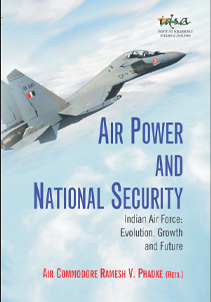
Air Power and National Security: Indian Air Force Evolution, Growth and Future

  • Publisher: Pentagon Press

In over a century since the first manned flight, air power has made spectacular progress. Every conflict since World War II has seen an increasingly bigger role of air power, but despite this, to a general reader, air power continues to be esoteric. The study highlights major air power lessons of all the major conflicts, and explains air power roles and missions. It frankly yet fairly discusses the somewhat contentious subject of air power in support of surface forces and traces the IAF’s contribution in war and peace in the last 68 years since independence. It critically examines if use of air power in the Indian subcontinent is indeed escalatory.

  • ISBN 978-81-8274-853-8
  • E-copy available

Who is Responsible for Defence of India?

Defence of India is a multi-dimensional responsibility involving coordination with not only organisations within MoD, but also several external departments and agencies. Irrespective of whether the subject of defence of India is assigned to DoD or DMA, it is the defence minister who is responsible for the subjects allocated to the ministry.