There is widespread commitment in India for Nepal’s reconstruction. India’s provision of reconstruction assistance to Nepal must be worked out as a long term strategy.
Nepal shares an open border of 1,868 km with five Indian states (Uttarakhand, Uttar Pradesh, Bihar, West Bengal and Sikkim) and 1,415 km with Tibet. Under the 1950 Treaty of Peace and Friendship with India, Nepali citizens enjoy ‘national’ treatment and Nepali businesses unhindered rights of trade, transit and movement. An estimated six million Nepalese live and work in India and contribute to their inward remittances. Social intercourse along the Gangetic plane is described by people as ‘roti-beti ka sambandh’ (a relationship based on sharing of hearth and marriage).
Given that the onus for settling the border disputes with Nepal and Bangladesh is on India, the Indian government has to demonstrate political wisdom in evolving political framework that would satisfy the national interests of both India and Nepal as well as win over the domestic opposition to the LBA.
India has significantly invested in Nepal’s development through economic assistance since 1952. Despite deploying aid to win the hearts and minds of the people of Nepal, India has not entirely succeeded in doing so. Paradoxically, an analysis of Indian aid and gaps in the planning, processes, modalities and perceptions of India’s motivation shows that it has possibly contributed to the fuelling of anti-India sentiments among the Nepalese population.
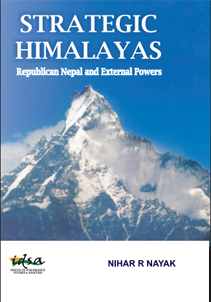
The ten years of Maoist insurgency followed by the political vacuum after the abolition of the monarchy and the delay in the drafting of the Constitution has given credence to the role of external powers in shaping the domestic politics in that country. The book examines the nature of external powers’ role during the political transition in Nepal since 2006. It analyses Nepal’s relations with external powers’ in the framework of ‘small and major powers’.
Transforming the India-Nepal border from an ‘open border’ to a ‘closed border’ would severely damage the traditional socio-cultural and economic ties. It would be prudent to keep the border open but manage it more effectively through mutual cooperation.
There is a perception in certain quarters that Nepal was not given due share in the three major water deals between Nepal and India, namely the Kosi Agreement, the Gandak Treaty and the Mahakali Treaty. However, these projects were found to be mutually advantageous to both Nepal and India. If there was any shortcoming in the Kosi Agreement or the Gandak Treaty, it was due to the lack of experience on the part of India. As and when the need was felt, India reciprocated the Nepalese sentiments by way of making revisions in the treaty/agreement.
Trafficking of drugs takes place overwhelmingly through land borders followed by sea and air routes. Given the vulnerability of the borders to drug trafficking, India has tried to tackle the problem through the strategy of drug supply and demand reduction, which involves enacting laws, co-operating with voluntary organisations, securing its borders and coasts by increasing surveillance, as well as seeking the active cooperation of its neighbours and the international community.
For a long time, it was common practice to term the rate of economic growth in India the ‘Hindu rate of growth’—a derogatory term for the low growth rate of the economy.