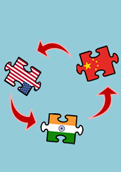
The manner in which the India–China–United States trilateral dynamics play out will have a significant bearing on the stability and shape of the regional and international order.
The media landscape in the Pacific Island countries is vulnerable to Chinese influence given the developmental needs and lack of robust regulatory mechanisms.
The Biden administration’s decision to temporarily extend the 1979 Science and Technology Agreement (STA) with China by six months in August 2023 came against the backdrop of apprehensions over Chinese technology theft.
The paper looks at the critical vulnerabilities of China in the Tibetan Autonomous Region (TAR). Ever since China captured and annexed Tibet in 1950, it has been unable to integrate the Tibetan people with the mainland. The author looks at these criticalities from an Indian viewpoint and draws some key assessments for China watchers in India with regard to policy on Tibet.
The Paper examines Chinese transport projects in Pakistan Occupied Kashmir in general and Gilgit-Baltistan in particular and their impact on local and regional economy and security. China and Pakistan are in the process of expanding the Karakoram Corridor in Gilgit-Baltistan which primarily serves the political and strategic interests of both countries with negligible benefits to the local people.
This Occasional Paper looks at the idea of China being a potential security threat as spoken about in India's official discourse that is, as written down in annual reports or governmental statements or mentioned in the speeches of Indian officials. It does not analyse India's foreign policy, the strategic environment, or offer a new perspective on the development of bilateral security relations.
This Occasional Paper analyzes the Chinese territorial claim from futuristic perspective by identifying three drivers of uncertainty that has bearing on future Chinese behaviour, namely, Chinese regime stability and nationalism; the Tibet factor and internal developments in Arunachal Pradesh. Based on the interactive interplay between the three drivers, the author offers four alternative scenarios with regard to China's territorial claim in 2032.
The Paper examines China´s general performance as a hydro-hegemon in Asia, presents the case study on China´s hydro-behaviour in the Yarlung-Tsangpo river basin, and outlines a framework for promoting trans-boundary watercooperation.
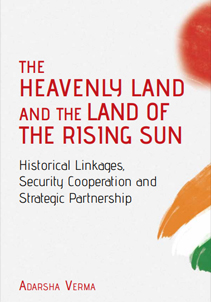
Security relations between India and Japan hold great potential to shape the future security architecture of the Indo-Pacific region. This book delves into this aspect holistically tracing the linkages between the two countries with advent of Buddhism into Japan from India, through China and Korea. Geography and strategic factors shaping the security of Japan have been evaluated and issues of defence cooperation, maritime security, cooperation in UN Peace Keeping Operations and strategic partnership between Indian and Japan have been deliberated. Set in both, a bilateral as well as a regional context, the security dynamics between the two countries has been analysed to arrive at pragmatic recommendations that must be implemented for an enhanced relationship in the security realm. Quantitatively assessing the India Japan security cooperation, the book carries out a Strength, Weakness, Opportunity and Threat (SWOT) analysis to arrive at the strategies for enhancement of such cooperation.
The incisive analysis of the vulnerabilities of the Chinese economy presented in this book is supported by a mass of statistics and data. Managing Chaos is a serious work. The book is essential reading for those trying to understand the Chinese economic miracle.