China has managed to establish an edge in solar energy manufacturing and technology, and any shift in its solar policy is likely to affect countries looking to increase their solar energy capacity.
There is a need to close the perception gap in India’s assessment of the state of Chinese politics, to distinguish between transformation and conflict, and respond accordingly.
India must jettison the attempt to maintain a balance between China and the US and instead take advantage of China’s internal and external vulnerabilities to gain an upper hand in the asymmetric power equation that has developed.
Authoritarian regimes are increasingly taking recourse to sharp power as a preferred means of realising national interests. Sharp power weaves an intricate web of responses short of war, such as coercion, persuasion, political power, and inducements to further a nation’s interests, all the while concealing a long stick. China, in particular, has perfected the art of using sharp power in recent years, often investing large political capital and monies to impose its will on nations all over the globe.
Aid to, and investment in, strategically located countries in the IOR to establish a strong presence has been the thrust of the Chinese strategy. The steadily growing economic cooperation with Comoros is part of this strategy. For a China with global aspirations and a large economy to bankroll that aspiration, the engagement with Comoros promises to yield significant benefits in return for relatively little.
China’s Contingencies and Globalisation was initially published as a special issue of the Third World Quarterly and consisted of papers presented at the Seventh Annual Global Studies Conference at Shanghai University, in June 2015. The current volume has three sections. The first four chapters of the book focus on impact of globalisation on China; the second section consisting of three chapters examines the economic transformation of China after the opening up; while the last four papers concentrate on the broader themes of the changing society, religion and culture in China.
Soft power has become a new currency of power in international relations. It assumes more significance with countries that are sovereign equals but vulnerable to dominance and hegemonic actions by powerful states in international system. Especially in countries that are extremely sovereignty-sensitive, actions through soft power becomes more acceptable as a means of intervention whether it is economic or cultural investment Of dominant powers. American soft power is much more about the attractiveness of America as a liberal democracy.
Geopolitical competition between the great powers with or without direct conflict will lead to a situation where productive cooperation among them on critical international issues is likely to prove difficult.
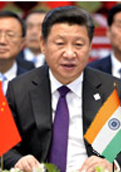
India should carefully understand the evolving foreign policy strategy of China under Xi Jinping, and notably, his worldview, and try to position bilateral relations accordingly.