Armed Forces

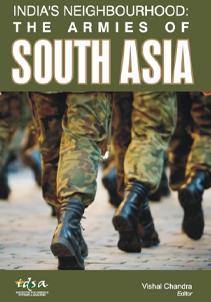
India’s Neighbourhood: The Armies of South Asia

  • Publisher: Pentagon Press

This book is an attempt to examine the role, relevance and status of the armies in the ever dynamic socio-political milieu of the countries in India’s South Asian neighbourhood. The book deals with the national armies of seven South Asian countries bordering India, namely Afghanistan, Bangladesh, Bhutan, Nepal, Maldives, Pakistan and Sri Lanka. The contributors to the volume also trace out the likely trajectory of the future role and position of the armies in the given or evolving national and geo-political settings.

  • ISBN 978-81-8274-706-0,
  • Price: ₹ 795/-
  • E-copy available

Needed: A Better Appraisal System for Better Leaders

There has been a palpable decline in the standards of morals, ethics and values as observed by officers in the armed forces and the bond between officers and men has weakened. This could be because officers with the requisite qualities are not adequately groomed to rise to the level of battalion commanders. The present appraisal system is largely to blame, it being based on a single Annual Confidential Report. A further drawback is that only superior officers report on a ratee. Inputs for appraisal need to be drawn from multiple sources geared towards a ‘360 degree evaluation’.

Roots of Moral Decline in the Armed Forces: Time to Reclaim our Izzat

The precipitate decline in moral and ethical values, as well as the steep fall in standards of private and public conduct, in recent years, has been accompanied by a concurrent erosion of values amongst India’s military personnel. Consequently, the armed forces, which were once considered exemplars of ethical conduct, discipline and decency, are rapidly slipping in the estimation of their countrymen.

Ethics at the Grassroots: A Values-based Approach

This article addresses the declining standards of morality in the armed forces and suggests measures to address it by undertaking appropriate interventions at the grassroots, unit or battalion. It traces the importance of ethics in the military, particularly in the context of the post-modern state, which grants exclusive authority to the armed forces for the use of violence. Further, it examines the state of ethics today and the challenges in codification to arrive at the basic ethical norms that need to be fostered in the military.

Role of Morals, Ethics and Motivation in a Counter-insurgency Environment

Morals, ethics and motivation are the bedrock of the Indian Army, since it is considered more than a profession: a way of life. These qualities are put to test under most conditions of soldiering; however, there cannot be a more difficult environment than involvement of an army in protracted counter-insurgency (CI) operations. The conditions faced pose peculiar challenges, which force a soldier to adapt. This adaptation can potentially become a morally corrupting influence unless the ethical standards of a force and its moral bearings continue to guide actions.

Institutional Challenges Confronting the Indian Armed Forces: The Moral and Ethical Dimension

The phenomenon of the apparent lowering of both personal and institutional moral and ethical standards in the armed forces is not limited to India. What is missing is an open debate on the complexities that drive the modern day profession of arms and the need for a mutually supporting relationship between the armed forces and the institutions of a democracy, especially at a time when newer forms of security threats are emerging.

Changing Socio-economic Norms and its Impact on India’s Armed Forces

The Indian Army remains rooted in an outdated, British-inherited system that is struggling to cope with the combination of challenges posed by demands of modern warfare and a society that is undergoing a great churn. The greatest challenge has been to the famous officer–men relationship in the Indian armed forces. In the past decade, the armed forces have faced a new problem: increasing incidents of indiscipline, suicides and fratricide. Are these incidents happening because the traditional bond between officers and men, the bedrock on which the military functions, is fraying at the edges?

Professional Ethics for the Armed Forces in War and Peace

This article looks at the current situation in the armed forces, which has been in the news for all wrong reasons recently. The author undertakes an analysis of the causes of this state of affairs and suggests that the armed forces, which were well known for their ethics and code of conduct, need to review the situation and take radical steps to ensure a return to their ethics, values and traditions.

Ethics and Morals in the Armed Forces: A Framework for Positive Action

Value systems form the spine of modern society, religion and every individual’s conscience with moral codes defining ‘appropriate’ and ‘expected’ activity. Ethics refer to an individual’s actions that are consistent with such value systems. While the former constitutes a basic human marker of right behaviour and conduct, the latter are a set of guidelines that define acceptable behaviour and practices for a certain group of individuals or society.