Africa

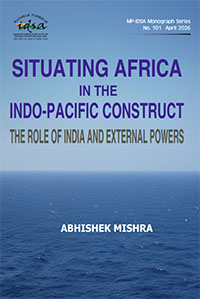
Situating Africa in the Indo-Pacific construct the Role of India and External Powers

From an African perspective, literature on maritime security and the Indo-Pacific is very limited. Any discussion on Africa's inclusion and role in the Indo-Pacific discourse is at a nascent stage. The maritime security aspects and challenges facing African countries situated in the Western Indian Ocean (WIO) region have thus far not been adequately explored in the existing literature. The scholarly debates and international responses have tended to focus mostly on piracy in African waters. Piracy has sensitised both Africa and the international community to the threats off Africa, but it has also skewed perceptions about Africa's maritime landscape. Despite that, maritime security in an African context has been increasingly assuming prominence in the African security agenda. This monograph studies, analyses, and highlights the imperative for African countries in the WIO region to integrate themselves and play a constructive role in the emerging Indo-Pacific debate. It also attempts to find out the ways through which African countries in the WIO region could benefit by developing common positions on the Indo-Pacific based on shared interests and principles. Such a study is important because multilateralism matters for African states as it gives them the best chance to pool resources and ideas to influence global decisions and ensure that their voices are factored in discussions that have a bearing on the continent's growth and development.

Abhishek Mishra | April 28, 2026 | Monograph

Russia’s Nuclear Energy Diplomacy in Africa

The strategic withdrawal of the United States from key energy initiatives in Africa, including the winding down of Power Africa and reduced support for Just Energy Transition Partnerships, has created a significant vacuum in the continent’s energy diplomacy. This retreat coincides with Africa’s acute energy deficit, where over 600 million people lack electricity access, primarily in sub-Saharan Africa. Russia has capitalised on this gap through its state-owned Rosatom corporation, aggressively expanding nuclear energy partnerships across over 20 African countries. Beyond addressing energy shortages, Russia’s nuclear diplomacy serves as a geopolitical tool to deepen influence, foster long-term dependencies, and secure strategic alliances. While Russia offers comprehensive nuclear infrastructure solutions backed by flexible financing and political support, challenges remain, including financing constraints, institutional capacity gaps, and safety concerns. Despite symbolic agreements and ambitious projects, the long-term success of Russia’s nuclear ambitions in Africa depends on genuine local engagement, transparency, and alignment with the continent’s developmental priorities amid growing competition from China and Western actors.

Samir Bhattacharya | January-June 2025 | Africa Trends